Aligning a client team around a shared strategic vision requires more than a standard presentation. It demands a structured environment where assumptions are challenged, data is synthesized, and decisions are made collectively. A Business Model Canvas (BMC) workshop serves as the engine for this alignment. When executed with precision, it transforms abstract strategy into tangible components that teams can operationalize.
This guide outlines the methodology for facilitating these sessions. It focuses on the mechanics of design, the psychology of group dynamics, and the logistical requirements needed to ensure the output translates into business value. The objective is to create a durable artifact that guides decision-making long after the participants leave the room.
🛠️ The Strategic Necessity of Structured Innovation
Organizations often struggle with the gap between high-level strategy and day-to-day execution. Teams may agree on goals but disagree on the mechanisms to achieve them. A dedicated workshop addresses this friction. It forces stakeholders to visualize the entire business logic on a single page.
Without this visual framework, discussions remain fragmented. Marketing might focus on channels while engineering focuses on infrastructure, ignoring the link between value proposition and cost structure. The workshop bridges these silos.
- Shared Language: Participants adopt a common vocabulary to discuss the business.
- Visual Clarity: Complex relationships become visible when mapped spatially.
- Speed: Rapid iteration allows teams to test hypotheses in minutes rather than months.
- Ownership: When the team builds the model together, they feel responsible for the outcome.
🛠️ Pre-Workshop Preparation
Success is determined before the session begins. Preparation involves defining the scope, securing the right participants, and gathering the necessary physical or digital materials. Skipping this phase often leads to wasted time and ambiguous outcomes.
Defining the Objective
Not all workshops require the same outcome. Clarify the specific goal before inviting anyone.
- Startup Validation: Testing a new value proposition with early adopters.
- Optimization: Identifying inefficiencies in the current revenue model.
- Pivot: Adjusting the business model due to market shifts.
- Alignment: Ensuring cross-functional teams understand the company direction.
Participant Selection
The group composition dictates the quality of the output. Aim for a diverse mix of roles that covers all nine building blocks of the canvas.
| Role | Contribution Focus |
|---|---|
| Executive Sponsor | Strategic vision and resource allocation |
| Product Lead | Value proposition and key activities |
| Sales/Marketing | Customer segments and channels |
| Finance | Cost structure and revenue streams |
| Operations/IT | Key resources and partnerships |
Avoid inviting too many people. A group larger than ten individuals often struggles to maintain focus and ensures that quieter voices are overshadowed.
Logistics and Materials
The environment influences cognitive load. Choose a space that allows for movement and collaboration.
- Physical Space: Walls covered in paper or whiteboards. Sticky notes in multiple colors. Markers that write clearly. Large floor space for grouping ideas.
- Digital Space: If remote, use a shared virtual board. Ensure all participants have access and can interact simultaneously.
- Time: Allocate at least half a day for a basic canvas update. A full day is recommended for significant pivots.
📅 Designing the Agenda Blueprint
A rigid agenda prevents scope creep. The session should follow a logical flow from understanding the context to designing the future state.
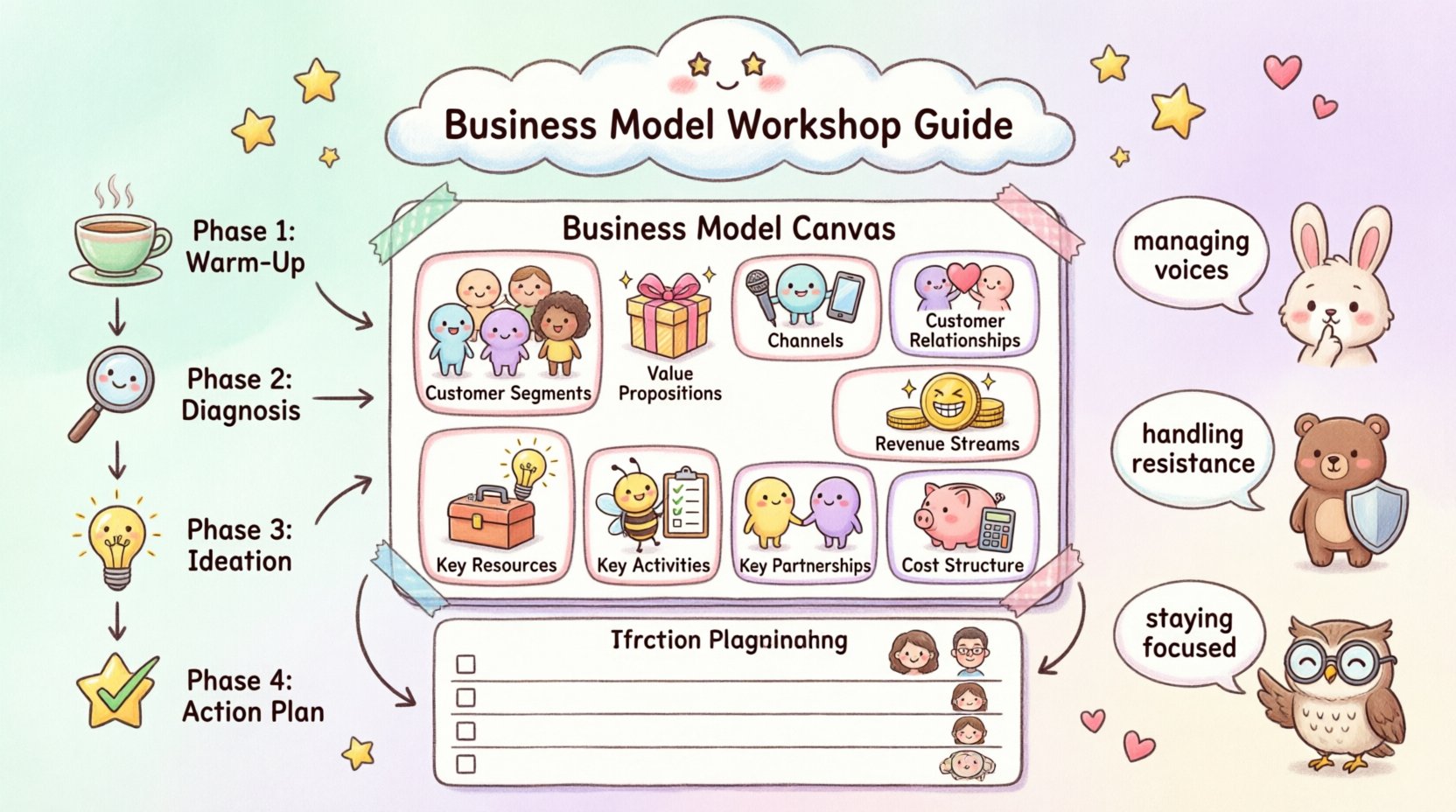
Phase 1: Warm-Up and Context (30 mins)
Begin by setting the stage. Review the current strategic intent and define the problem statement. Ensure everyone understands why they are there.
- Review the mission statement.
- State the specific challenge the workshop addresses.
- Set ground rules for collaboration (e.g., defer judgment, build on ideas).
Phase 2: Diagnosis of Current State (60 mins)
Before designing a new model, map the existing one. This reveals where the actual business logic resides versus where perception dictates it should be.
- Fill in the nine blocks based on current operations.
- Highlight contradictions or gaps between blocks.
- Identify the most critical bottleneck.
Phase 3: Ideation and Redesign (90 mins)
This is the core creative work. Challenge the status quo. Ask “What if?” questions to break cognitive inertia.
- Brainstorm alternative value propositions.
- Explore new customer segments.
- Reconfigure cost drivers.
Phase 4: Prioritization and Next Steps (60 mins)
Generate multiple options, then select the most viable path. Convert the visual model into an action plan.
- Vote on the strongest hypotheses.
- Assign owners to specific experiments.
- Schedule follow-up reviews.
🧩 Navigating the 9 Building Blocks
The Business Model Canvas consists of nine distinct elements. During the workshop, each block requires specific facilitation techniques to extract high-quality information. Do not treat them as isolated boxes; emphasize the connections between them.
1. Customer Segments
Who are we creating value for? Avoid generic answers like “everyone.”
- Question: Who are the most profitable customers?
- Question: What are their pain points?
- Output: Defined personas with specific needs.
2. Value Propositions
What bundle of products and services are we offering? This is the heart of the model.
- Question: Which customer problem are we solving?
- Question: What is the unique benefit compared to competitors?
- Output: Clear statements of value (e.g., convenience, price, design).
3. Channels
How do we reach our customer segments? Consider touchpoints across the customer journey.
- Question: Where do customers expect to find us?
- Question: Which channels are most cost-effective?
- Output: A mix of owned, earned, and paid media.
4. Customer Relationships
What type of relationship does each segment expect?
- Question: Is it personal, automated, or community-driven?
- Question: How do we acquire and retain them?
- Output: Defined relationship strategies (e.g., self-service, dedicated account).
5. Revenue Streams
How does the business generate cash? Be specific about pricing mechanisms.
- Question: What are customers willing to pay for?
- Question: How do they currently pay?
- Output: Pricing models (subscription, licensing, usage-based).
6. Key Resources
What assets are required to make the model work?
- Question: What physical, intellectual, or human resources are essential?
- Question: Which resources are constrained?
- Output: List of critical assets.
7. Key Activities
What strategic actions must be performed to deliver value?
- Question: What are the most important things the company must do?
- Question: Are these production, problem-solving, or platform activities?
- Output: Prioritized list of operational tasks.
8. Key Partnerships
Who are the key suppliers and partners?
- Question: Who are our key suppliers?
- Question: Which key resources are we acquiring from others?
- Output: Network map of dependencies.
9. Cost Structure
What are the most important costs inherent in the business model?
- Question: Which key resources/activities are most expensive?
- Question: Is the model cost-driven or value-driven?
- Output: Fixed and variable cost breakdown.
🧠 Facilitation Dynamics and Group Psychology
Facilitation is not just about managing time; it is about managing energy and conflict. A skilled facilitator guides the group without imposing their own bias.
Managing Dominant Voices
Some participants speak more than others. This can skew the model toward their perspective.
- Technique: Use silent brainstorming first. Have everyone write ideas on sticky notes before sharing.
- Technique: Directly invite quiet members. “What is your perspective on this block?”
- Technique: Timebox speaking turns to ensure equitable airtime.
Handling Resistance
Change often meets resistance. Stakeholders may defend existing processes that the workshop intends to critique.
- Reframe: Frame challenges as “hypotheses to test” rather than “problems to fix.”
- Data: Bring market data to support changes. Reduce reliance on intuition.
- Validation: Acknowledge the history of the current model before proposing changes.
Maintaining Focus
Discussions can drift into operational weeds. Keep the focus on the business model level.
- Parking Lot: Write down off-topic issues on a separate board to address later.
- Timer: Use a visible timer for each block discussion.
- Interruption: Gently steer the conversation back to the canvas structure.
🗺️ Turning Insights into Actionable Roadmaps
A completed canvas is a snapshot, not a strategy. The real value lies in the experiments and actions derived from it.
Identifying Hypotheses
Every block on the canvas contains assumptions. The workshop should end with a list of the riskiest assumptions.
- Revenue Assumption: Will customers pay for this specific feature?
- Channel Assumption: Can we reach customers through this platform?
- Value Assumption: Does this solve the customer problem effectively?
Creating the Action Plan
Translate assumptions into experiments. Assign owners and deadlines.
| Experiment | Owner | Timeline | Success Metric |
|---|---|---|---|
| Customer Interview Survey | Marketing Lead | Week 1 | 20 Validated Interviews |
| Prototype Launch | Product Lead | Week 3 | 5% Conversion Rate |
| Pricing Test | Finance Lead | Week 4 | Average Revenue Per User |
Communication Strategy
Share the outcomes with the wider organization. Those who did not attend the workshop need to understand the strategic shift.
- Create a one-page summary of the new model.
- Host a town hall or all-hands meeting to present the findings.
- Archive the canvas for future reference.
🔄 Post-Workshop Sustainability and Follow-Through
The risk of strategy workshops is that the output gathers dust. To prevent this, integrate the canvas into regular operational rhythms.
Regular Reviews
Schedule quarterly reviews to update the canvas. Markets change, and the model must evolve with them.
- Check if the original hypotheses were validated.
- Identify new market entrants or technologies.
- Adjust the cost structure based on actual spend.
Cultural Integration
Make the canvas a living document within the company culture.
- Display the canvas in meeting rooms.
- Reference the blocks in performance reviews.
- Use the framework for onboarding new employees.
Measuring Success
How do you know the workshop was effective? Look for tangible changes in behavior and metrics.
- Decision Speed: Are decisions made faster based on clearer understanding?
- Alignment: Do teams speak the same language regarding the business?
- Execution: Are experiments being launched as planned?
Running a high impact business model workshop is a discipline. It requires preparation, precise facilitation, and a commitment to action. When done correctly, it provides the clarity needed to navigate complex market landscapes. The canvas itself is secondary to the alignment and shared understanding it generates among the team.