
Strategic clarity often feels like a distant goal for many organizations. Whether you are leading a startup, managing a department, or planning a personal career move, understanding your position relative to the environment is crucial. The SWOT matrix offers a structured approach to this understanding. It is a foundational tool used globally to assess four critical dimensions: Strengths, Weaknesses, Opportunities, and Threats. This guide provides a practical, step-by-step pathway to constructing a high-quality SWOT analysis within thirty minutes, without relying on complex software or external consultants.
Many people approach strategic planning with hesitation, fearing the process will be time-consuming or overly theoretical. However, the power of this framework lies in its simplicity and its ability to force focus. By dedicating a short, concentrated block of time to this exercise, you can move from vague ideas to concrete strategic insights. This tutorial is designed to be executed with a pen and paper or a blank digital canvas, ensuring you focus on the content rather than the tools.
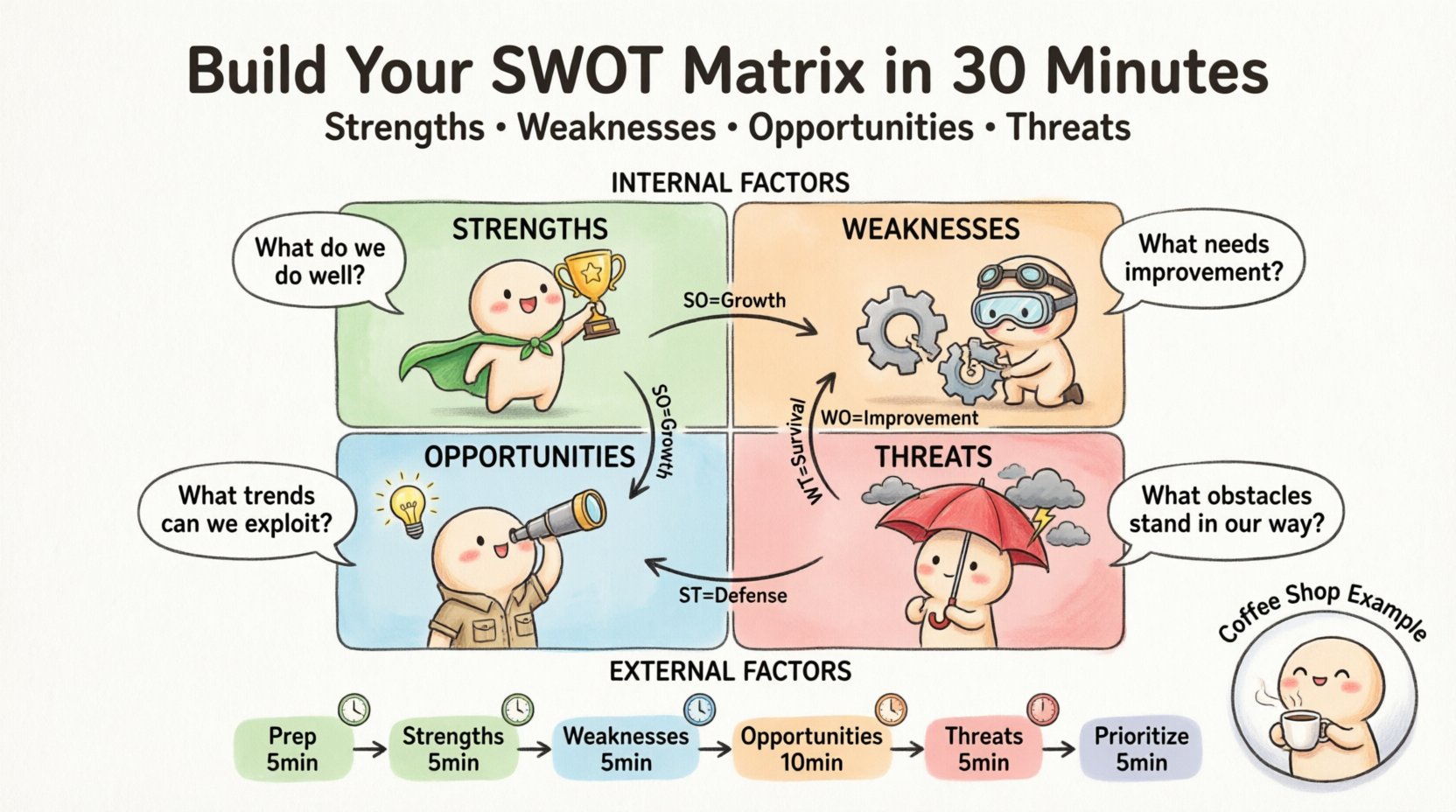
🧠 Understanding the Core Components
Before diving into the execution, it is essential to understand the anatomy of the matrix. The acronym SWOT stands for Strengths, Weaknesses, Opportunities, and Threats. These categories are not merely labels; they represent specific types of factors that influence your organization or project.
The framework divides factors into two primary groups: internal and external. Internal factors are elements within your control, while external factors are elements in the environment that you cannot control but must react to. Confusion often arises when participants mix these groups. To maintain clarity, we categorize them as follows:
- Internal Factors: Strengths and Weaknesses. These are attributes of the organization itself.
- External Factors: Opportunities and Threats. These are conditions in the market, industry, or economy.
1. Strengths (Internal)
Strengths represent the positive attributes that are within your control. These are the assets, resources, and capabilities that give you an advantage over others. When identifying strengths, ask what you do better than anyone else. Consider tangible assets like intellectual property, cash reserves, or proprietary technology, as well as intangible assets like brand reputation, team culture, or specialized skills.
It is vital to be honest here. Do not list generic virtues like “good work ethic.” Instead, specify the competitive advantage. For example, instead of “fast service,” write “24-hour customer support capability via automated chat system.” Specificity drives actionable strategy.
2. Weaknesses (Internal)
Weaknesses are internal limitations that hinder performance or place you at a disadvantage. These are areas where you lack resources, expertise, or efficiency compared to competitors. Acknowledging weaknesses is often difficult, yet it is the most critical step for improvement. If you cannot see where you are vulnerable, you cannot protect against it.
Common examples include outdated technology, limited budget, poor location, or gaps in staff skills. The goal is not to dwell on negativity but to identify the friction points that prevent growth. Recognizing a weakness allows you to either eliminate it, mitigate it, or partner with someone who can fill the gap.
3. Opportunities (External)
Opportunities are favorable conditions in the external environment that you can leverage to improve your position. These are trends, changes, or gaps in the market that align with your strengths. Unlike strengths, you cannot create opportunities directly; you must spot them and act on them.
External drivers include regulatory changes, emerging technologies, shifts in consumer behavior, or the exit of a major competitor. For instance, a new government subsidy for green energy might present an opportunity for a manufacturing firm to innovate its supply chain. Identifying these requires scanning the horizon and asking what the world is doing differently.
4. Threats (External)
Threats are external challenges that could cause trouble for the business or project. These are obstacles you must defend against. They include economic downturns, new regulations, changing consumer tastes, or aggressive competitors. Threats are often the most immediate cause of decline if ignored.
For example, a shift in data privacy laws might threaten a company that relies heavily on user data collection. Identifying threats allows for risk management. It enables the creation of contingency plans or defensive strategies before the threat materializes into a crisis.
📋 The SWOT Quadrant Breakdown
To ensure you are categorizing correctly, refer to the table below. This visual guide helps distinguish between internal and external factors.
| Dimension | Control | Focus | Key Question |
|---|---|---|---|
| Strengths | Internal | Positive | What do we do well? |
| Weaknesses | Internal | Negative | What do we need to improve? |
| Opportunities | External | Positive | What favorable trends can we exploit? |
| Threats | External | Negative | What obstacles stand in our way? |
🛠️ Preparation Phase (5 Minutes)
Before writing down a single item, you must set the stage. A successful analysis requires the right environment and participants. Attempting this alone often leads to blind spots. Aim to gather 3 to 5 key stakeholders who understand the business from different angles.
Here is the checklist for the preparation phase:
- Define the Scope: Are you analyzing the entire company, a specific product line, or a marketing campaign? A narrow scope yields deeper insights. For example, analyzing “The Company” is too broad. Analyzing “The Launch of Product X” is actionable.
- Set the Timer: Commit to thirty minutes. This constraint prevents overthinking and keeps the discussion focused.
- Gather Materials: You need a grid. This can be a physical whiteboard, a flip chart, or a blank document on a screen. Draw a cross to create four quadrants. Label them S, W, O, T.
- Establish Ground Rules: Agree that there are no wrong answers during the brainstorming phase. Criticism is paused until the analysis phase begins.
🏃 The 30-Minute Execution Process
Now, we move into the active work. The thirty minutes should be divided into four distinct phases to ensure balance.
Minute 0-5: Brainstorming Strengths
Start with the positive. This builds momentum. Go around the room and ask participants to list internal factors that provide an advantage. Write every idea down. Do not filter yet. If someone says “We have good morale,” write that down. If another says “We have a patent on Algorithm Y,” write that down.
Guiding Questions:
- What unique resources do we own?
- Who is our most loyal customer base?
- What processes are more efficient than our competitors?
Minute 5-10: Brainstorming Weaknesses
This phase requires honesty. Ask the team to identify where the organization is vulnerable. Focus on internal limitations. This is often the most uncomfortable section.
Guiding Questions:
- What resources are we missing?
- Where do we lose money or time?
- What skills does our team lack?
Minute 10-20: Brainstorming Opportunities
Shift your gaze outward. Look at the market, the industry, and the economy. This section is about potential growth. Connect the external environment to your internal strengths.
Guiding Questions:
- Are there new markets we can enter?
- Is there a technology we can adopt to improve efficiency?
- Are there regulatory changes that favor our business model?
Minute 20-25: Brainstorming Threats
Finally, address the risks. What could go wrong? This section is about risk mitigation. It is important to be realistic rather than alarmist.
Guiding Questions:
- Are competitors launching similar products?
- Is the supply chain stable?
- Could a change in consumer preference hurt us?
Minute 25-30: Review and Prioritize
At the end of the twenty-five minutes, you will have a list of items in each quadrant. Now, review them as a group. Remove duplicates. Combine vague points. Select the top three items for each quadrant. A list of fifty items is less useful than a list of twelve high-impact factors.
🔗 Connecting the Dots: Strategic Analysis
Completing the matrix is only half the battle. The true value lies in connecting the internal factors to the external factors. This process is sometimes referred to as TOWS analysis. It moves you from observation to strategy.
SO Strategies (Maxi-Maxi)
Use your Strengths to take advantage of Opportunities. This is your growth engine. For example, if you have a strong brand (Strength) and a new market is emerging (Opportunity), launch a targeted campaign to capture that market.
WO Strategies (Mini-Maxi)
Overcome Weaknesses by taking advantage of Opportunities. This is about improvement. If you lack a sales team (Weakness) but a new technology allows remote selling (Opportunity), invest in that technology to bridge the gap.
ST Strategies (Maxi-Mini)
Use Strengths to avoid Threats. This is your defense mechanism. If you have a large cash reserve (Strength) and an economic recession is looming (Threat), you can weather the storm while competitors struggle.
WT Strategies (Mini-Mini)
Minimize Weaknesses and avoid Threats. This is survival mode. If you have outdated software (Weakness) and a new security regulation is coming (Threat), you must upgrade immediately or face penalties.
⚠️ Common Pitfalls to Avoid
Even with a structured process, errors can occur during the creation of the matrix. Be vigilant against these common mistakes.
- Vagueness: Statements like “poor marketing” are useless. “Low engagement on social media due to lack of video content” is actionable.
- Confusing Internal and External: A threat is external. “We are bad at selling” is a weakness. “A competitor is selling cheaper” is a threat.
- Ignoring Data: Do not rely solely on opinions. Use sales data, customer feedback, and market reports to validate your points.
- Groupthink: If everyone agrees too quickly, someone is likely holding back. Encourage dissenting views to ensure all angles are covered.
- Creating and Dropping: The most common failure is creating the matrix and filing it away. This document must feed into decision-making.
🚀 Turning Insights into Action
Once the matrix is complete and the connections are made, the next step is execution. A strategy without action is merely a wish list. Here is how to operationalize the findings.
- Assign Owners: Every strategic point should have a person responsible for it. If no one owns it, it will not happen.
- Set Deadlines: Strategic initiatives need timeframes. A goal without a date is a dream.
- Allocate Resources: Ensure the budget and personnel are available to support the actions derived from the SWOT.
- Review Regularly: The environment changes. Revisit the matrix quarterly or annually to update your understanding.
📝 Real-World Application Example
Consider a mid-sized coffee shop chain. Here is how the matrix might look for them.
- Strengths: High customer loyalty, prime locations in downtown areas, consistent product quality.
- Weaknesses: High cost of labor, limited digital ordering system, reliance on foot traffic.
- Opportunities: Growing demand for delivery services, new residential developments nearby, partnership with local bakeries.
- Threats: Rising cost of coffee beans, new national chains opening nearby, inflation reducing disposable income.
From this, a strategy emerges: Leverage the high loyalty (Strength) to launch a delivery app (Opportunity) to counter the lack of digital ordering (Weakness) and protect against the rising foot traffic reliance (Threat).
🏁 Final Thoughts on Strategic Clarity
The SWOT matrix is a tool for thinking, not just a document to fill out. It forces a disciplined look at reality. By spending thirty minutes on this exercise, you gain a snapshot of where you stand and where you can go. The value is not in the grid itself, but in the conversation it sparks and the clarity it brings to decision-making.
Remember that strategy is dynamic. What is a strength today might be a weakness tomorrow. What is an opportunity today might be a threat if the market shifts. Regular review ensures you remain agile. Use this framework as a starting point for deeper analysis, but do not let the process become an end in itself. The goal is always action and results.
Begin your next planning session with this structure. Gather your team, set the timer, and start mapping your path to a stronger position. The competitive edge is often found in the details that others overlook. This framework helps you see those details clearly.