
In the complex landscape of modern business, defining where you stand relative to competitors is not merely a strategic exercise—it is a necessity for survival. Market positioning determines how customers perceive your brand, product, or service. It influences pricing, messaging, and resource allocation. To navigate this terrain effectively, organizations require robust analytical frameworks. One of the most enduring and versatile tools for this purpose is the SWOT analysis. When applied correctly, it moves beyond a simple checklist to become a dynamic engine for strategic planning.
This guide explores the intersection of market positioning and SWOT analysis. We will examine how internal capabilities and external market forces interact to shape a sustainable competitive advantage. By understanding the nuances of Strengths, Weaknesses, Opportunities, and Threats, leaders can make informed decisions that drive long-term growth.
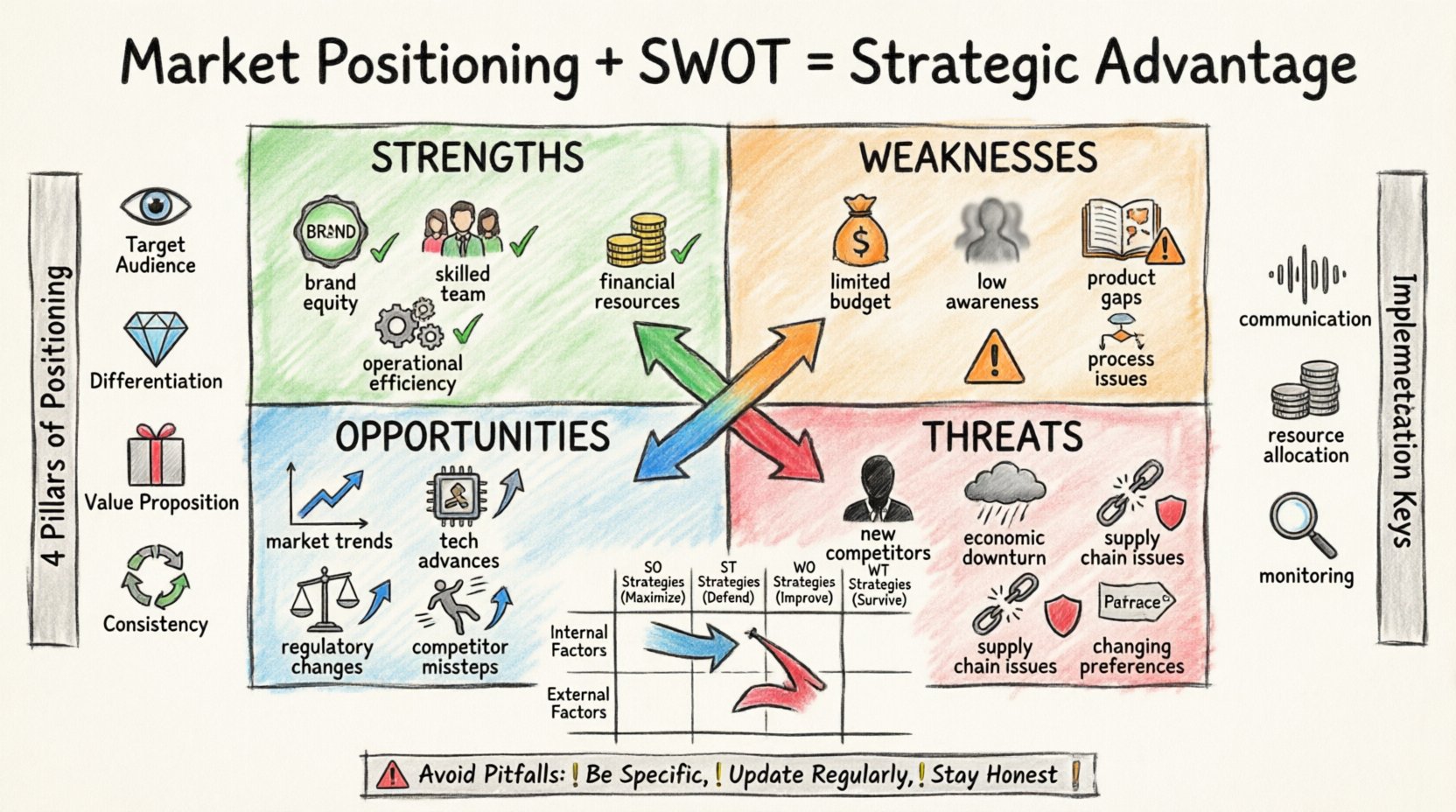
🧭 Understanding Market Positioning
Market positioning is the process of establishing a distinct image of a product or brand in the minds of the target consumer. It answers the fundamental question: Why should a customer choose this specific option over another? Positioning is not about changing the product itself; it is about changing the perception of the product.
Effective positioning relies on several core pillars:
- Target Audience: Who are you serving? Understanding demographics, psychographics, and behavioral patterns is critical.
- Differentiation: What makes you unique? This could be price, quality, speed, or customer service.
- Value Proposition: What specific problem do you solve better than anyone else?
- Consistency: Does every touchpoint reinforce the same message?
Without a clear position, a business risks becoming a commodity. In a saturated market, commoditization leads to price wars, which erode margins and brand equity. Therefore, identifying and defending a position is a continuous process that requires constant vigilance and data-driven insight.
🔍 The SWOT Framework Deep Dive
SWOT stands for Strengths, Weaknesses, Opportunities, and Threats. It is a strategic planning technique used to evaluate these four elements. While often used for general business planning, its power in market positioning lies in its ability to connect internal realities with external possibilities.
1. Strengths (Internal)
Strengths are the internal attributes that give an organization an advantage over others. These are within the control of the company. When analyzing strengths for positioning, look beyond surface-level metrics.
- Core Competencies: What does the organization do better than anyone else? Is it proprietary technology, a highly skilled workforce, or a unique supply chain?
- Brand Equity: Does the market already trust the name? High brand recognition can be a significant defensive moat.
- Financial Resources: Cash flow and access to capital allow for aggressive marketing or R&D investment.
- Operational Efficiency: Lower costs of production can allow for competitive pricing or higher margins.
When documenting strengths, be specific. Instead of noting “good team,” specify “team with 10 years of specialized experience in regulatory compliance.” Specificity ensures the positioning strategy is grounded in reality.
2. Weaknesses (Internal)
Weaknesses are internal factors that place the organization at a disadvantage relative to competitors. Acknowledging these is difficult but essential for honest positioning. Hiding weaknesses often leads to strategic failure when they inevitably surface to customers.
- Resource Constraints: Limited budget, manpower, or technology stack.
- Market Presence: Low brand awareness or limited distribution channels.
- Product Gaps: Missing features that competitors offer as standard.
- Process Inefficiencies: Slow response times or high error rates.
Identifying a weakness does not mean abandoning a strategy. It means recognizing where the positioning needs support. For example, if a weakness is limited distribution, the positioning might focus on direct-to-consumer channels to bypass traditional retail constraints.
3. Opportunities (External)
Opportunities are external chances to improve performance or gain a foothold in the market. These are trends, changes, or gaps in the market that the organization can exploit.
- Market Trends: Shifts in consumer behavior, such as a move toward sustainability or remote work.
- Technological Advances: New tools that can improve delivery or reduce costs.
- Regulatory Changes: New laws that might disadvantage competitors or open new sectors.
- Competitor Missteps: A rival facing a scandal or product recall creates a vacuum for others to fill.
Opportunities are the fuel for growth. A strong positioning strategy aligns internal strengths with external opportunities. For instance, if a strength is strong R&D and an opportunity is a regulatory push for green energy, the positioning should highlight innovation and sustainability.
4. Threats (External)
Threats are external elements that could cause trouble for the business. Unlike weaknesses, these are outside the organization’s direct control.
- Competitor Actions: New entrants, price cuts, or aggressive marketing campaigns.
- Economic Downturns: Inflation or recession reducing consumer spending power.
- Supply Chain Disruptions: Geopolitical issues or natural disasters affecting raw materials.
- Changing Consumer Preferences: Shifts in taste that make current offerings less desirable.
Threat analysis helps in risk mitigation. If a threat is identified, the positioning strategy must account for it. For example, if a threat is price competition, the positioning might emphasize value and longevity rather than low upfront cost.
⚙️ Integrating SWOT into Positioning Strategy
Collecting data is only the first step. The true value lies in synthesizing this information into actionable strategies. This process involves cross-referencing internal factors with external factors to create a coherent narrative.
Below is a structured approach to mapping these elements.
| Internal ➝ External ➝ | Opportunities (O) | Threats (T) |
|---|---|---|
| Strengths (S) | SO Strategies Maximize potential by using strengths to capture opportunities. |
ST Strategies Use strengths to minimize the impact of threats. |
| Weaknesses (W) | WO Strategies Overcome weaknesses by taking advantage of opportunities. |
WT Strategies Minimize weaknesses and avoid threats to survive. |
SO Strategies (Maximize)
These are aggressive strategies. If a company has a strong brand (Strength) and the market is growing (Opportunity), the strategy should be to capture maximum market share. Positioning here is about dominance and leadership.
ST Strategies (Defend)
These are protective strategies. If a company has loyal customers (Strength) but new competitors are entering (Threat), the positioning should focus on loyalty programs and community building to retain the base.
WO Strategies (Improve)
These are remedial strategies. If a company lacks technology (Weakness) but AI is becoming essential (Opportunity), the strategy involves investing in acquisition or partnership to fill the gap. Positioning must communicate readiness and adaptation.
WT Strategies (Survive)
These are defensive strategies. If a company has high costs (Weakness) and a recession is coming (Threat), the focus is on efficiency and cost-cutting. Positioning might shift to value-for-money messaging.
📈 Implementation and Execution
Once the SWOT analysis informs the positioning, execution becomes paramount. A strategy on paper is useless without operational alignment.
- Communication: Ensure the marketing team understands the SWOT-derived positioning. Sales scripts, website copy, and ad campaigns must reflect the identified strengths and value propositions.
- Resource Allocation: Direct budget and talent toward the SO strategies. Do not spread resources thinly across all quadrants.
- Monitoring: Set up key performance indicators (KPIs) to track whether the positioning is resonating. Metrics like customer acquisition cost, lifetime value, and net promoter score are vital.
It is also crucial to involve the entire organization. When employees understand the strategic rationale behind the positioning, they act as brand ambassadors. Frontline staff can provide feedback on whether the market perception matches the internal reality.
⚠️ Common Pitfalls in SWOT Analysis
While powerful, the SWOT framework is prone to misuse. Several common errors can render the analysis ineffective.
- Generic Statements: Phrases like “high quality” or “good service” are meaningless without context. Specificity drives strategy.
- Confusing Internal and External: A common mistake is listing a competitor’s weakness as your strength. Your strength must be internal. Similarly, a market trend cannot be a strength; it is an opportunity.
- Static Analysis: SWOT is not a one-time event. Markets change rapidly. A SWOT conducted five years ago may be obsolete today.
- Analysis Paralysis: Spending too much time gathering data and not enough time making decisions. The goal is action, not perfection.
- Bias: Teams often focus only on positives or ignore weaknesses due to fear. Honest self-assessment requires psychological safety within the leadership team.
🔄 Maintaining Dynamic Positioning
The business environment is fluid. What constitutes a strength today may become a weakness tomorrow if the market shifts. Therefore, positioning must be dynamic.
Regular reviews are necessary. Quarterly or bi-annual SWOT sessions should be scheduled. These reviews should not just update the data but re-evaluate the strategic assumptions. If a competitor launches a disruptive technology, the “Threat” quadrant changes, which may require a complete pivot in the “Opportunity” quadrant.
Furthermore, customer feedback loops are essential. Direct surveys, social listening, and sales feedback provide real-time data that feeds into the SWOT. This ensures the positioning remains grounded in current market realities rather than historical data.
🌐 Case Study Application
Consider a hypothetical mid-sized software provider. Initially, they positioned themselves as a low-cost alternative to enterprise solutions.
- Strength: Agile development and low overhead.
- Weakness: Limited brand recognition and lack of enterprise-grade security certifications.
- Opportunity: Small businesses seeking affordable but secure tools.
- Threat: Large competitors lowering prices.
Using the SWOT, the company shifted its positioning. They stopped competing on price alone (which invites a price war) and moved to emphasize “Security for Small Business.” They leveraged their agility to offer customized security protocols (Strength + Opportunity) while mitigating the threat of large competitors by focusing on a niche they ignored. This pivot was a direct result of cross-referencing the SWOT quadrants.
🏁 Final Thoughts on Strategic Alignment
Market positioning is the compass that guides an organization through turbulent waters. SWOT analysis provides the map. Together, they form a powerful combination for long-term success. By rigorously analyzing internal capabilities and external conditions, businesses can craft a narrative that resonates with customers and withstands market pressures.
The path to competitive advantage is not about being the biggest; it is about being the most relevant. Relevance comes from understanding where you stand and where you can go. Continuous analysis, honest self-reflection, and strategic alignment are the keys to maintaining that position over time.
Organizations that treat SWOT as a living document rather than a static report will find themselves better equipped to navigate change. They will be able to pivot when necessary and double down when the market rewards them. This agility is the true competitive advantage in the modern economy.