
In the contemporary economic landscape, the stability of a business hinges less on the brilliance of an idea and more on the robustness of its execution. Central to this execution is the supply chain. When designing a modern business model, leaders must integrate risk management directly into the architecture of the organization. This is not merely an operational concern; it is a strategic imperative that touches every facet of the Business Model Canvas. 🧩
Supply chain disruptions can originate from a single point of failure: a geopolitical shift, a natural disaster, or a supplier bankruptcy. These events ripple outward, affecting cash flow, customer satisfaction, and brand reputation. Therefore, embedding risk assessment into the design phase of a business model is the only viable path to sustainability. This guide explores how to map supply chain vulnerabilities against key business model components and construct a resilient framework. 🌍📉
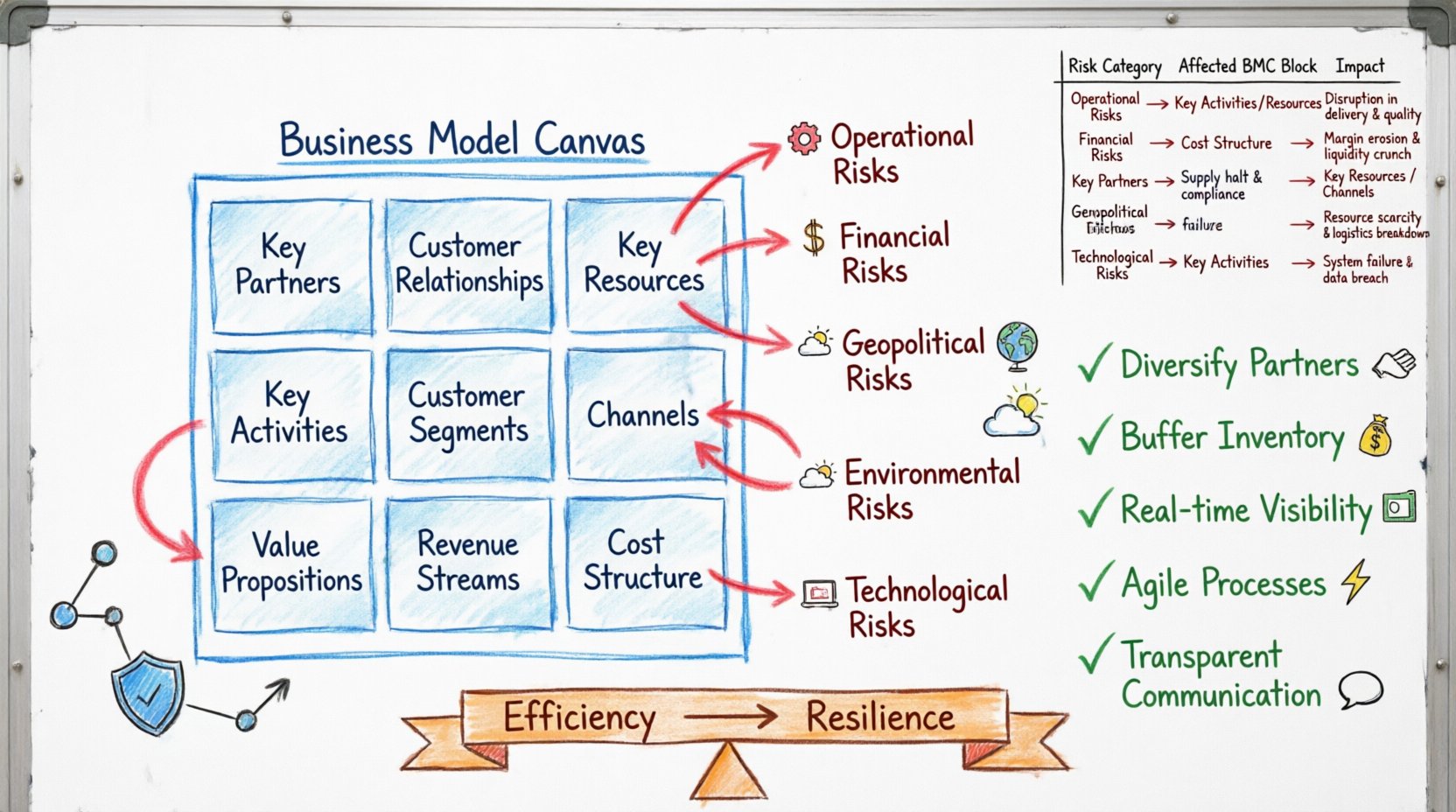
Understanding the Intersection of Supply Chain and Business Models 🤝
The Business Model Canvas (BMC) provides a visual chart with elements describing a firm’s value proposition, infrastructure, customers, and finances. However, traditional BMC templates often treat “Key Partners” and “Key Activities” as static boxes. In reality, these areas are dynamic and highly susceptible to external shocks. 📊
When designing a business model today, one must recognize that the supply chain is the backbone of value delivery. If the backbone breaks, the body cannot move. Integrating risk management into the canvas requires a shift in perspective. It moves risk from a post-mortem analysis to a pre-design parameter.
- Value Propositions: Can the promise made to the customer be fulfilled if logistics fail? 🎯
- Key Partners: Are the dependencies too concentrated or too fragile? 🤝
- Key Activities: Do internal processes allow for rapid pivoting during a crisis? ⚙️
- Cost Structure: Are margins thin enough that a single disruption wipes out profitability? 💰
By scrutinizing these blocks through a risk lens, organizations can build models that are not just efficient, but resilient. Efficiency drives short-term gains, while resilience ensures long-term survival. 🏃💨
Categorizing Supply Chain Risks 🚨
To manage risk, you must first define it. Supply chain risks are multifaceted. They are rarely isolated events but rather a convergence of factors. Understanding the taxonomy of these risks allows for targeted mitigation strategies within the business model design.
1. Operational Risks ⚙️
These are the most immediate threats to day-to-day functioning. They include equipment failures, labor strikes, or quality control issues at supplier sites. In the context of the BMC, these risks directly impact Key Activities and Key Resources. If a manufacturing partner cannot meet quality standards, the Value Proposition is compromised immediately.
2. Financial Risks 💸
Volatility in currency exchange rates, interest rate hikes, or the insolvency of a major supplier can destabilize the Cost Structure. A business model that relies on just-in-time inventory without financial buffers is particularly vulnerable. Cash flow interruptions can halt production before the first product is even sold.
3. Geopolitical and Regulatory Risks 🌏
Trade wars, tariffs, and changing regulations can alter the cost and feasibility of sourcing materials. This is increasingly relevant in globalized supply chains. A model designed for free trade may collapse overnight if a new tariff is imposed on a critical component.
4. Environmental and Climate Risks 🌦️
Extreme weather events are becoming more frequent. These physical risks can destroy infrastructure or disrupt transport routes. Furthermore, regulatory pressure to reduce carbon footprints adds a layer of compliance risk to the operational model.
5. Technological Risks 💻
Over-reliance on a single technology stack or digital platform for supply chain visibility can create a single point of failure. Cyberattacks can paralyze logistics networks, preventing orders from being fulfilled.
Mapping Risks to Business Model Blocks 🗺️
A systematic approach involves mapping specific risks to the specific blocks of the Business Model Canvas. This visualization helps stakeholders understand where vulnerabilities lie. The following table outlines common risk categories and their direct impact on BMC components.
| Risk Category | Affected BMC Block | Impact Description |
|---|---|---|
| Supplier Failure | Key Partners | Loss of critical input prevents value creation. |
| Logistics Disruption | Channels | Product cannot reach the customer on time. |
| Raw Material Shortage | Key Resources | Inability to scale production or maintain quality. |
| Cost Volatility | Cost Structure | Margins shrink, potentially rendering the model unprofitable. |
| Brand Reputation Damage | Customer Relationships | Loss of trust leads to churn and reduced lifetime value. |
By reviewing this matrix during the design phase, entrepreneurs and managers can identify blind spots. For instance, if a model relies heavily on a single supplier (Key Partners), the risk of operational failure is high. The design must account for redundancy.
Strategic Mitigation within the Canvas 🛠️
Once risks are identified, the next step is designing mitigations directly into the model. This is not about adding a separate “risk department” but weaving resilience into the DNA of the business.
1. Diversifying Key Partners 🤝
Concentration risk is a primary cause of supply chain collapse. A robust model avoids over-reliance on a single source. This means qualifying multiple suppliers for critical components. While this may increase initial onboarding costs, it secures continuity.
- Nearshoring: Moving suppliers closer to the end market reduces transit time and geopolitical exposure.
- Dual Sourcing: Maintaining two active suppliers for critical items ensures a backup if one fails.
- Local Sourcing: Utilizing regional resources reduces dependence on complex international logistics.
2. Optimizing Cost Structure for Resilience 💰
Many modern models prioritize lean inventory to maximize efficiency. While this works in stable times, it is fragile during shocks. A resilient Cost Structure allocates budget for safety stock and buffer capacity. This trade-off between efficiency and resilience must be calculated carefully.
- Variable vs. Fixed Costs: Higher fixed costs in production might offer stability, but higher variable costs allow flexibility to scale down during downturns.
- Insurance and Hedging: Incorporating the cost of hedging against currency or commodity price fluctuations into the financial model.
3. Enhancing Key Activities ⚙️
Internal processes should include contingency planning. This involves regular stress testing of the supply chain. It also means building internal capabilities rather than outsourcing everything. Core competencies related to logistics and procurement should remain under direct control.
- Real-time Visibility: Implementing systems to track inventory levels and shipment status without relying solely on third-party updates.
- Agile Manufacturing: Designing production lines that can switch between product variants quickly to adapt to material shortages.
4. Strengthening Channels and Customer Relationships 📢
If the supply chain falters, communication with customers becomes the primary defense. Transparency builds trust. If a delay occurs, informing the customer proactively is better than waiting for them to find out.
- Alternative Channels: If direct shipping is blocked, can the product be picked up at a local hub or sold through a partner network?
- Subscription Models: Recurring revenue models allow for better demand forecasting, smoothing out the impact of supply fluctuations.
The Shift from Efficiency to Resilience 🔄
For decades, the dominant philosophy in supply chain management was efficiency. The goal was to minimize inventory and costs. This approach maximized return on assets but minimized slack. Today, the paradigm is shifting toward resilience. A resilient supply chain can absorb shocks and recover quickly.
This shift requires a re-evaluation of the Business Model Canvas. Efficiency might lower the Cost Structure, but resilience often raises it slightly. The question is whether the cost of resilience is lower than the cost of disruption. In most volatile markets, the answer is yes.
Organizations must ask:
- What is the cost of a one-week shutdown? 💸
- How much revenue is lost when a key product is unavailable? 📉
- What is the long-term cost to brand reputation if customers cannot trust delivery dates? 🏷️
The answer to these questions justifies the investment in redundancy and diversification. It transforms risk management from a cost center into a value protector.
Financial Implications and Revenue Streams 💵
Supply chain risks also impact the Revenue Streams block. If a business cannot fulfill orders, revenue stops. Moreover, the cost of mitigating risks often requires upfront capital. This affects the cash flow runway.
Strategies to align financials with risk management include:
- Dynamic Pricing: Adjusting prices based on supply availability. If a component is scarce, prices may rise to reflect the higher cost or scarcity value.
- Service Contracts: Moving from one-time sales to maintenance contracts creates recurring revenue that is less susceptible to immediate supply shocks.
- Pre-selling: Securing orders and payments before production begins reduces the financial risk of unsold inventory.
It is crucial to model these financial scenarios. A static financial plan will fail in a dynamic supply chain environment. Projections must include stress tests for worst-case scenarios.
Building a Culture of Risk Awareness 🧠
Technology and models are only as good as the people operating them. A culture of risk awareness ensures that the Business Model Canvas is treated as a living document. Teams should be encouraged to report vulnerabilities without fear of reprisal. This psychological safety allows for early detection of issues.
Key practices include:
- Regular Review Cycles: Revisit the BMC quarterly to assess changes in the external environment.
- Supplier Audits: Regularly evaluate the financial and operational health of key partners.
- Scenario Planning: Conduct “what-if” exercises to test the team’s reaction to simulated disruptions.
When every employee understands the link between their daily tasks and supply chain stability, the entire organization becomes more agile. The supply chain is not just a logistics function; it is a cross-functional responsibility.
Future-Proofing the Model 🔮
The landscape of global trade is changing rapidly. Automation, AI, and sustainable practices are reshaping how goods move. A business model designed today must anticipate these trends.
- Sustainability Integration: Customers and regulators are demanding greener supply chains. Ignoring this can lead to compliance risks and loss of market share. Integrating sustainability into the Value Proposition can be a differentiator.
- Digital Twins: Creating virtual replicas of the supply chain allows for simulation without real-world risk. This aids in planning without disrupting operations.
- Blockchain Technology: Using distributed ledgers for tracking provenance can reduce fraud and improve transparency, though implementation requires careful consideration of cost versus benefit.
Adopting these technologies should not be done for the sake of novelty. They must solve specific problems identified in the risk mapping process. If a technology does not reduce risk or improve efficiency, it is likely a distraction.
Final Thoughts on Designing for Uncertainty 🌐
Designing a business model in the 21st century requires acknowledging that uncertainty is the only certainty. Supply chain risks are inevitable. The goal is not to eliminate them entirely, which is impossible, but to build a system that can withstand them.
By mapping risks to the Business Model Canvas, organizations gain clarity. They can see exactly where their dependencies lie and how those dependencies threaten their value proposition. Mitigation strategies must be woven into the cost structure, key partners, and activities.
The journey from a fragile model to a resilient one is ongoing. It requires constant vigilance and a willingness to adapt. Leaders who prioritize resilience over short-term efficiency will find themselves better positioned when the next disruption occurs. The supply chain is the engine of the business; ensuring it runs smoothly is the primary duty of the architect. 🏗️🚀