
When founders step into a boardroom or a video call with potential backers, the stakes are high. Investors are not just looking for a great product; they are looking for a viable business model and a team capable of navigating uncertainty. One of the most common documents scrutinized during this process is the SWOT analysis. However, too often, this framework is treated as a checkbox exercise rather than a strategic tool. To truly build confidence, you must present your SWOT analysis with clarity, honesty, and strategic foresight. This guide details how to leverage this framework to demonstrate maturity and resilience to your audience.
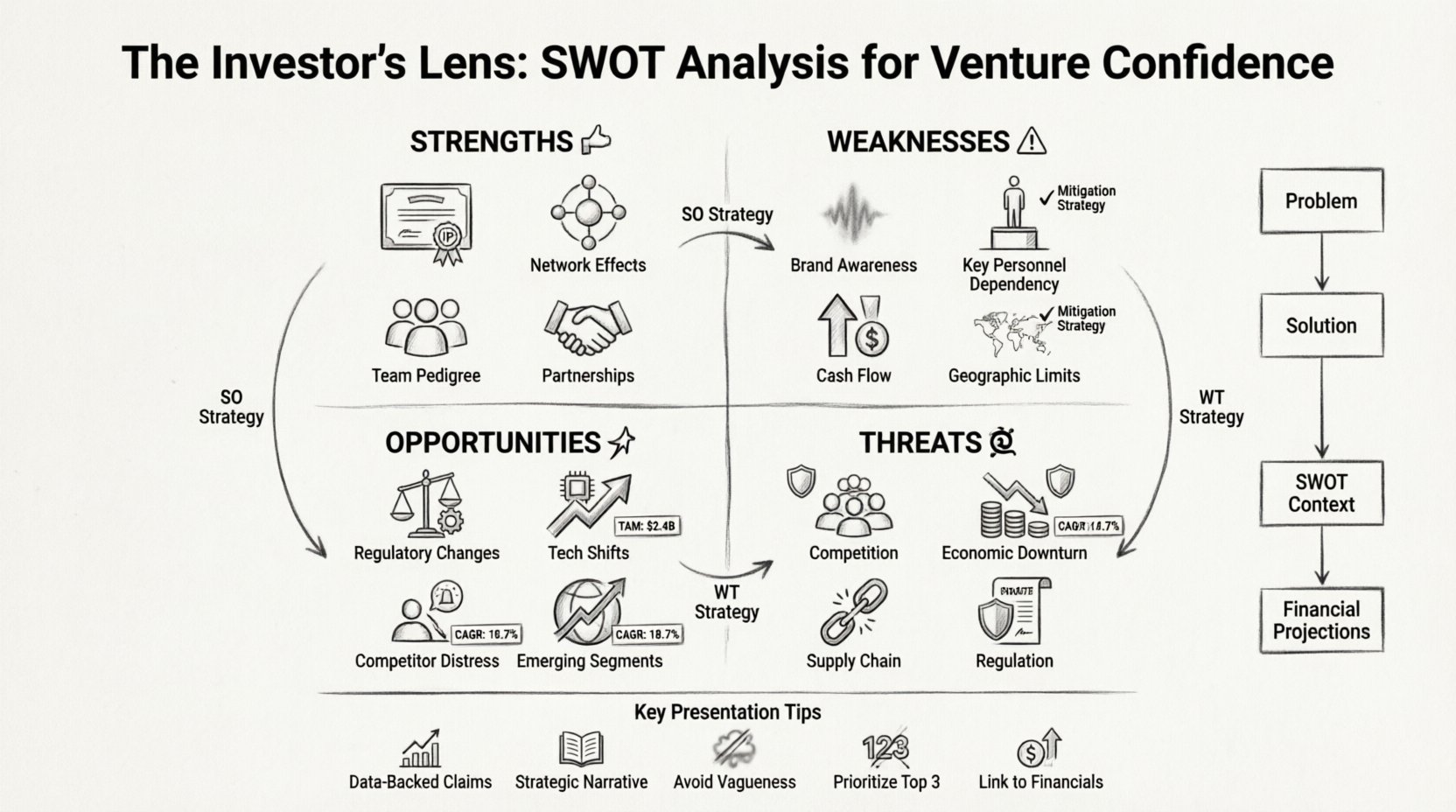
Why Investors Scrutinize Your SWOT Analysis 📊
Investors operate under conditions of information asymmetry. They know less about your daily operations than you do, which creates risk. A SWOT analysis serves as a bridge, allowing them to assess your internal capabilities against external market forces. It is not merely a list of pros and cons; it is a snapshot of your strategic thinking.
When an investor reviews your SWOT, they are looking for specific signals:
- Self-Awareness: Do you understand your business deeply, including its flaws?
- Risk Management: Have you identified potential threats and planned for them?
- Market Realism: Is your assessment of opportunities grounded in data rather than hope?
- Strategic Alignment: Do your strengths directly support the opportunities you are chasing?
If your analysis appears generic or overly optimistic, it signals a lack of depth. Conversely, a nuanced presentation suggests that you have stress-tested your venture and are prepared for the challenges ahead.
Deconstructing the Four Quadrants for an Investor Audience 🧠
To present a compelling case, you must move beyond standard definitions. Each quadrant requires specific attention to detail when addressing potential capital partners.
1. Strengths: Defensible Advantages 💪
Strengths are internal attributes that give you an edge over competitors. In an investor pitch, generic strengths like “hardworking team” or “high-quality product” carry little weight. You need to highlight defensible moats.
Focus on:
- Intellectual Property: Patents, trademarks, or proprietary algorithms that protect your core technology.
- Network Effects: Does the value of your product increase as more people use it?
- Exclusive Partnerships: Are there contracts or agreements that prevent competitors from accessing the same supply chain or distribution channels?
- Team Pedigree: Not just where people worked, but specific achievements relevant to the current challenge (e.g., “Scaled a previous startup from seed to exit”).
When listing these, connect them directly to revenue growth or cost reduction. Investors want to see how these strengths translate to financial performance.
2. Weaknesses: Honest Vulnerabilities ⚠️
This is the quadrant where many founders stumble. Hiding weaknesses or framing them as strengths undermines credibility. Investors expect to see weaknesses, provided you have a mitigation strategy. Transparency builds trust.
Examples of honest weaknesses include:
- Limited Brand Awareness: Acknowledging that you are a new player in a crowded market.
- Dependency on Key Personnel: Recognizing that the loss of a specific founder or engineer could halt operations.
- Current Cash Flow Constraints: Admitting that early-stage burn rates require careful management.
- Geographic Limitations: Being clear about where you operate versus where you do not.
The key is to pair every weakness with an action plan. If you are dependent on a key person, state that you are building a succession plan or cross-training team members. If cash flow is tight, outline your runway extension strategy.
3. Opportunities: Market Potential 🚀
Opportunities are external factors you can exploit to grow. Investors are looking for scale here. They want to know that the market is large enough to support a significant return on investment.
Highlight:
- Regulatory Changes: Laws that might open new markets for your solution.
- Technological Shifts: New hardware or software capabilities that make your product better or cheaper to deliver.
- Competitor Distress: If a major competitor is struggling, is there a chance to capture their market share?
- Emerging Segments: New customer demographics that have not been fully served yet.
Ensure these opportunities are quantified. Instead of saying “the market is growing,” specify the projected CAGR (Compound Annual Growth Rate) and the Total Addressable Market (TAM) size.
4. Threats: External Risks 🌪️
Threats are external obstacles that could cause trouble for your venture. Acknowledging threats shows you are realistic about the operating environment.
Common threats to address:
- Competitive Aggression: A well-funded incumbent entering your space.
- Economic Downturns: How does a recession affect your customer’s budget?
- Supply Chain Disruptions: Risks related to raw materials or logistics.
- Regulatory Compliance: New laws that might increase operational costs.
Like weaknesses, threats require mitigation. Discussing how you hedge against these risks demonstrates operational maturity.
Structuring the Information for Clarity 📋
Visual organization plays a crucial role in how your analysis is received. A wall of text is difficult to digest during a presentation. Use tables to categorize factors and clarify relationships.
Consider using a matrix to distinguish between Internal and External factors. This helps investors quickly understand the scope of your analysis.
| Factor Type | Definition | Example for Venture |
|---|---|---|
| Internal | Attributes within your control | Proprietary technology, cash reserves, team skills |
| External | Market conditions outside your control | Interest rates, competitor pricing, regulatory shifts |
Another useful table is the “Weakness vs. Threat” comparison. Confusing these two can lead to flawed strategy. Weaknesses are internal deficiencies; Threats are external dangers.
| Category | Focus | Strategic Question |
|---|---|---|
| Weakness | Internal Deficit | How do we fix this to improve operations? |
| Threat | External Risk | How do we defend against this impact? |
Presenting the Narrative: Beyond the Grid 🗣️
While the grid format is useful for data, the story is what sells. The SWOT analysis should not exist in isolation within your pitch deck. It must weave into the broader narrative of the business.
Connecting Strengths to Opportunities
This is the most critical strategic link. It is not enough to list strengths and opportunities separately. You must explain how your specific strengths allow you to capture the identified opportunities. This is often called the “SO Strategy” (Strengths-Opportunities).
For example:
- Strength: Proprietary AI engine.
- Opportunity: Growing demand for automated customer service.
- Strategy: Use the engine to launch a SaaS product that integrates with existing CRM platforms, capturing the market shift.
Addressing Weaknesses with Threats
This involves your “WT Strategy” (Weaknesses-Threats). Here, you explain how you will avoid failing due to internal flaws when external pressures rise. This shows risk management capability.
For instance:
- Weakness: Limited marketing budget.
- Threat: Competitor price wars.
- Strategy: Focus on high-value enterprise clients rather than price-sensitive SMBs, reducing exposure to price wars while leveraging existing relationships.
Common Pitfalls to Avoid 🚫
Even with a solid framework, presentation errors can undermine your credibility. Review your draft against these common mistakes.
- Being Too Vague: Phrases like “strong market presence” are meaningless without data. Use specific market share percentages or growth rates.
- Over-Optimism: Listing only positive attributes and downplaying risks. Investors will do their own due diligence and find the gaps. If you hide them, you lose trust.
- Static Analysis: Treating the SWOT as a one-time document. Markets change. Mention that this analysis is a living document that will be updated quarterly.
- Lack of Prioritization: Every item is important, but not equally. Highlight the top three strengths and the top three threats. Focus the investor’s attention on the critical few.
- Disconnect from Financials: If your SWOT suggests a major opportunity, your financial model should reflect the revenue associated with that opportunity. Consistency across documents is vital.
Integrating SWOT into the Pitch Deck 📁
Where does this analysis sit in your presentation? It should not be the first thing investors see, nor should it be buried in the appendix. The ideal placement is after the problem and solution overview, but before the financial projections.
This flow makes logical sense:
- The Problem: What needs solving?
- The Solution: How are you solving it?
- The Context (SWOT): Why you can win in this environment.
- The Numbers: What the win looks like financially.
By placing it here, you provide the logical bridge between your vision and your financial expectations. It justifies the assumptions you make in your projections.
Preparing for Investor Questions 🗣️
Once you present your SWOT, expect follow-up questions. Investors often use the analysis to probe deeper into specific areas.
Be ready to answer:
- On Weaknesses: “You listed limited brand awareness as a weakness. How will you spend the capital raised to address this specifically?”
- On Threats: “You mentioned a competitor entering the space. What is your specific defensive moat that will survive that entry?”
- On Opportunities: “This opportunity seems dependent on a third-party platform. What happens if they change their API policies?”
Having pre-written responses to these questions based on your SWOT analysis will demonstrate that you have thought through the implications of your own assessment.
Data-Backed Claims Are Essential 📈
Opinions are not enough. Every claim in your SWOT should be backed by evidence. This applies to every quadrant.
For Strengths, use:
- Customer retention rates.
- Patent filing numbers.
- Employee tenure averages.
For Weaknesses, use:
- Current customer acquisition costs.
- Operational bottlenecks identified in recent audits.
For Opportunities, use:
- Industry reports from reputable research firms.
- Surveys of potential customer demand.
For Threats, use:
- Historical data on competitor price drops.
- Regulatory change timelines.
When you anchor your SWOT in data, it moves from being a theoretical exercise to a strategic asset. It shows that your confidence is derived from evidence, not just optimism.
Final Thoughts on Strategic Honesty 💡
Presenting a SWOT analysis for investors is an exercise in balance. You must advocate for your venture’s potential while acknowledging its vulnerabilities. This balance is the essence of professional credibility. Investors are partners, not just sources of capital. They need to know the terrain before they invest in the journey.
By structuring your analysis clearly, avoiding generic statements, and linking internal capabilities to external market shifts, you transform a standard framework into a powerful confidence-building tool. The goal is not to hide the rough patches of the road, but to show that you have the map and the vehicle to navigate them successfully.
Take the time to refine this document. Treat it with the same rigor as your financial model. A well-presented SWOT analysis signals that you are ready for the scrutiny that comes with scaling a venture. It tells investors that you are not just dreaming of success, but planning for it.