Strategic clarity does not happen by accident. It requires a disciplined approach to understanding where an organization stands today and where it can go tomorrow. The SWOT analysis is a foundational tool used by leaders to navigate this complexity. However, many organizations treat it as a checkbox exercise rather than a cognitive framework for decision-making.
This guide explores how to conduct a SWOT analysis with rigor. It moves beyond the basic definition to examine the internal mechanics of strategic planning. We will look at how to gather data, how to interpret findings, and how to translate abstract concepts into concrete business actions.
Understanding the Core Framework 📊
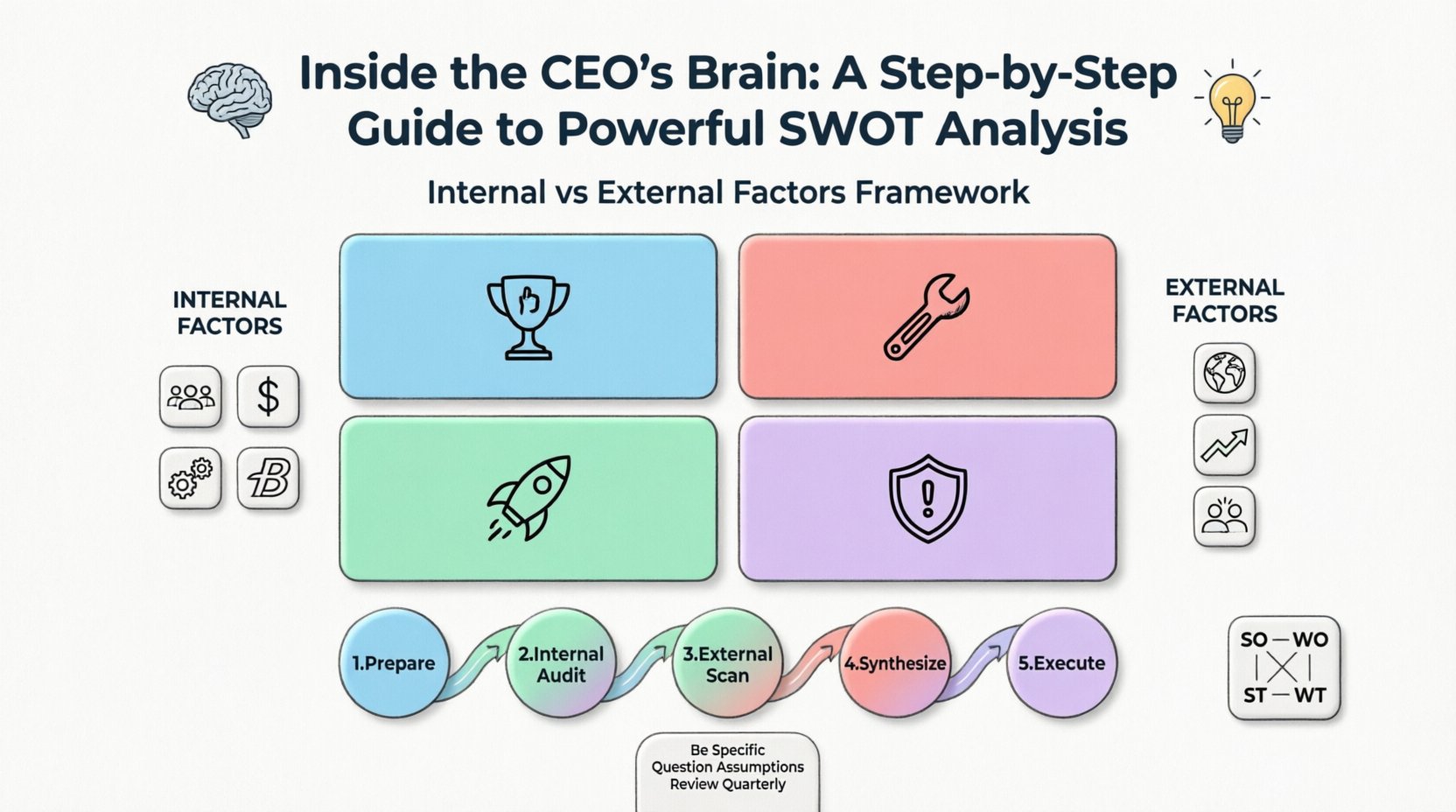
A SWOT analysis breaks down into four distinct categories. These categories represent the intersection of internal and external factors. Understanding the distinction is critical for accurate diagnosis.
- Internal Factors: These are elements within the organization’s control. They include resources, culture, processes, and capabilities.
- External Factors: These are elements outside the organization’s control. They include market trends, regulatory changes, competitor actions, and economic shifts.
By separating these forces, leaders can avoid the common error of trying to control the uncontrollable or ignoring the controllable. The goal is not just to list attributes, but to understand the implications of those attributes.
The Four Pillars Defined
- Strengths (Internal): What do you do better than anyone else? What unique resources do you possess?
- Weaknesses (Internal): Where are you falling short? What do competitors do better than you?
- Opportunities (External): What market trends can you leverage? Where is demand growing?
- Threats (External): What obstacles stand in your way? What are competitors doing that could hurt you?
It is important to note that a weakness in one context might be a strength in another. For example, a small team size is often seen as a weakness due to limited bandwidth. However, in a niche market requiring agility, that same small size can be a strength for speed.
Phase 1: Preparing for the Analysis 🛠️
Before writing a single item on a whiteboard, preparation determines the quality of the output. A hasty meeting yields hasty conclusions. Here is how to set the stage.
Assemble the Right Stakeholders
Strategy is not the sole domain of the executive suite. To get a complete picture, you need diverse perspectives.
- Operational Staff: They know the daily bottlenecks and process inefficiencies.
- Sales and Marketing: They hear customer complaints and competitor pitches directly.
- Finance: They provide the data on margins, cash flow, and cost structures.
- Product/Engineering: They understand technical debt and innovation capacity.
Excluding these voices leads to blind spots. A CEO might see a strong balance sheet, while the engineering team sees a system that is days away from collapse.
Define the Scope and Timeline
A SWOT analysis can cover the entire organization or a specific product line. Narrowing the scope often yields more actionable insights.
- Time Horizon: Are you planning for the next quarter or the next five years? The factors influencing a 5-year plan differ significantly from a 3-month sprint.
- Geographic Scope: Is this analysis for a global entity or a regional branch? Local regulations affect threats differently than global trends.
Phase 2: Internal Audit (Strengths & Weaknesses) 🔍
This phase requires brutal honesty. Internal assessments are often clouded by optimism bias. Leaders tend to overestimate their capabilities and underestimate their risks.
Gathering Data on Strengths
Do not rely on assumptions. Use evidence to validate what you consider a strength.
- Intellectual Property: Do you hold patents or proprietary technology?
- Brand Equity: Is customer loyalty measurable through retention rates or Net Promoter Scores?
- Financial Health: Do you have strong cash reserves or favorable debt ratios?
- Human Capital: Do you have a leadership team with unique experience in your specific industry?
Key Question: If we lost this asset tomorrow, would our business stop functioning? If the answer is yes, it is a core strength.
Gathering Data on Weaknesses
Weaknesses are often the hardest to identify because they are painful to acknowledge. They must be surfaced through data.
- Operational Inefficiency: Are delivery times slower than industry averages?
- Talent Gaps: Is there a specific skill set you cannot hire for?
- Legacy Systems: Is your technology stack slowing down innovation?
- Customer Satisfaction: Are there recurring complaints in support tickets?
Key Question: Where are we losing market share to competitors, and is it due to an internal deficit?
Internal Factors Checklist
| Category | Strength Indicators | Weakness Indicators |
|---|---|---|
| Financial | High profit margins, low debt | High burn rate, reliance on single revenue stream |
| Human Resources | Low turnover, high skill density | High turnover, lack of succession planning |
| Operations | Lean processes, high automation | Manual workflows, frequent downtime |
| Brand | High brand recognition, advocacy | Negative PR history, low trust scores |
Phase 3: External Environment (Opportunities & Threats) 🌍
External factors are dynamic. They change without warning. This phase requires constant scanning of the horizon. It is less about what you are, and more about where you are going.
Identifying Opportunities
Opportunities are external situations that could benefit the organization if leveraged correctly.
- Market Gaps: Is there a segment of customers competitors are ignoring?
- Technological Shifts: Are new tools emerging that could reduce costs or improve quality?
- Regulatory Changes: Are new laws creating a need for compliance services?
- Competitor Moves: Is a major competitor pulling back from a region or product line?
Key Question: If we could change one thing about the market environment, what would make us more successful?
Identifying Threats
Threats are external challenges that could jeopardize the business. These require mitigation strategies.
- Economic Downturns: Is the economy trending toward recession?
- New Entrants: Are startups entering your space with disruptive models?
- Supply Chain Risks: Are you dependent on a single supplier or region?
- Changing Consumer Behavior: Are customers moving away from your core offering?
Key Question: What could stop us from achieving our goals next year if we do nothing?
Phase 4: Synthesis and Strategic Alignment 🧩
Listing the four quadrants is only the first step. The real value comes from cross-referencing them. This is where strategy is born.
The TOWS Matrix Approach
Without specific software, you can manually map these interactions. This process connects internal capabilities with external possibilities.
- SO Strategies (Maxi-Maxi): Use Strengths to maximize Opportunities. Example: Use strong cash reserves to acquire a competitor before a market consolidation.
- WO Strategies (Mini-Maxi): Overcome Weaknesses by taking advantage of Opportunities. Example: Partner with a tech firm to fill a skills gap caused by a market shift.
- ST Strategies (Maxi-Mini): Use Strengths to minimize Threats. Example: Use brand loyalty to defend against a price war initiated by a new entrant.
- WT Strategies (Mini-Mini): Minimize Weaknesses and avoid Threats. Example: Cut unprofitable lines of business to reduce exposure to economic volatility.
Validating the Findings
Before finalizing the strategy, challenge the data. Is the information current? Is it accurate? Is it biased?
- Peer Review: Have someone outside the immediate team review the findings.
- Historical Comparison: Compare current findings with data from previous years.
- Customer Verification: Ask customers if they perceive your strengths as you do.
Phase 5: Execution and Maintenance 🚀
A SWOT analysis that sits in a presentation deck is useless. It must drive action. This requires translating the matrix into a roadmap.
Turning Insights into KPIs
Each strategic point derived from the analysis should have a measurable outcome.
- Action Item: Reduce operational costs by 10%.
- Source: Identified as a Weakness (Internal).
- Goal: Improve profitability.
Assign owners to every action item. Ambiguity in ownership leads to inaction. Ensure deadlines are set and progress is tracked.
Regular Review Cycles
The business environment changes. A SWOT analysis done once a year might be obsolete by month six. Establish a cadence for review.
- Quarterly Reviews: Check if the identified threats have materialized.
- Annual Deep Dive: Re-run the full analysis to capture macro shifts.
- Trigger-Based Updates: Update immediately if a major competitor launches a product or if a regulation changes.
Common Pitfalls to Avoid ⚠️
Even with a solid process, human nature introduces errors. Being aware of these traps helps maintain objectivity.
Confusing Symptoms with Causes
Low revenue is a symptom. The cause might be poor marketing, bad product, or high prices. A SWOT analysis must dig for the root cause. If you list “Low Revenue” as a weakness, you cannot fix it. You must list “Ineffective Marketing Strategy” as the weakness.
Being Too Vague
Terms like “Good Quality” or “Strong Team” are subjective. Quantify them. “99% Uptime” or “Team with 10 years average experience”.
Ignoring the Competition
Internal focus is dangerous. If you are the only one in the room talking about your company, you are missing the market context. Competitor analysis must be a core component of the Threat and Opportunity sections.
Analysis Paralysis
Do not let the pursuit of perfect data delay decision-making. Aim for 80% accuracy on the analysis so you can move to 100% action.
Advanced Considerations for Strategic Depth 🧠
For organizations seeking a higher level of sophistication, there are additional layers to consider when conducting this analysis.
Quantitative vs. Qualitative Data
Most leaders prefer data they can see. However, qualitative data often holds the key to future risks.
- Quantitative: Sales figures, market share percentages, employee counts.
- Qualitative: Employee morale, customer sentiment, brand perception.
A balanced approach requires both. You cannot manage morale with a spreadsheet, but you cannot manage cash flow with intuition.
The Role of Culture
Culture acts as a multiplier. A strong culture can turn a weakness into a strength through innovation and resilience. A toxic culture can destroy a strength through attrition and poor execution.
When assessing Strengths and Weaknesses, include cultural factors explicitly.
- Adaptability: How quickly does the team pivot?
- Collaboration: Do silos exist between departments?
- Accountability: Do people own their mistakes?
Final Thoughts on Strategic Discipline 📝
Conducting a SWOT analysis is a discipline. It is not a one-time event but a recurring practice that keeps an organization aligned with reality. By following a structured approach, leaders can move from reactive management to proactive strategy.
The value of this framework lies not in the grid itself, but in the conversations it sparks. It forces stakeholders to agree on the current reality before debating the future. This alignment is the foundation of sustainable growth.
Start with the data. Question the assumptions. Map the connections. Execute the plan. Review the results. This cycle creates a resilient business capable of navigating uncertainty.