Strategic planning is often described as the bridge between where an organization stands today and where it aims to stand tomorrow. Yet, many organizations build this bridge on shaky ground. The SWOT analysis—Strengths, Weaknesses, Opportunities, and Threats—remains one of the most ubiquitous frameworks in business strategy. However, the standard application of this tool frequently results in superficial insights that fail to capture the complexity of modern markets. To move beyond surface-level observations, one must examine the components that are often overlooked or misinterpreted during the assessment process.
This guide dissects the nuances of the SWOT framework. It focuses specifically on the hidden weaknesses and the interconnections between components that standard exercises miss. We will explore cognitive biases, structural dependencies, and the subtle risks that lurk within apparent strengths. By understanding these deeper layers, decision-makers can construct strategies that are resilient rather than reactive.
🧩 The Standard View vs. The Nuanced Reality
Most organizations approach SWOT analysis as a brainstorming session. Teams gather to list positive and negative attributes. This process often suffers from confirmation bias, where teams list strengths they want to believe they possess rather than what is objectively verifiable. Furthermore, the categorization of items often becomes rigid. A “Weakness” is treated as a static flaw, rather than a dynamic vulnerability that can shift based on context.
Consider the difference between a standard list and a strategic breakdown:
Standard Approach: “We have a loyal customer base.” (Strength)
Nuanced Approach: “Our customer base is loyal due to high switching costs, but this creates a dependency that limits innovation incentives.” (Strength with Hidden Weakness)
The second example reveals the tension within a strength. It acknowledges that what protects the business today might hinder it tomorrow. Advanced analysis requires this level of scrutiny.
💪 Strengths: The Illusion of Competence
Strengths are rarely just assets. They are often the result of past decisions that may no longer serve current goals. When an organization relies heavily on a specific strength, it risks developing a “competency trap.” This occurs when the capability that once drove success becomes a barrier to adaptation.
Common hidden issues within strengths include:
Over-specialization: Deep expertise in a niche area can blind an organization to broader market shifts. If the niche shrinks, the expertise becomes a liability.
Resource Drain: Maintaining a flagship product or service often consumes disproportionate resources, starving emerging initiatives.
Brand Rigidity: Strong brand identity can make it difficult to pivot messaging or target new demographics without alienating the core audience.
Cultural Entrenchment: A “winning culture” can become resistant to new methodologies that challenge established norms.
When evaluating strengths, ask not just “What are we good at?” but “What cost does this strength impose on our agility?” This question shifts the focus from celebration to critical evaluation.
📉 Weaknesses: The Cultural Debt
Weaknesses are typically the easiest category to identify, yet they are often the most difficult to address. Standard lists might cite “lack of funding” or “older technology.” These are symptoms, not root causes. The true weaknesses often lie in the organizational culture and internal processes.
Deep dive into potential hidden weaknesses:
Communication Silos: Departments operate in isolation. Information does not flow freely, leading to duplicated efforts and missed signals.
Decision Paralysis: Excessive bureaucracy slows down execution. The speed of response becomes a competitive disadvantage.
Talent Retention Gaps: High turnover in key roles indicates a deeper issue with management or compensation structures, not just market competition.
Innovation Fatigue: Employees are exhausted by constant change initiatives, leading to a passive resistance to new projects.
Data Fragmentation: Information is scattered across disparate systems, making holistic analysis difficult.
Addressing these weaknesses requires more than just hiring or buying software. It requires structural realignment and cultural shifts. Ignoring these underlying issues means treating the symptoms while the disease progresses.
🚀 Opportunities: The Siren Call
Opportunities are external possibilities. However, not all opportunities are viable. The danger lies in pursuing growth without assessing the capability to capture it. This is often called “growth blindness.” An organization might see a market trend and assume they can capitalize on it without realizing they lack the necessary infrastructure.
Key considerations for opportunities include:
Market Saturation: Just because a market exists does not mean it is profitable. Analyze the density of competitors.
Resource Availability: Do you have the capital and personnel to seize this opportunity without compromising core operations?
Regulatory Risks: Emerging markets often come with evolving compliance requirements that can delay or block entry.
Customer Readiness: Is the target audience actually ready to adopt the solution, or is the market still in the early education phase?
Opportunities must be filtered through the lens of internal capacity. A great opportunity that cannot be executed is a distraction.
⚠️ Threats: The Slow Burn
Threats are often categorized as immediate risks, such as a new competitor or a supply chain disruption. However, the most dangerous threats are slow-moving. They erode value over time without triggering immediate alarms.
Hidden threats often include:
Technological Obsolescence: A gradual decline in the relevance of current technology stacks.
Regulatory Shifts: Changes in laws that affect the business model subtly over years.
Brand Reputation Erosion: Slow deterioration of trust due to minor service failures accumulating over time.
Dependency Risks: Over-reliance on a single supplier or channel that could fail without warning.
Internal Complacency: A belief that the current position is secure, leading to a lack of defensive measures.
Identifying slow-burn threats requires long-term horizon scanning. It involves looking beyond the next fiscal quarter to the next decade.
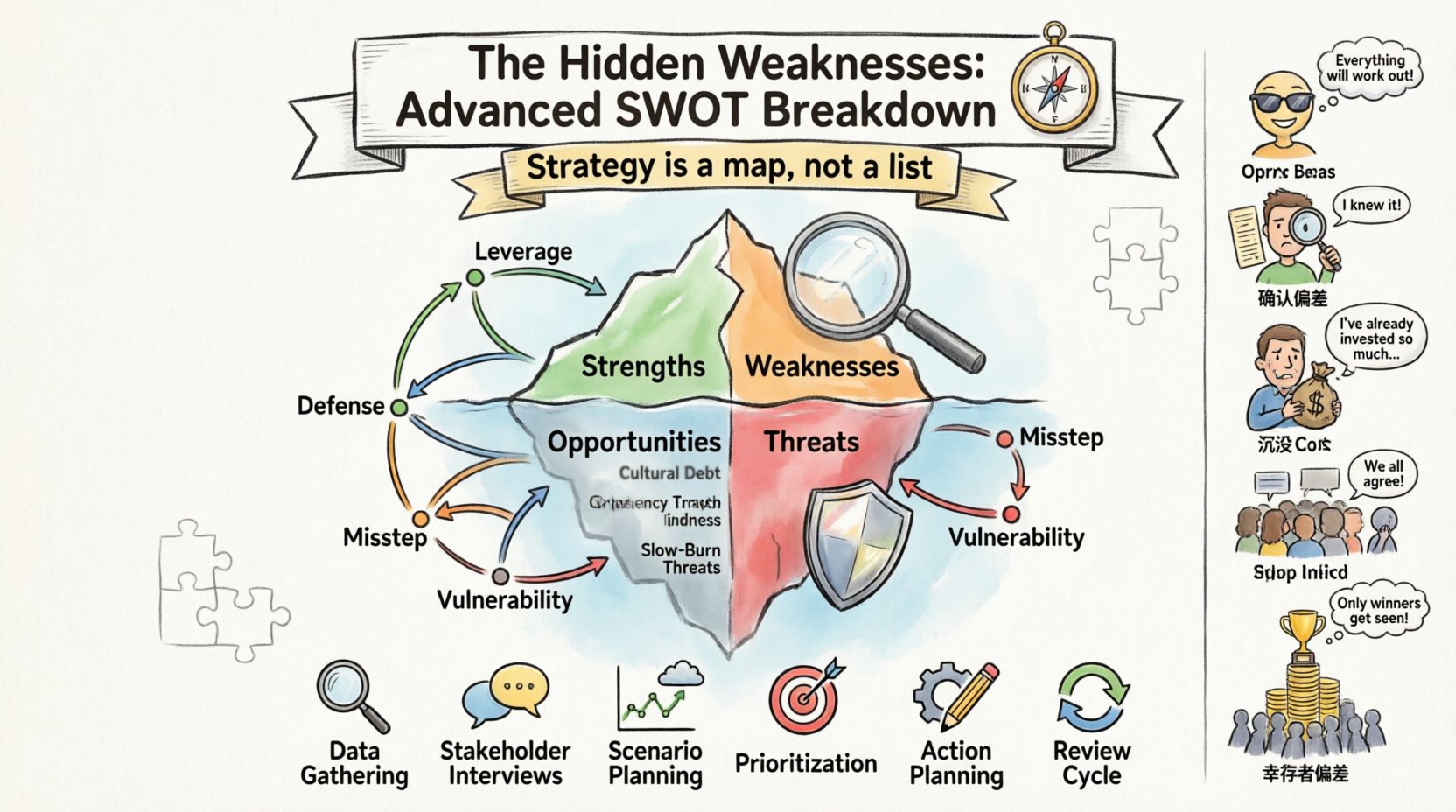
🔗 The Interconnectivity Matrix
The components of a SWOT analysis do not exist in isolation. A strength can become a threat if the market changes. A weakness can become an opportunity if a competitor fails to address it. Understanding these cross-connections is vital for robust strategy.
The following table outlines how components interact:
Component | Interaction | Impact | Example |
|---|---|---|---|
Strength | vs. Opportunity | Leverage | Strong R&D team (S) enters a new tech market (O). |
Strength | vs. Threat | Defense | Brand loyalty (S) protects against price wars (T). |
Weakness | vs. Opportunity | Misstep | Poor distribution (W) prevents capturing online growth (O). |
Weakness | vs. Threat | Vulnerability | Outdated security (W) exposes firm to cyber threats (T). |
Opportunity | vs. Threat | Risk | New market entry (O) exposes firm to regulatory risk (T). |
Strategies should be built on the “Leverage” and “Defense” quadrants while actively mitigating the “Misstep” and “Vulnerability” quadrants.
🛡️ Implementation Framework
Moving from analysis to action requires a disciplined approach. Here is a framework for executing an advanced SWOT assessment:
1. Data Gathering: Collect quantitative and qualitative data. Do not rely solely on memory or perception.
2. Stakeholder Interviews: Talk to employees at all levels. Front-line staff often see weaknesses that leadership misses.
3. Scenario Planning: Test findings against different future scenarios. How does the SWOT change if the market shrinks by 20%?
4. Prioritization: Not all items are equal. Rank them by impact and urgency.
5. Action Planning: Assign owners and timelines to each strategic initiative derived from the analysis.
6. Review Cycle: Set a schedule to revisit the analysis. Strategic environments change rapidly.
🧠 Cognitive Biases to Avoid
Even with a structured framework, human psychology can skew results. Being aware of these biases is crucial for maintaining objectivity.
Optimism Bias: Overestimating positive outcomes and underestimating risks. This leads to inflated strength counts and ignored threats.
Confirmation Bias: Seeking information that supports existing beliefs. Teams may ignore data that contradicts their view of their own strengths.
Sunk Cost Fallacy: Continuing to invest in a failing strategy because of past investment. This masks weaknesses in legacy projects.
Groupthink: The desire for harmony in a group leads to unrealistic assessments. Dissenting opinions on weaknesses are suppressed.
Survivorship Bias: Focusing on successful companies and ignoring the failures. This distorts the understanding of what actually drives success.
🛠️ Validation Steps
To ensure the analysis holds up to scrutiny, apply these validation steps:
External Benchmarking: Compare findings against industry standards and competitor performance.
Third-Party Review: Engage an external consultant to review the analysis for blind spots.
Stress Testing: Ask “What if this strength disappears?” to test dependency levels.
Customer Feedback: Validate perceived strengths and weaknesses with direct customer input.
Financial Modeling: Translate strategic points into financial projections to test viability.
🔄 Long-term Sustainability
Strategy is not a one-time event. It is a continuous cycle. The environment shifts, and so must the analysis. Organizations that treat SWOT as a static document fail to adapt. Those that treat it as a living process maintain relevance.
Key practices for sustainability include:
Regular Updates: Conduct a mini-review quarterly and a full review annually.
Integration: Embed SWOT findings into budgeting and hiring decisions.
Transparency: Share findings openly within the organization to build collective ownership.
Adaptability: Be willing to discard old assumptions when new data emerges.
Focus: Limit the number of strategic priorities to ensure execution focus.
📝 Summary of Key Takeaways
The standard SWOT analysis is a useful starting point, but it is insufficient for complex strategic challenges. True insight comes from digging beneath the surface labels. Strengths can hide dependencies. Weaknesses can be cultural rather than technical. Opportunities can be traps. Threats can be slow-moving.
By applying rigorous scrutiny, avoiding cognitive biases, and understanding the interconnections between components, organizations can build strategies that are robust. This requires quiet confidence in the data, not hype about the potential. It requires a willingness to face uncomfortable truths about internal capabilities. The goal is not to be perfect, but to be aware. Awareness is the foundation of effective action.
When executing this process, remember that the output is not a list. It is a map. It shows where the ground is solid and where it is prone to collapse. Use this map to navigate the future with precision.