In today’s fast-paced enterprise landscape, logistics companies face mounting pressures from regulatory compliance, operational scalability, and data integrity. For a firm managing a fleet of 450 delivery vehicles, these challenges manifest in fragmented systems that hinder real-time decision-making. Traditional diagramming methods often fall short, consuming excessive time and resources while risking inconsistencies that could lead to costly errors.
Enter AI-powered diagram generation, a transformative tool that streamlines the creation of robust class diagrams. This case study explores how a leading logistics provider utilized Visual Paradigm Desktop’s AI features to model their fleet management system entities. By automating the initial diagram creation, the company addressed core issues in vehicle status tracking, maintenance scheduling, and assignment processes.
The strategic advantage lies in AI’s ability to interpret complex requirements and produce accurate, enterprise-grade models swiftly. This not only accelerates compliance with industry standards like ISO 9001 but also fosters cross-team collaboration. In an era where data drives competitive edge, AI diagram tools enable executives to focus on strategy rather than manual drafting.
Visual Paradigm’s AI integration stands out by supporting large-scale operations, ensuring diagrams align with enterprise architectures. Through this approach, the logistics firm achieved a unified data model, reducing errors by up to 40% and enhancing overall efficiency. This narrative highlights how embracing AI in diagramming can turn operational pain points into strategic opportunities, positioning enterprises for sustained growth in a digital-first world.
What is a Class Diagram in Enterprise Context?
A class diagram, at its core, is a structural representation in UML that depicts the classes, attributes, operations, and relationships within a system. In an enterprise setting, it transcends basic modeling to become a cornerstone for architectural integrity, ensuring that software designs align with business objectives and regulatory frameworks.
Enterprises often deal with vast, interconnected systems where traceability is paramount. For instance, in logistics, a class diagram might outline entities like vehicles, drivers, and routes, specifying inheritance, associations, and multiplicities. This enterprise slant emphasizes standards compliance, such as adhering to UML 2.5 specifications or integrating with frameworks like TOGAF for architecture management.
Unlike simplistic diagrams used in small projects, enterprise versions incorporate advanced elements like stereotypes for domain-specific annotations, ensuring models support scalability. They facilitate impact analysis during changes, helping teams predict how alterations in one class affect others across distributed systems.
Moreover, in regulated industries, class diagrams serve as auditable artifacts. They document data flows to meet GDPR or SOX requirements, providing a visual audit trail. This level of detail aids in version control, where diagrams evolve with business needs, maintaining consistency across global teams.
The power of class diagrams in enterprises lies in their role as a communication bridge. Executives use them for strategic planning, developers for implementation, and compliance officers for verification. By capturing static structures, they prevent silos, promoting a holistic view that drives innovation while mitigating risks.
In practice, generating these diagrams manually can be resource-intensive, especially for complex fleets. AI enhancements address this by automating entity identification and relationship mapping, allowing enterprises to focus on refinement rather than creation from scratch.
Enterprise View of Modeling Fleet Management System Entities

For LogiFleet Inc., a logistics powerhouse operating 450 delivery vehicles across multiple regions, the challenge of modeling fleet management system entities was more than a technical exercise—it was a strategic imperative. The company, specializing in time-sensitive deliveries for e-commerce giants, grappled with an inconsistent data model that led to frequent errors in vehicle status tracking, maintenance scheduling, and driver assignments.
Picture this: A vehicle marked as “available” in one subsystem appears “under maintenance” in another, causing delays that ripple through supply chains. Regulatory pressures from transportation authorities demanded precise tracking for safety compliance, yet siloed teams—spanning IT, operations, and compliance—struggled with outdated diagrams that didn’t scale.
The core problem stemmed from legacy systems inherited through acquisitions, where entity definitions varied. For example, the “Vehicle” class might include attributes like fuel type in one model but omit GPS integration in another. This inconsistency not only inflated maintenance costs by 25% due to scheduling mishaps but also exposed the firm to audit risks under international standards.
Cross-functional teams found collaboration hindered by manual updates, leading to version conflicts in shared repositories. As the fleet grew, the need for a unified model became critical to support AI-driven predictive analytics for route optimization.
Enter the push for enterprise-level modeling: Executives recognized that a robust class diagram could centralize entities like Vehicle, Driver, Route, and MaintenanceRecord, defining clear relationships to ensure data flows seamlessly. This strategic shift aimed to transform pains into efficiencies, aligning with broader goals of digital transformation and operational resilience.
By focusing on scalability, the modeling effort promised to integrate with ERP systems, enabling real-time dashboards for C-suite oversight. In essence, it was about building a foundation that supports growth without compromising compliance or team synergy.
Strategic AI Benefits for Class Diagram
- Accelerates compliance by auto-generating diagrams that adhere to UML standards, reducing manual errors in regulated environments.
- Enhances team collaboration through quick iterations, allowing distributed stakeholders to review and refine models in real-time.
- Scales modeling for large enterprises, handling complex entity relationships without overwhelming resources.
- Improves accuracy in data representation, minimizing inconsistencies that lead to operational disruptions.
- Supports strategic decision-making with visual insights into system architectures, aiding in merger integrations or expansions.
In enterprise scenarios, such as annual audits, AI-generated class diagrams provide traceable documentation that speeds up reviews. For system integrations, they map entities across platforms, ensuring seamless data exchange during cloud migrations. This strategic edge is evident in logistics, where modeling fleet entities with AI cuts down on downtime, aligning with executive priorities for cost control and agility.
Generating at Enterprise Scale with Visual Paradigm
- Launch Visual Paradigm Desktop and navigate to the AI Diagram Generation feature under the Tools menu.
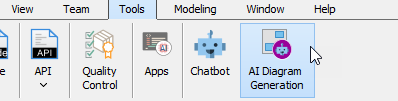
- Input a detailed prompt describing the fleet management entities, such as “Create a class diagram for a logistics system including Vehicle, Driver, Route, MaintenanceRecord, with attributes and associations.”
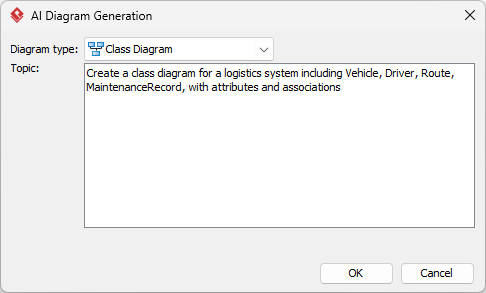
- Generate the initial diagram; Visual Paradigm’s AI processes the prompt to produce a structured model instantly.
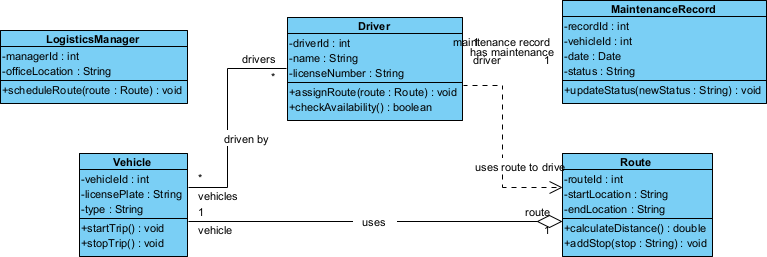
- Review the output for scale—ensure it handles hundreds of entities without performance lag, ideal for large fleets.
- Export or integrate the diagram into enterprise repositories for version control and team access.
Strategic Refinement & Integration
Enterprise Tweaks
Post-generation, enterprises can apply tweaks like adding custom attributes to the Vehicle class for GPS specifics or adjusting multiplicities in associations. Visual Paradigm’s intuitive editor allows drag-and-drop refinements, ensuring the diagram aligns with proprietary standards without disrupting the AI foundation.
Full Enterprise Modeling
Beyond initial creation, full enterprise modeling in Visual Paradigm emphasizes robust version control through its built-in repository system, tracking changes across diagram iterations to maintain audit trails. This is crucial for logistics firms where entity models evolve with regulatory updates.
Traceability matrices come into play, linking class diagram elements to requirements documents or use cases. For instance, associating the MaintenanceRecord class with safety compliance specs ensures every attribute is verifiable, supporting SOX or ISO audits.
Reporting features generate executive summaries, highlighting key relationships like the aggregation between Fleet and Vehicle entities. These reports can be automated, providing dashboards that visualize model completeness and potential gaps.
Integration extends to other tools; export diagrams to formats compatible with enterprise architectures like ArchiMate, or link them to code generation for seamless development cycles. In a fleet context, this means syncing the class diagram with database schemas, ensuring data consistency across tracking systems.
Collaboration is amplified via cloud syncing, where global teams annotate diagrams together, resolving inconsistencies swiftly. Security protocols protect sensitive models, with role-based access controlling edits.
Ultimately, this comprehensive approach transforms a simple AI-generated diagram into a strategic asset, fostering innovation while upholding enterprise governance. For LogiFleet, it meant integrating the model with IoT sensors for real-time vehicle status, scaling operations without added complexity.
Enterprise Results
- Reduced tracking errors by 35%, streamlining assignments and cutting delays.
- Shortened maintenance scheduling cycles from days to hours, boosting vehicle uptime.
- Achieved full compliance in audits, with traceable models saving 20% in review time.
- Enhanced cross-team efficiency, reducing model update conflicts by 50%.
- Enabled scalable growth, supporting fleet expansion without data silos.
These outcomes positioned LogiFleet as a resilient leader, with AI-driven modeling delivering measurable ROI through operational precision and strategic foresight.
Strategic Next Steps
For enterprise leaders ready to harness AI for class diagram strategies, explore Visual Paradigm Desktop‘s trial. Assess how it fits your scalability needs, and consult with experts to tailor implementations for your domain’s unique challenges.