
In the modern business landscape, the static document often becomes obsolete before it is finalized. Traditional strategic planning models frequently rely on assumptions that hold true only for a specific window of time. When market conditions accelerate, a SWOT analysis performed six months ago may no longer reflect the reality on the ground. This guide explores the necessity of evolving your strategic assessment into a living system.
A dynamic SWOT approach ensures that your internal capabilities and external threats are constantly evaluated against current data. It moves away from annual review cycles and embraces continuous adaptation. This shift is not merely administrative; it is a survival mechanism in volatile industries.
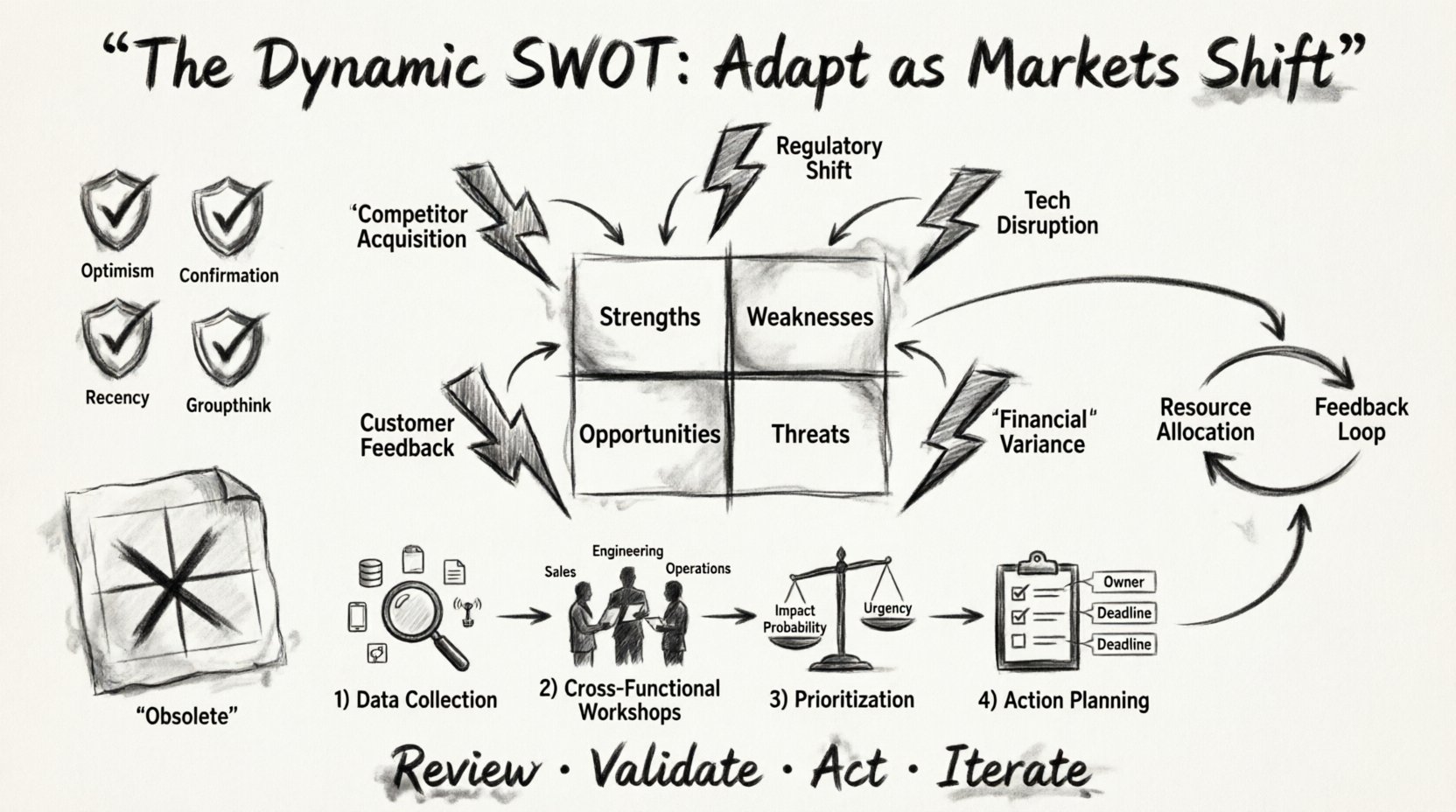
📉 Why Static SWOT Models Fail in Volatile Markets
Many organizations treat the SWOT analysis as a box-checking exercise. They conduct it once a year, present it to stakeholders, and file it away. While this provides a snapshot, it lacks the temporal depth required for agile decision-making. Several factors contribute to the rapid decay of value in static assessments:
- Speed of Change: Technological advancements and competitor moves happen faster than annual planning cycles.
- Information Lag: By the time data is collected and synthesized, market trends may have shifted.
- Confirmation Bias: Teams often update lists to match pre-existing beliefs rather than objective reality.
- Resource Misallocation: Strategies built on outdated strengths can lead to investment in declining areas.
When a market shifts rapidly, the gap between perception and reality widens. A dynamic approach bridges this gap by instituting regular review intervals. This ensures that the strategic foundation remains solid even as the building blocks around it change.
🏗️ Re-evaluating the Four Pillars
To maintain relevance, each component of the SWOT matrix must be scrutinized with fresh eyes. The definitions remain the same, but the criteria for inclusion must be flexible.
1. Strengths (Internal)
Strengths are not just permanent assets; they are current advantages. A resource that was a strength last year might be a liability today due to obsolescence. Ask the following questions during a review:
- Is this capability still superior to the competition?
- Has the cost structure changed, making this advantage less viable?
- Are our key personnel retaining the necessary skills for the current environment?
For instance, a proprietary technology might have been a major strength. However, if open-source alternatives emerge, that strength diminishes rapidly. Continuous monitoring prevents over-reliance on fading assets.
2. Weaknesses (Internal)
Weaknesses are internal limitations that hinder performance. Identifying these requires honesty and often external feedback. In a dynamic context, weaknesses can emerge overnight.
- Process Bottlenecks: Operational inefficiencies become critical when demand spikes.
- Talent Gaps: New market requirements may reveal missing skill sets.
- Financial Health: Liquidity ratios may shift due to changing credit conditions.
Recognizing a weakness early allows for mitigation before it impacts the bottom line. Regular audits of internal processes help surface these issues before they become crises.
3. Opportunities (External)
Opportunities exist outside the organization. They are favorable trends that can be exploited. In a fast-moving market, opportunities appear and disappear quickly.
- Emerging Segments: New customer demographics may form due to cultural shifts.
- Regulatory Changes: New laws can open markets previously restricted.
- Partner Availability: New alliances can provide access to distribution channels.
Tracking these requires active listening. It involves scanning news feeds, industry reports, and competitor announcements. Ignoring these signals can lead to missed revenue streams while competitors capture the market.
4. Threats (External)
Threats are external challenges that could cause trouble. These are often the most volatile part of the matrix.
- Competitor Actions: Price wars or new product launches.
- Economic Downturns: Inflation or recession affecting purchasing power.
- Supply Chain Disruptions: Geopolitical events affecting logistics.
A dynamic threat assessment involves scenario planning. It prepares the organization for multiple outcomes rather than a single predicted future.
⚠️ Triggers for Re-evaluation
Setting a schedule is one thing, but reacting to events is another. Certain triggers should prompt an immediate review of the SWOT analysis regardless of the calendar cycle.
| Trigger Event | Impact Area | Action Required |
|---|---|---|
| Major Competitor Acquisition | Market Share | Reassess competitive strengths |
| Regulatory Policy Shift | Compliance | Update threat and opportunity lists |
| Tech Disruption (e.g., AI) | Operations | Evaluate internal capability gaps |
| Quarterly Financial Variance | Financial Health | Review resource allocation |
| Customer Feedback Spike | Product Fit | Adjust value proposition |
These triggers serve as warning lights. When one illuminates, it signals that the previous analysis is no longer sufficient. The team must pause and integrate new information before proceeding with strategic execution.
🔍 The Process of Continuous Integration
Implementing a dynamic SWOT requires a structured process. It is not enough to simply decide to update; the method of update must be consistent and rigorous.
Step 1: Data Collection
Gather data from diverse sources to avoid siloed thinking. This includes:
- Customer surveys and Net Promoter Scores.
- Competitor pricing and feature releases.
- Internal operational metrics and KPIs.
- Industry news and macroeconomic indicators.
Diverse data sources ensure a holistic view. Relying on a single report often leads to incomplete conclusions.
Step 2: Cross-Functional Workshops
Strategy should not be confined to the executive suite. Bring in representatives from sales, operations, and engineering. Different departments see different signals.
- Sales: Knows why customers are leaving or staying.
- Engineering: Knows technical debt and innovation capacity.
- Operations: Knows supply chain fragility.
Collaborative workshops reduce blind spots. They also foster buy-in for the resulting strategic changes.
Step 3: Prioritization and Validation
Once new points are added, they must be validated. Not every new piece of information is a critical factor. Use a scoring system to prioritize.
- Impact: How much does this affect the business?
- Probability: How likely is this to happen or persist?
- Urgency: Does it require immediate attention?
This step filters out noise. It ensures that the team focuses on the factors that truly move the needle.
Step 4: Action Planning
A SWOT analysis is useless without action. Every point should have an associated strategy.
- Strengths: How can we leverage this for growth?
- Weaknesses: What is the plan to fix or mitigate this?
- Opportunities: How do we capture this value?
- Threats: How do we defend against this risk?
Assign owners and deadlines to each action item. This transforms the analysis from a document into a task list.
🧠 Mitigating Human Bias
Even with a structured process, human bias can skew the results. It is vital to acknowledge these tendencies and build checks into the workflow.
- Optimism Bias: Overestimating strengths and opportunities. Counter this by asking for evidence.
- Confirmation Bias: Seeking data that supports existing strategies. Counter this by inviting dissenting opinions.
- Recency Bias: Focusing only on the most recent events. Counter this by looking at long-term trends.
- Groupthink: Aligning with the majority view. Counter this by using anonymous input methods.
Creating a culture of psychological safety allows team members to challenge assumptions without fear. This honesty is the bedrock of an accurate dynamic analysis.
📊 Integrating with Agile Strategy
The dynamic SWOT fits naturally into agile methodologies. Instead of a rigid annual plan, strategy becomes iterative. The SWOT acts as the compass, while the agile sprints are the steps.
When using agile frameworks, update the SWOT at the end of every quarter or major milestone. This aligns strategic thinking with execution cycles. It ensures that the team is always working toward the most current objectives.
Integration also means connecting the analysis to resource management. If a threat emerges, resources should be shifted to defense. If an opportunity arises, resources should be allocated to offense. This fluidity is the key advantage of the dynamic approach.
🛑 Common Pitfalls to Avoid
While the dynamic approach is superior, it introduces new risks if not managed well. Be aware of these common traps.
- Analysis Paralysis: Updating too frequently without making decisions. Set a threshold for when a change is significant enough to warrant a pivot.
- Shallow Updates: Changing the list without changing the strategy. The document must drive action, not just exist.
- Lack of Documentation: Failing to record changes over time. Tracking the evolution of the analysis helps identify patterns in decision-making.
- Overlooking the Micro: Focusing only on macro trends. Small operational changes can accumulate into significant strategic shifts.
Balance is key. You need enough updates to stay relevant, but not so many that the strategy loses coherence.
🚀 Moving Forward
The business environment is defined by change. Organizations that cling to outdated models risk irrelevance. Adopting a dynamic SWOT analysis is a commitment to truth and adaptability. It requires discipline, regular attention, and a willingness to challenge assumptions.
By treating your strategic assessment as a living entity, you position the organization to navigate uncertainty with confidence. The goal is not to predict the future perfectly, but to be prepared for whatever comes. Continuous improvement in your strategic planning process is the most reliable path to long-term success.
Start by scheduling your next review. Gather your team. Look at the data. And be ready to update the map as the territory changes.