
Hypergrowth is not merely about rapid expansion; it is about maintaining structural integrity while accelerating. Many startups fail not because they lack innovation, but because their underlying business model cannot sustain the pressure of scaling. To navigate this complex landscape, founders and executives must utilize robust frameworks that align operational capacity with market demand. The Business Model Canvas (BMC) provides a strategic management template for developing new or documenting existing business models. When applied with a focus on scalability, this tool transforms from a static diagram into a dynamic engine for growth.
This guide explores how to engineer business models capable of withstanding the demands of hypergrowth. We will dissect the nine building blocks of the BMC through the lens of scalability, examining revenue streams, cost structures, and value propositions that support exponential expansion. The goal is to build systems that grow efficiently, ensuring that growth does not outpace the organization’s ability to deliver value.
🔍 Understanding the Foundation: The Business Model Canvas
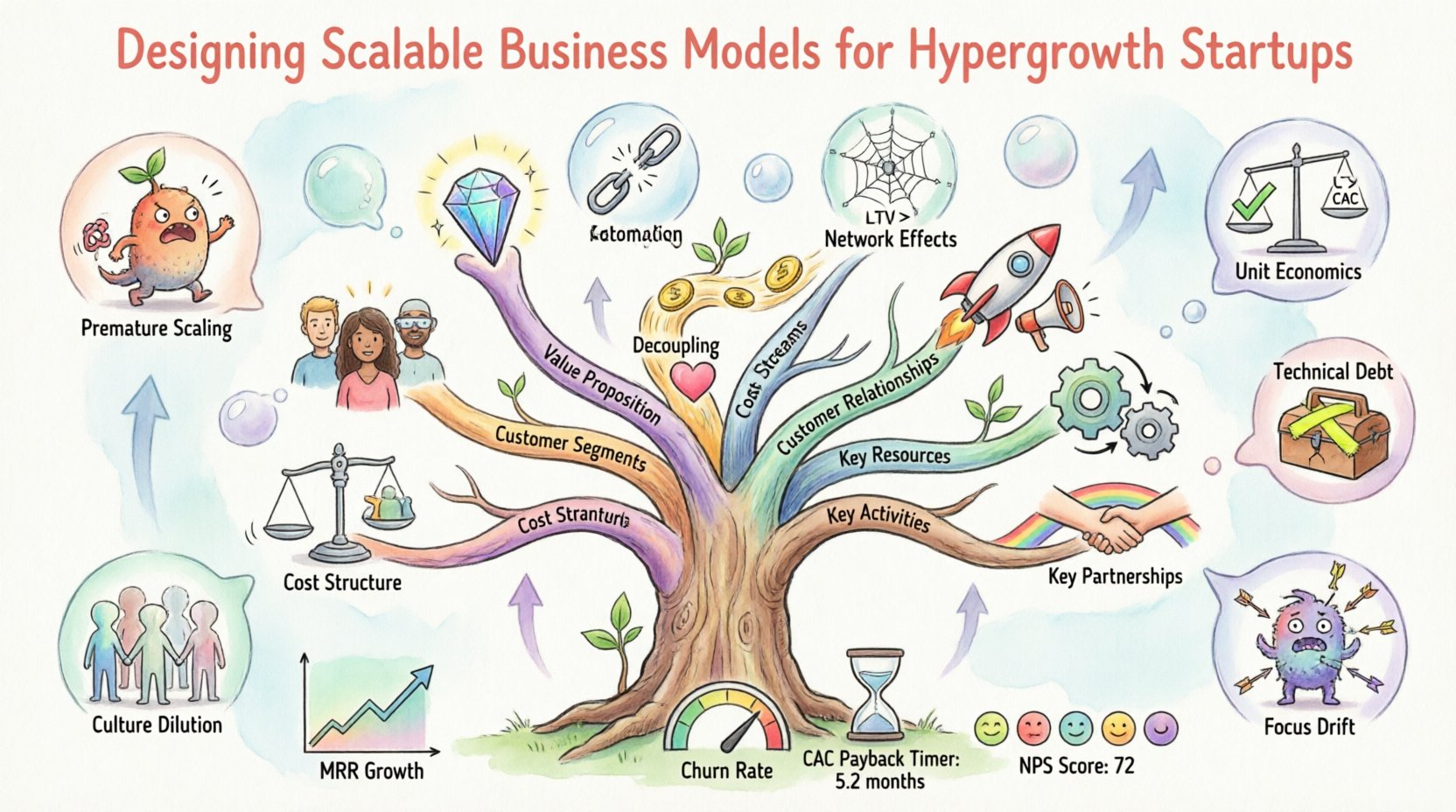
The Business Model Canvas is a visual chart with elements describing a firm’s or product’s value proposition, infrastructure, customers, and finances. For hypergrowth startups, the standard application of the BMC requires modification. Standard models often focus on stability or niche markets. Hypergrowth models prioritize elasticity, automation, and network effects. Every element on the canvas must be interrogated for scalability potential.
When constructing a scalable model, consider the following dimensions:
- Automation: Can processes be automated as volume increases?
- Decoupling: Can revenue generation be decoupled from time spent by staff?
- Network Effects: Does the value increase as more users join?
- Unit Economics: Are the costs of acquiring a customer lower than the lifetime value?
Failure to address these dimensions early often leads to operational bottlenecks. A model that works for 100 customers may collapse under 10,000 if the underlying mechanics rely on manual intervention or fixed costs that do not scale linearly.
🚀 Value Proposition: Solving at Scale
The value proposition is the core reason customers choose one product over another. In a hypergrowth context, the value proposition must be universally applicable and easily communicated. If the value relies on heavy customization for every client, scaling becomes a logistical nightmare.
Scalable value propositions typically share these characteristics:
- Standardization: The core solution solves a common problem for a large segment.
- Digital Delivery: Products are delivered via software or digital platforms, minimizing marginal costs.
- Network Utility: The product becomes more useful as more people use it.
- Clear ROI: The return on investment is measurable and compelling for new users.
Consider the difference between a consulting firm and a SaaS platform. Consulting trades time for money; scaling requires hiring more people, which increases complexity and management overhead. A SaaS platform sells a standardized solution; serving one customer costs nearly the same as serving ten thousand. This distinction is critical when designing for hypergrowth.
👥 Customer Segments: Defining the Market
Identifying the right customer segment is vital. Hypergrowth often comes from targeting a large, addressable market rather than a niche with high retention but low volume. However, breadth must be balanced with relevance.
| Segment Type | Scalability Potential | Key Challenge |
|---|---|---|
| Mass Market | High | Acquisition costs can be high |
| Niche Market | Medium | Limited ceiling for growth |
| B2B Enterprise | Medium-High | Long sales cycles |
| B2C Consumer | High | High churn risk |
For rapid scaling, organizations often target segments where the pain point is acute and the willingness to pay is immediate. The goal is to find a wedge market that allows for rapid adoption, which can then expand into adjacent segments. Segmentation should not be static. As the company grows, the definition of the customer may shift from early adopters to the mainstream majority.
💰 Revenue Streams: Economics of Growth
Revenue models dictate how value is captured. For hypergrowth, the focus is on recurring revenue and high-margin transactions. One-time sales require constant reinvestment in acquisition, whereas recurring revenue builds a predictable cash flow that supports expansion.
Effective revenue models for scaling include:
- Subscription: Recurring payments provide stability and predictability. This allows for better planning of capital allocation.
- Freemium: Offering a basic version for free captures a large user base, converting a percentage to paid tiers. This reduces friction in acquisition.
- Usage-Based: Charging based on consumption aligns cost with value. As customers grow, revenue grows without extra marketing spend.
- Marketplace Fees: Taking a cut of transactions allows the platform to scale without holding inventory.
Unit economics must be positive. If the Cost of Acquisition (CAC) exceeds the Lifetime Value (LTV), growth accelerates the path to insolvency. The ratio of LTV to CAC should ideally be 3:1 or higher. This ensures that every dollar spent on growth generates three dollars in return over time.
💸 Cost Structure: Managing Fixed vs. Variable Costs
Scalability is heavily influenced by the cost structure. A model with high fixed costs is risky during the early stages but can become efficient at high volumes. A model with high variable costs is safer initially but may limit margins as volume increases.
To design for scalability, aim for:
- Low Marginal Costs: The cost to serve one additional customer should be near zero.
- Lean Infrastructure: Utilize cloud infrastructure that scales automatically with demand.
- Outsourcing Non-Core Functions: Focus internal resources on product development and strategy, while outsourcing logistics or support initially.
- Automation: Invest in tools that reduce manual labor as transaction volume rises.
Monitoring burn rate is essential. Hypergrowth requires significant capital. The cost structure must support the cash runway needed to reach profitability milestones. Controlling fixed costs ensures that the organization remains agile even if growth slows temporarily.
📢 Channels: Reaching the Audience
Channels are how a company communicates with and reaches customer segments. For scalable growth, channels must be reproducible and cost-effective.
Key channel strategies include:
- Digital Marketing: SEO, content marketing, and paid ads allow for precise targeting and rapid testing of messages.
- Product-Led Growth: The product itself drives adoption through virality and ease of use.
- Partnerships: Leveraging existing networks can provide instant access to a large audience without building it from scratch.
- Community Building: Creating a community fosters organic growth through word-of-mouth and advocacy.
Direct sales channels are often harder to scale than self-service digital channels. As the customer base grows, the ratio of sales staff to customers must remain manageable. If the model relies on a large sales force, the organization faces management complexity and high variable costs. Self-service models allow the sales infrastructure to scale without proportional headcount increases.
🤝 Customer Relationships: Retention and Engagement
Acquiring a customer is only half the battle; keeping them is where profitability lies. In hypergrowth, retention metrics are often more important than acquisition metrics. Churn can negate the effects of aggressive marketing.
Relationship strategies for scale include:
- Automated Onboarding: Ensure users understand value immediately through guided tours and emails.
- Self-Service Support: Knowledge bases and chatbots handle common queries without human intervention.
- Proactive Engagement: Use data to identify at-risk users and intervene before they churn.
- Community Support: Allow users to help each other, reducing the burden on official support teams.
Building a relationship does not always mean personal interaction. For software products, the relationship is often defined by the reliability and speed of the service. Consistency builds trust, which drives retention and referrals.
🛠️ Key Resources and Activities
Resources are the assets required to make the business model work. Activities are the most important things a company must do to make its model work. For hypergrowth, these must be aligned with speed and efficiency.
Key Resources:
- Intellectual Property: Patents, proprietary algorithms, or brand equity.
- Human Capital: Skilled talent that can execute complex tasks quickly.
- Financial Capital: Cash reserves to fund growth until positive cash flow is achieved.
- Technological Infrastructure: Servers, software, and data pipelines.
Key Activities:
- Product Development: Continuous iteration to stay ahead of competitors.
- Platform Management: Ensuring uptime and security.
- Marketing: Driving awareness and acquisition.
- Regulatory Compliance: Managing legal requirements in new markets.
Outsourcing can be a strategic move here. If an activity is not a core competency, it should be handled by partners. This allows the core team to focus on the unique value drivers of the business.
🔗 Key Partnerships
Networks of suppliers and partners can optimize business models. In hypergrowth, partnerships can accelerate market entry and reduce risk.
Types of partnerships include:
- Strategic Alliances: Non-competitors working together to create new offerings.
- Joint Ventures: Co-creating new businesses to share risk and reward.
- Buyer-Supplier Relationships: Ensuring supply chain stability and cost efficiency.
Strategic partnerships can provide access to new customer segments without the cost of building a sales force from scratch. For example, integrating with a larger platform can expose the startup to that platform’s user base instantly.
📊 Metrics and KPIs for Hypergrowth
Success in hypergrowth is measured differently than in traditional businesses. Vanity metrics like total downloads are less important than engagement and retention metrics. The following KPIs are critical for monitoring scalability:
| Metric | Definition | Why It Matters |
|---|---|---|
| Monthly Recurring Revenue (MRR) | Revenue expected every month | Measures predictable income |
| Churn Rate | Percentage of customers leaving | Indicates product-market fit |
| CAC Payback Period | Time to recover acquisition cost | Assesses cash flow efficiency |
| NPS (Net Promoter Score) | Customer loyalty metric | Predicts organic growth |
Monitoring these metrics weekly or daily allows leaders to pivot quickly. If CAC spikes, the marketing channel needs adjustment. If churn rises, the product experience needs improvement. Data-driven decision-making is the backbone of scalable growth.
⚠️ Common Pitfalls in Scaling
Even with a solid model, execution risks remain. Common pitfalls that derail hypergrowth include:
- Premature Scaling: Expanding before product-market fit is confirmed leads to wasted capital.
- Culture Dilution: Rapid hiring can erode company values and efficiency.
- Technical Debt: Cutting corners on infrastructure to speed up delivery causes crashes later.
- Focus Drift: Trying to serve too many segments at once dilutes the value proposition.
Discipline is required to resist the urge to expand into unrelated areas. Staying focused on the core value proposition ensures that growth is sustainable. Regular reviews of the business model canvas help identify when the model no longer matches the reality of the market.
🔄 Iteration and Adaptation
A business model is not a one-time creation. It is a living document that evolves with the market. As the startup grows, the canvas should be revisited regularly. New customer segments may emerge, or cost structures may shift due to inflation or supply chain changes.
Agility is a competitive advantage. Startups that can pivot their model faster than competitors can capture market share. This requires a culture that values experimentation and learning from failure. Testing hypotheses about revenue or channels before full implementation reduces risk.
Continuous improvement of the business model ensures long-term viability. By focusing on unit economics, automation, and customer retention, organizations can build a foundation that supports not just growth, but profitable, sustainable expansion.