
In the modern business landscape, attempting to serve everyone often results in serving no one effectively. As markets fragment and consumer expectations rise, the strategy shifts from broad appeal to targeted precision. This guide explores the mechanics of defining a Unique Value Proposition (UVP) specifically tailored for highly niche markets within the framework of the Business Model Canvas. Understanding this distinction is critical for sustainable growth and customer retention.
A generic UVP relies on volume and broad features. A niche UVP relies on depth and specific problem-solving. The following sections detail how to construct this asset without relying on generic marketing fluff or unverified assumptions.
Understanding the Niche Mindset 🧠
Before constructing a value proposition, one must understand the psychology of the niche buyer. These customers are not looking for a “good enough” solution; they are looking for a “perfect fit” solution. They often possess specific knowledge about their own industry or lifestyle needs.
- Specificity is Currency: In a niche market, general claims are viewed with skepticism. Specific claims build trust.
- High Switching Costs: Niche customers often have entrenched workflows. Your value proposition must outweigh the effort of changing systems.
- Community Validation: Decisions are frequently influenced by peer groups rather than broad advertising.
When defining your UVP, you must move beyond the surface level. You are not just selling a product; you are selling an understanding of a specific situation. This requires a granular approach to customer discovery.
The Business Model Canvas Connection 📊
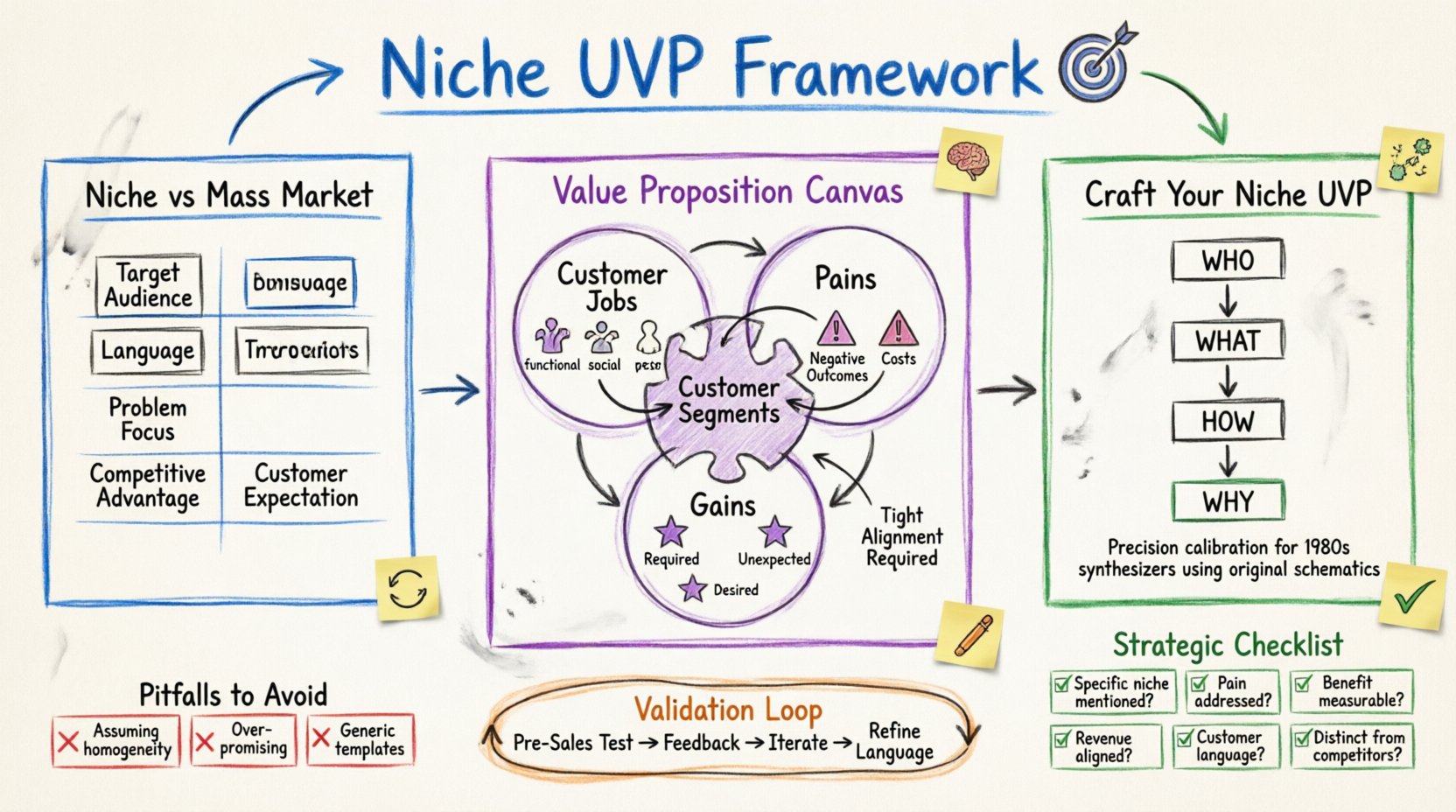
The Business Model Canvas (BMC) provides a structured way to visualize the value you deliver. The central block, “Value Propositions,” connects directly to the “Customer Segments” block. For a niche market, this connection must be tight.
In a mass market canvas, the Value Propositions block often lists broad benefits. In a niche canvas, it lists specific outcomes. The following table illustrates the difference in focus between the two approaches.
| Feature | Mass Market UVP | Niche Market UVP |
|---|---|---|
| Target Audience | Everyone with a general need | Specific group with a distinct profile |
| Language | Generic, accessible terms | Industry-specific jargon and context |
| Problem Focus | Common, widespread pain points | Complex, specific, or emerging pain points |
| Competitive Advantage | Price or Brand Recognition | Specialized Functionality or Expertise |
| Customer Expectation | Reliability and Convenience | Precision and Customization |
Aligning your BMC requires you to map your specific pain relievers and gain creators directly to the jobs your niche customers are trying to get done. If the alignment is loose, the business model will struggle to gain traction.
Deconstructing the Value Proposition Canvas 🧩
To define a UVP for a niche, we utilize the Value Proposition Canvas, a detailed tool that sits inside the BMC. It breaks down the customer profile into three distinct areas.
1. Customer Jobs
What are the tasks, problems, or needs that your niche customer is addressing? In a niche context, these are often functional, social, or emotional jobs.
- Functional Jobs: What specific work must be completed? (e.g., “Repair vintage audio equipment without damaging original components.”)
- Social Jobs: How does the customer want to be perceived? (e.g., “Be seen as a preservationist of classic tech.”)
- Personal Jobs: What personal needs must be met? (e.g., “Feel confident in a technical repair task.”)
Identifying these requires direct engagement with the target group. Surveys often fail here because niche customers know their own jobs better than a generalist researcher does. Interviews are superior.
2. Pains
Pains are negative outcomes, risks, or obstacles before, during, or after trying to get a job done. For a niche market, these pains are often highly specific.
- Obstacles: What prevents them from succeeding? (e.g., “Lack of specialized tools.”)
- Negative Outcomes: What happens if they fail? (e.g., “Irreversible damage to rare equipment.”)
- Unwanted Costs: What is the financial or time cost of failure? (e.g., “Hiring a generalist costs more due to trial and error.”)
3. Gains
Gains are the benefits or outcomes customers expect or would be surprised to receive. In a niche market, gains are often about exclusivity or mastery.
- Required Gains: What must happen for the job to be considered done? (e.g., “Equipment must function at original specifications.”)
- Desired Gains: What would be nice to have? (e.g., “Documentation of the repair process.”)
- Unexpected Gains: What would delight them? (e.g., “Access to a community of other restorers.”)
Crafting the Statement 📝
Once the research is complete, the actual statement must be written. It should not be vague. It must speak directly to the specific jobs, pains, and gains identified above.
Key Elements of a Niche UVP
- The Who: Explicitly state the target segment. Do not hide this.
- The What: State the specific product or service.
- The How: Explain the mechanism of value. Is it faster? More accurate? More durable?
- The Why: Explain the specific benefit relative to their pain.
Avoid using broad adjectives like “best” or “premium” without context. Instead, use comparative language that highlights your specific advantage. For example, rather than saying “We offer high-quality service,” say “We offer precision calibration for 1980s synthesizers using original schematics.”
Validation and Iteration 🔁
A UVP is not a static document. It is a hypothesis that requires testing. In niche markets, validation happens through early adoption and feedback loops.
- Pre-Sales Testing: Attempt to sell the value proposition before the product is fully built. If they do not understand the value, the statement is unclear.
- Feedback Loops: Ask customers specifically about the value they received. Did it solve the specific pain point?
- Iteration: Refine the language based on customer terminology. If they call it “X” and you call it “Y”, switch to “X”.
Do not fall in love with the product; fall in love with the problem. The UVP is the bridge between the problem and the solution. If the bridge is weak, traffic will not cross.
Common Pitfalls to Avoid ⚠️
Even with a solid strategy, errors can occur. These mistakes often stem from a lack of depth in the niche understanding.
- Assuming Homogeneity: Just because a market is niche does not mean everyone is the same. Segment further within the niche if necessary.
- Over-Promise: Niche customers are experts. They will spot exaggeration immediately. Be honest about limitations.
- Neglecting the Cost Structure: Serving a niche often costs more per unit. Ensure the value proposition justifies the price point required to sustain the business model.
- Using Generic Templates: Do not copy UVPs from mass-market companies. The language will not resonate.
Long-term Alignment 🔄
Finally, consider the longevity of the value proposition. Niche markets can be small, but they can be profitable. However, they can also be transient.
- Market Evolution: As the niche grows, the UVP may need to shift from “specialized” to “scalable specialized.”
- Technology Changes: New tools may render the specific value less relevant. Continuous innovation is required.
- Competitor Entry: If the niche is profitable, others will enter. Your UVP must evolve to maintain the advantage.
Strategic Checklist ✅
Before finalizing your Unique Value Proposition, run through this checklist to ensure alignment with the Business Model Canvas.
| Check | Criteria |
|---|---|
| 1 | Does the statement mention the specific niche? |
| 2 | Is the primary pain point explicitly addressed? |
| 3 | Is the benefit measurable or observable? |
| 4 | Does it align with the revenue stream model? |
| 5 | Is the language consistent with customer terminology? |
| 6 | Is it distinct from general competitors? |
This systematic approach ensures that the value proposition is not just a marketing slogan, but a core component of the business strategy. It anchors the other blocks of the canvas, including Key Resources, Key Activities, and Customer Relationships.
Deep Dive: Functional vs. Emotional Value 🧠
In niche markets, the value often shifts from purely functional to emotional or social. While a mass market buyer wants a car that runs, a niche collector wants a car that represents a specific era.
Functional Value: This is the baseline. The product must work. If it does not, the value proposition is void. However, in a niche, this is the table stakes. It is not a differentiator.
Emotional Value: This relates to how the product makes the customer feel. In a niche, this is often about identity. “I am the kind of person who owns this.” “I am the kind of expert who knows how to use this.”
Social Value: This relates to status within the community. Does owning this product grant access to a group? Does it allow the user to contribute to a shared knowledge base?
When crafting your UVP, ensure you are addressing at least one of these emotional or social layers. Functional benefits are easily copied. Identity benefits are harder to replicate.
Integration with Key Resources 🔗
Your Unique Value Proposition is only as strong as the resources backing it. If your UVP promises “24/7 specialized support,” you must have the Key Resources to deliver that.
- Human Capital: Do you have staff with the specific skills required by the niche?
- Intellectual Property: Do you own the patents or processes that make the solution unique?
- Partnerships: Do you rely on suppliers that are rare or exclusive?
If the UVP claims exclusivity, the resource map must reflect exclusivity. A mismatch here leads to customer churn. The BMC forces you to confront whether you actually possess the assets to deliver the promise.
Conclusion on Precision 🔍
Defining a Unique Value Proposition for a highly niche market requires a departure from traditional mass-market logic. It demands a deeper understanding of the customer’s specific reality. It requires precision in language, alignment with the Business Model Canvas, and a commitment to validation. By focusing on specific jobs, pains, and gains, you build a foundation that is difficult for generalists to copy. This precision is the path to sustainable profitability in specialized segments.
The work does not end with the draft. It continues through the lifecycle of the business. Regular review of the UVP against market changes ensures the proposition remains relevant. This ongoing process is the hallmark of a mature business model.