In the modern economy, static strategies rarely survive long-term market shifts. Organizations require periodic reassessment of their fundamental logic for creating, delivering, and capturing value. This process is known as business model redesign. It is not merely tweaking pricing or launching a new product. It is a structural evolution. Consultants facilitate this evolution. They bring objectivity and method. This guide outlines how to approach these projects with precision.
Business model redesign often begins when legacy systems create friction. Revenue streams stagnate while costs rise. Customer expectations shift faster than internal capabilities. In these moments, a structured approach prevents chaos. The Business Model Canvas serves as the primary framework. However, the canvas is a tool, not a strategy. The consulting methodology determines the outcome.
Understanding the Engagement Context 🧩
Before any workshop begins, the scope must be defined. Redesign projects vary significantly based on organizational maturity. A startup needs a model from scratch. A mature corporation needs optimization of existing structures. The consultant must identify the root cause of the need for change.
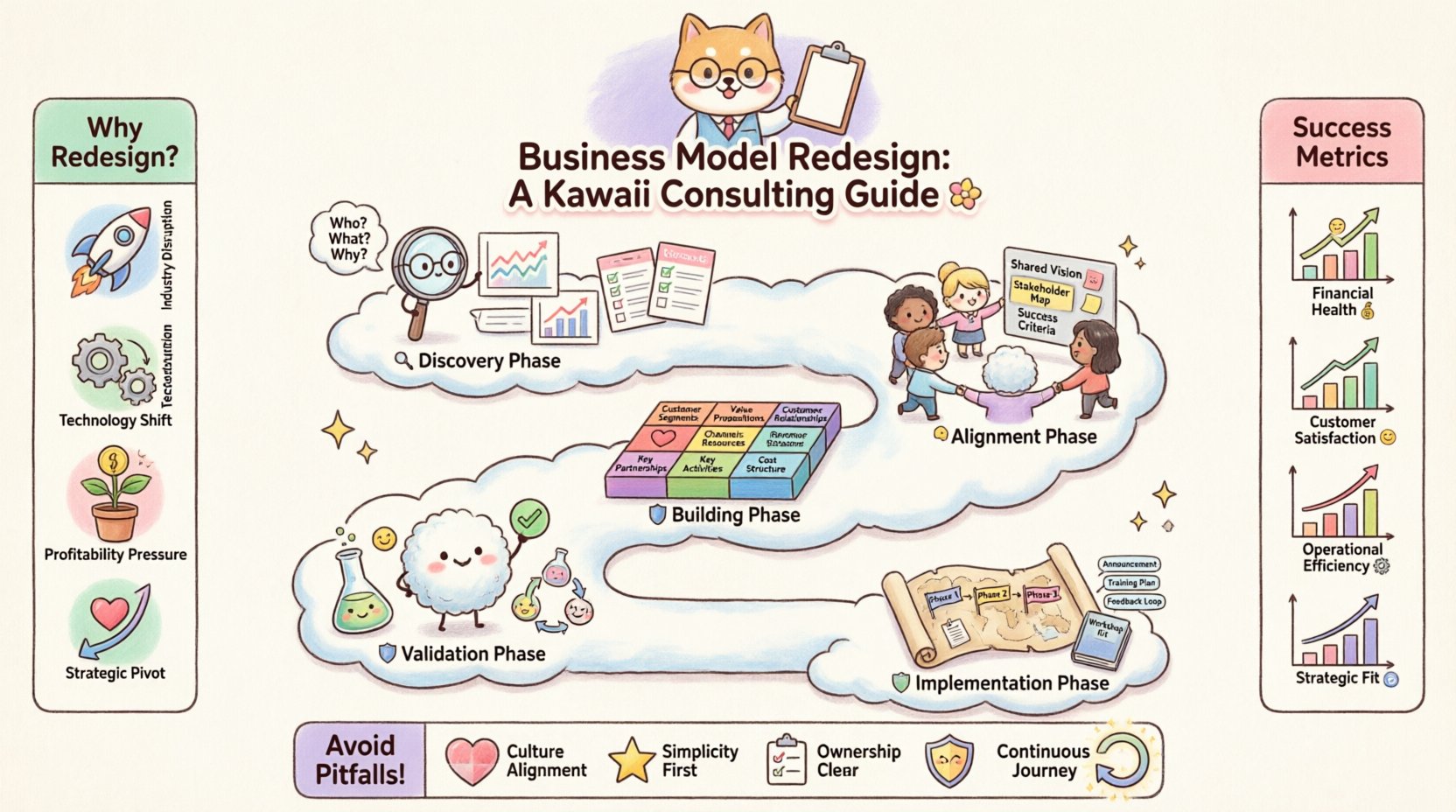
Why Redesign Happens
- Market Disruption: New competitors enter the space with lower costs or better value propositions.
- Technological Shifts: Digitalization changes how customers interact with products.
- Financial Pressure: Margins are compressing, requiring efficiency or new revenue streams.
- Strategic Pivot: Leadership decides to exit a specific market or enter a new one.
The Consultant’s Role
The consultant acts as a neutral party. They facilitate dialogue between conflicting departments. Sales teams often want aggressive growth. Finance teams focus on risk reduction. The consultant bridges these gaps. They ensure the model remains coherent across all functions.
Phase 1: Discovery and Diagnostic 🕵️♂️
The first phase is about understanding the current state. You cannot redesign what you do not understand. Data collection is critical during this stage. Interviews, financial analysis, and customer feedback form the foundation.
Data Collection Methods
- Seminar Interviews: Conduct one-on-one sessions with key stakeholders to understand pain points.
- Customer Surveys: Quantify customer satisfaction and willingness to pay for new features.
- Financial Audits: Review unit economics to identify profitable and unprofitable segments.
- Process Mapping: Trace the value delivery process from order to fulfillment.
Current State Analysis
Map the existing business model onto the canvas. Identify gaps. Is the value proposition clear? Do the channels align with customer behavior? Are the cost structures sustainable? This analysis reveals where the friction lies. It highlights assumptions that may no longer hold true.
For example, a company might assume their primary value driver is product quality. Data may reveal that speed of delivery is the actual driver. This insight shifts the focus of the redesign. It moves the emphasis from manufacturing efficiency to logistics optimization.
Phase 2: Strategic Alignment and Facilitation 🤝
Once the diagnosis is complete, alignment is required. Stakeholders must agree on the direction. Misalignment at this stage leads to resistance later. The consultant facilitates workshops to build consensus.
Workshop Facilitation Techniques
- Visual Collaboration: Use large physical or digital whiteboards to make ideas visible.
- Round Robin Input: Ensure every voice is heard before voting on decisions.
- Assumption Surfacing: Explicitly state the beliefs driving current decisions.
- Conflict Resolution: Address disagreements about resource allocation immediately.
Building the Vision
The team must define the future state. What does success look like in three years? What risks are acceptable? This vision guides the canvas construction. It prevents the team from optimizing for the past while designing for the future.
It is common for teams to fall into the trap of “feature creep.” They add capabilities to the canvas without checking if customers value them. The facilitator must enforce discipline. Every block must serve the strategic vision.
Phase 3: Building the New Model 🧱
This is the core design phase. The team populates the nine building blocks of the Business Model Canvas. This requires creativity balanced with rigor. Each block influences the others.
The Nine Blocks Explained
| Block | Consulting Focus |
|---|---|
| Customer Segments | Define who creates value. Are we targeting mass market or niche? |
| Value Propositions | What bundle of products solves customer problems? |
| Channels | How do we reach customers? Physical or digital? |
| Customer Relationships | Personal assistance or self-service? Retention or acquisition? |
| Revenue Streams | Subscription, transaction, licensing? What is the pricing model? |
| Key Resources | Physical, intellectual, human, or financial assets required? |
| Key Activities | Production, problem-solving, or platform management? |
| Key Partnerships | Suppliers, alliances, or joint ventures to optimize? |
| Cost Structure | Fixed vs variable costs. Cost-driven or value-driven? |
Interconnectivity
Changing one block affects others. If you change the Revenue Stream from transaction to subscription, the Key Activities must shift from one-off sales to ongoing support. The Cost Structure will change from variable sales commissions to fixed customer success salaries. The consultant ensures these links are logical.
Use the following checklist to verify coherence:
- Do the Channels match the Customer Relationships?
- Do the Key Resources support the Value Proposition?
- Are the Revenue Streams sufficient to cover the Cost Structure?
Phase 4: Validation and Stress Testing 🛡️
A model on paper is a hypothesis. It must be tested against reality. Validation reduces the risk of failure during implementation. This phase involves small-scale experiments.
Testing Assumptions
Identify the riskiest assumptions. Is there demand for the new value proposition? Can the supply chain support the new volume? Run pilots. Test landing pages. Conduct pre-sales.
Feedback Loops
Create mechanisms to gather feedback quickly. If the pilot fails, the model must be adjusted. Do not attach ego to the design. The goal is a viable model, not a perfect design. Iterate based on data.
Phase 5: Implementation Planning 🗺️
Once the model is validated, the transition begins. This is often the hardest part. Change management is required. Employees must understand their new roles.
Transition Roadmap
- Phased Rollout: Launch in one region or segment first.
- Training Programs: Equip staff with skills for the new model.
- Communication Plan: Explain the “why” to all stakeholders.
- Resource Reallocation: Move budget and talent to new priorities.
Monitoring Progress
Define Key Performance Indicators (KPIs) for the new model. Track revenue growth, customer acquisition costs, and retention rates. Regular reviews ensure the model stays on track. Adjustments may be needed as external conditions change.
Common Pitfalls to Avoid ⚠️
Even experienced consultants encounter obstacles. Awareness of common errors helps navigate them.
- Ignoring the Culture: A great model fails if the culture resists it. Address the human side of change.
- Over-Engineering: Keep the model simple. Complexity creates confusion.
- Skipping Validation: Never skip the testing phase. It is too risky to bet on unproven assumptions.
- Lack of Ownership: Ensure internal leaders own the model, not just the consultants.
Measuring Success 📊
How do you know the redesign worked? Financial metrics are obvious, but behavioral metrics matter too. Customer satisfaction scores should improve. Employee engagement should stabilize. Operational efficiency should increase.
| Metric Category | Example Metrics |
|---|---|
| Financial | Revenue Growth, Profit Margins, Cash Flow |
| Customer | Net Promoter Score, Churn Rate, Lifetime Value |
| Operational | Cycle Time, Cost per Unit, Utilization Rate |
| Strategic | Market Share, Innovation Rate, Brand Perception |
Final Considerations 🌟
Business model redesign is a continuous journey. Markets evolve. Technology advances. The model must remain adaptable. Consultants should train internal teams to conduct their own future reviews. This builds resilience.
The ultimate goal is sustainable value creation. It is not about a quick win. It is about building a foundation that supports long-term growth. By following these best practices, organizations can navigate complexity with confidence. The result is a robust engine for value generation.
Remember that the canvas is a living document. It requires maintenance. Regular reviews ensure it stays relevant. Stay engaged with the market. Listen to your customers. Adapt your model. This is the essence of modern consulting.