Transitioning into systems engineering offers a pathway to high-impact work where technology meets strategy. As systems grow more complex, the demand for professionals who can model, analyze, and integrate these structures increases. Systems Modeling Language (SysML) serves as the backbone for this discipline. It provides a standardized way to describe systems without relying solely on text-based documentation. This guide explores the landscape of systems engineering, the specific role of SysML, and the steps required to pivot your career successfully.
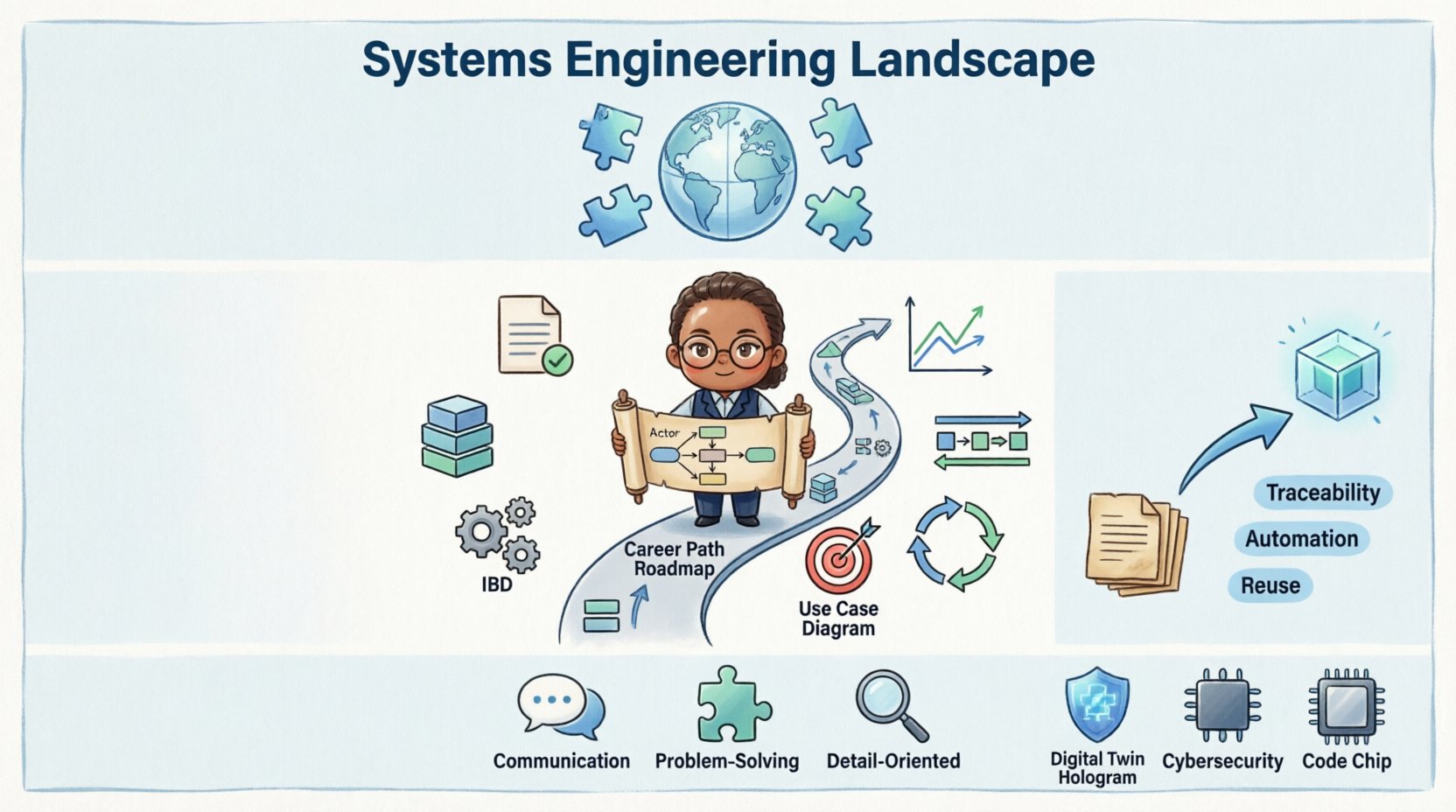
Understanding the Systems Engineering Landscape 🌍
Systems engineering is not just about coding or building hardware in isolation. It is the holistic approach to designing and managing complex systems over their life cycles. When you enter this field, you are looking at the interaction between software, hardware, processes, and people. The goal is to ensure that the final product meets the needs of the stakeholders while managing risk and cost.
Traditional engineering often relies on documents like requirements specifications, design documents, and test plans. While effective for simple projects, these documents can become difficult to maintain and verify as projects scale. This is where Model-Based Systems Engineering (MBSE) comes into play. MBSE uses formalized models to drive the design process. SysML is the most widely adopted language for creating these models.
Why SysML Matters for Your Career 📐
Learning SysML distinguishes you in a competitive job market. It signals that you understand the importance of abstraction and verification. Employers value professionals who can visualize system architecture before implementation begins. This reduces errors during the development phase and saves significant resources. Here is why this skill set holds weight:
- Standardization: SysML is an industry standard, recognized across aerospace, defense, automotive, and software industries.
- Clarity: Diagrams communicate complex relationships faster than text.
- Traceability: You can link requirements directly to design elements and verification tests.
- Integration: It facilitates collaboration between different engineering disciplines.
Core Concepts in SysML 🧩
To work effectively with SysML, you must understand the specific diagrams and constructs available. These visual tools allow you to describe different aspects of a system. You do not need to learn every single diagram for an entry-level role, but familiarity is essential.
1. Requirement Diagrams 📝
This diagram type focuses on the “what” of the system. It captures stakeholder needs and technical requirements. In a career context, this is often where you start. You define what the system must do, such as “The vehicle must stop within 100 meters.” These requirements are then traced to other parts of the model to ensure they are met.
2. Block Definition Diagrams (BDD) 🧱
Blocks represent the components of a system. A block can be a physical part, a software module, or a function. BDDs show the structure of the system and the relationships between these blocks. You will see associations, aggregations, and generalizations. This helps you understand how components fit together logically.
3. Internal Block Diagrams (IBD) ⚙️
While BDDs show high-level structure, IBDs look inside a block. They define the internal composition of a block. You specify ports and connectors. Ports are where the block interacts with the outside world. Connectors show how these ports are linked. This is critical for understanding data flow and interface definitions.
4. Parametric Diagrams 📊
These diagrams are used for quantitative analysis. They allow you to define equations and constraints. For example, you might model the relationship between fuel consumption and engine size. Parametric diagrams enable engineers to perform trade-off analyses and verify performance metrics before building a prototype.
5. Sequence Diagrams 🔄
Systems are dynamic. Sequence diagrams capture the behavior of the system over time. They show the order of messages exchanged between objects. This is useful for understanding workflows, user interactions, and control logic. It bridges the gap between static structure and dynamic operation.
6. State Machine Diagrams 🔁
Complex systems often have states. A traffic light system, for instance, has states like “Red,” “Green,” and “Yellow.” State machine diagrams define these states and the transitions that trigger them. They are essential for modeling control logic and ensuring the system responds correctly to events.
7. Use Case Diagrams 🎯
Use cases describe interactions between actors (users or external systems) and the system itself. They help define the functional boundaries of the system. This is often the starting point for understanding system scope.
Key Roles in Systems Engineering 💼
The field offers various titles depending on the organization and project phase. Understanding these roles helps you target your job search effectively. Below is a breakdown of common positions.
| Role Title | Primary Focus | Typical Responsibilities |
|---|---|---|
| Systems Engineer | Overall System Design | Define requirements, manage trade-offs, oversee integration. |
| Requirements Engineer | Requirement Capture | Gather stakeholder needs, maintain requirement baselines. |
| Model-Based Systems Engineer | MBSE Implementation | Create and maintain SysML models, ensure model quality. |
| Systems Architect | High-Level Structure | Define system architecture, select technologies, ensure scalability. |
| Integration Engineer | Component Assembly | Combine subsystems, verify interfaces, resolve conflicts. |
Building the Foundation for Transition 🧱
Switching careers requires a structured approach. You cannot simply jump into advanced modeling without understanding the underlying principles. Here is a roadmap to guide your preparation.
1. Strengthen Your Technical Base 🔧
Even if you come from a software background, systems engineering requires a broader perspective. You need to understand how hardware and software interact. If you are coming from hardware, you need to grasp software architecture concepts. Familiarity with logic, set theory, and basic mathematics is beneficial for understanding constraints and equations in parametric diagrams.
Consider these areas for self-study:
- System Lifecycle: Understand phases like conception, development, production, operations, and retirement.
- Verification & Validation: Learn the difference between checking if you built the product right (verification) and checking if you built the right product (validation).
- Interface Management: Study how different systems exchange data and energy.
2. Learn the Language Standards 📜
SysML is based on the Unified Modeling Language (UML). If you have experience with UML, you already have a head start. SysML is a profile of UML tailored for systems engineering. It adds specific diagram types and constructs while reusing others. Review the official SysML specification to understand the grammar and semantics. This ensures your models are valid and understandable by others.
3. Practice Modeling Concepts 📝
Theory is not enough. You must practice drawing models. Start with simple systems, like a coffee machine or a traffic light. Define the requirements, draw the blocks, and then create the sequences. This hands-on experience builds the intuition needed for complex real-world projects.
Focus on these exercises:
- Create a Block Definition Diagram for a library system.
- Map out the internal composition of a user account module.
- Define a sequence of events for a login process.
- Establish constraints for a budget calculation model.
The MBSE Shift in Industry 🔄
Many organizations are moving away from document-centric processes to model-centric processes. This shift is known as MBSE. It changes how teams collaborate. Instead of reviewing Word documents, engineers review the model.
Benefits of the MBSE Approach 📈
- Single Source of Truth: The model holds the authoritative data.
- Automated Analysis: Some checks can be automated to find inconsistencies.
- Change Impact Analysis: When a requirement changes, you can trace its effect on the design immediately.
- Reuse: Models can be templated and reused for similar projects.
For a career switcher, understanding this shift is crucial. You are not just learning a drawing tool; you are learning a workflow methodology. Employers are looking for people who can adapt to this workflow and improve the team’s efficiency.
Essential Skills for Transition 🧠
Beyond technical modeling, you need a set of soft skills to succeed in systems engineering. Communication is paramount because you are often the bridge between different technical groups.
Communication and Collaboration 🗣️
You will spend a significant amount of time explaining your models to stakeholders who may not be familiar with SysML. You must be able to translate technical concepts into business value. This involves listening to requirements and asking clarifying questions. You must also collaborate with developers, testers, and managers to ensure the model aligns with reality.
Problem-Solving and Analysis 🧩
Systems engineering is fundamentally about solving problems. You will encounter conflicting requirements or performance gaps. You need the analytical skills to break down complex issues into manageable parts. Root cause analysis is a common task. You must determine why a system failed to meet a requirement and propose a solution.
Attention to Detail 🎯
A small error in a model can lead to a significant issue in the physical system. Precision is required when defining interfaces and constraints. You must be meticulous about ensuring that every requirement has a corresponding design element and that every design element has a verification test.
Common Challenges to Expect ⚠️
Transitioning is not without obstacles. Being aware of potential challenges helps you prepare.
- Tooling Complexity: Modeling platforms can be complex. Learning the interface and features takes time. Focus on the concepts first, not just the buttons.
- Organizational Resistance: Some teams prefer traditional documentation. You may need to advocate for the value of modeling.
- Scope Creep: Systems engineering projects often grow. Managing the scope of your models is difficult but necessary.
- Keeping Up with Standards: The language and industry standards evolve. Continuous learning is required.
Strategies for Job Hunting 💼
Once you have built your skills, you need to position yourself for the right roles. Here is how to approach the market.
Optimize Your Resume 📄
Highlight projects where you used modeling or systems thinking. If you do not have direct SysML experience, emphasize related skills like requirements management, system architecture, or process modeling. Use keywords like “Systems Engineering,” “MBSE,” “Requirements Analysis,” and “System Design.”
Describe your contributions clearly. Instead of saying “Used a modeling tool,” say “Defined system architecture using model-based techniques to reduce integration errors by 15%.” Quantifiable results stand out.
Network Within the Industry 🤝
Join professional organizations. Groups like INCOSE (International Council on Systems Engineering) offer resources and networking opportunities. Attend conferences and webinars. Engage with communities on platforms where engineers discuss best practices. These connections can lead to referrals and insider knowledge about job openings.
Consider Certification 🏅
While experience is king, certifications validate your knowledge. Look for certifications related to systems engineering or model-based engineering. These demonstrate to employers that you have a standardized understanding of the field.
Future Outlook and Trends 🔭
The demand for systems engineering skills is growing. As technology integrates more deeply into everyday life, the complexity of systems increases. Autonomous vehicles, smart cities, and medical devices all require rigorous engineering processes.
- Digital Twins: Creating virtual replicas of physical systems for simulation and monitoring is a growing trend.
- Software-Defined Systems: As hardware becomes more commodity, software logic drives value. SysML helps manage this logic.
- Cybersecurity: Security is becoming a core system requirement, not an afterthought. Models help integrate security controls early.
Final Thoughts on Your Path 🚀
Entering the field of systems engineering with a focus on SysML is a strategic career move. It positions you at the intersection of technology and business strategy. The learning curve is steep, but the long-term value is substantial. You become a translator between different engineering disciplines and a guardian of system integrity.
Start small. Learn the basics of the language. Practice with simple models. Seek out mentorship. Keep refining your understanding of the industry standards. With persistence and focus, you can build a successful career that leverages these critical skills. The industry needs professionals who can think in systems. You are well-positioned to fill that need.
Summary of Key Takeaways 📌
- SysML is the standard language for systems modeling and MBSE.
- Systems engineering focuses on the holistic design and lifecycle management of complex systems.
- Key roles include Systems Engineer, Requirements Engineer, and Systems Architect.
- MBSE offers benefits like traceability and automated analysis.
- Soft skills like communication and problem-solving are vital for success.
- Industry trends point toward digital twins and software-defined systems.
- Continuous learning and networking are essential for career growth.
Embarking on this journey requires dedication, but the rewards include working on challenging projects that shape the future of technology. You are now equipped with the knowledge to begin this transition. Focus on building your practical skills and understanding the broader context of systems engineering. Your path forward is clear.