In the modern commercial landscape, the acquisition of a new customer is merely the beginning of the journey. The true value of a business lies in the depth and durability of the connections formed with its audience. Strategic planning provides the framework necessary to transform transactional interactions into enduring partnerships. This guide explores how to utilize the Business Model Canvas to architect sustainable customer relationships that drive retention and loyalty over time.
🔍 The Foundation: Why Strategic Planning Matters
Spontaneous interactions rarely yield lasting results. Organizations that rely on reactive measures often find themselves chasing trends rather than building a stable foundation. Strategic planning shifts the focus from immediate gains to long-term stability. It requires a deliberate examination of how value is delivered and how that delivery evolves as customer needs change.
- Consistency: Planning ensures that the customer experience remains reliable across all touchpoints.
- Adaptability: A strategic approach allows the business to pivot when market conditions shift without losing core value.
- Resource Allocation: It directs budget and effort toward initiatives that genuinely improve retention rather than short-term sales spikes.
Without a clear strategy, customer relationship efforts become fragmented. Different departments may pursue conflicting goals, confusing the client. A unified plan aligns the entire organization around the goal of long-term satisfaction.
🧩 Contextualizing the Business Model Canvas
The Business Model Canvas offers a visual framework to describe, design, and challenge the structure of a business. Within this tool, the “Customer Relationships” block is critical, but it does not exist in isolation. It interacts with nine key building blocks, each influencing the potential for long-term engagement.
| Block | Impact on Customer Relationships |
|---|---|
| Customer Segments | Defines who you are serving. Relationships vary by segment type. |
| Value Propositions | Delivers the reason for the relationship. Solves problems effectively. |
| Channels | Determines how you reach customers. Affects accessibility and convenience. |
| Customer Relationships | Describes the type of interaction (e.g., personal, automated). |
| Revenue Streams | Aligns pricing with value perception to ensure fairness. |
When planning for longevity, it is essential to view these blocks as interconnected. A change in the Value Proposition may require a shift in the Customer Relationship type. For instance, moving from a product-based model to a service-based model often necessitates more frequent personal contact.
🎯 Understanding Customer Segments
Not all customers are the same. A strategic approach requires segmenting the audience to tailor relationship management appropriately. Treating every client with the same level of attention can lead to inefficiency or perceived indifference for high-value accounts.
1. Mass Markets vs. Niche
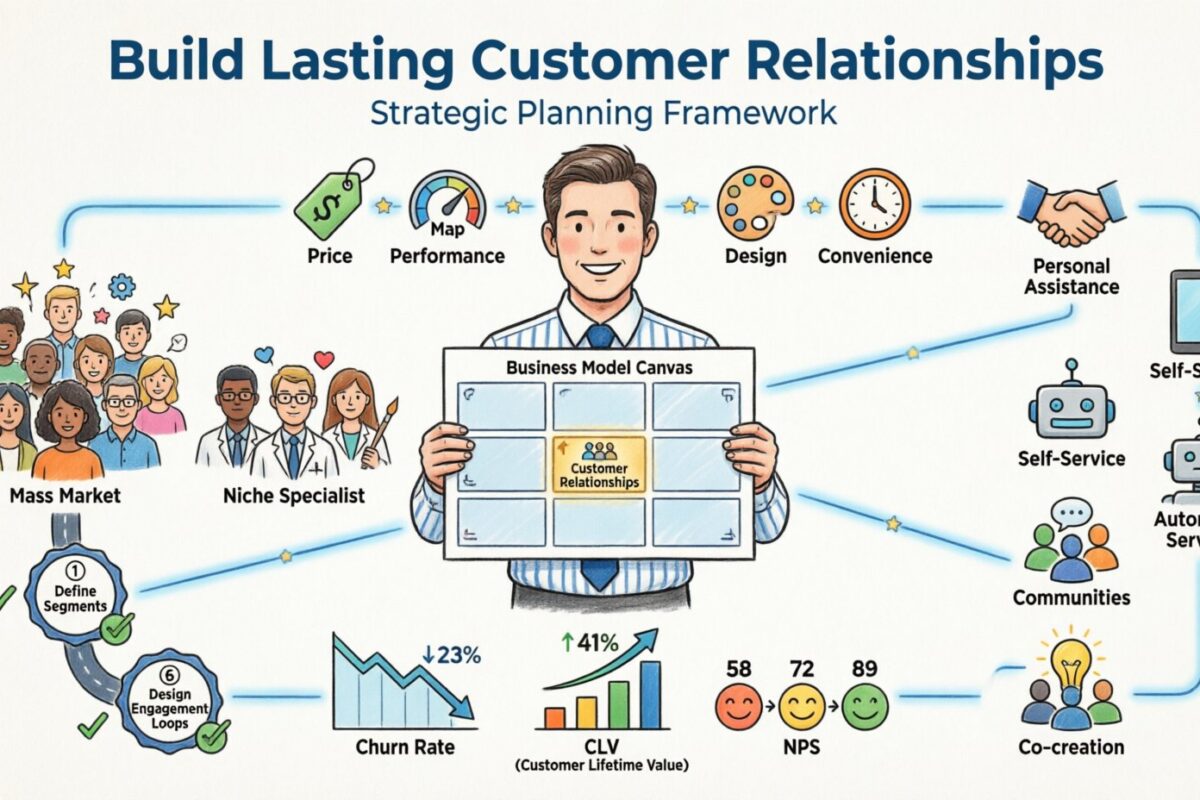
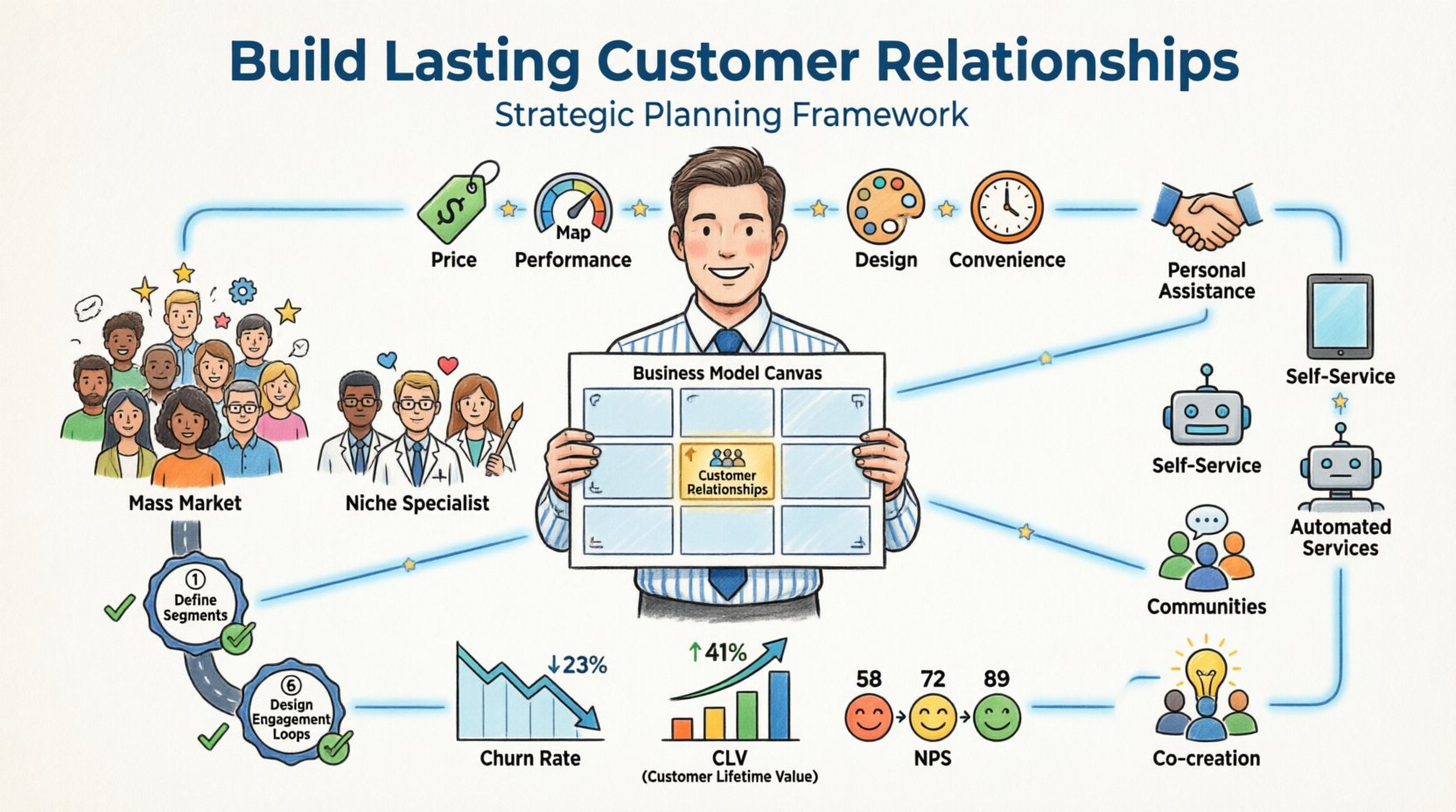
Mass market strategies often rely on self-service or automated support to manage volume. Niche markets, however, demand personalized attention. The strategic plan must define which segment deserves which level of engagement.
2. Segments Based on Needs
- Customization: Some segments require tailored solutions.
- Standardization: Others prefer efficient, off-the-shelf options.
- Co-creation: A growing number of clients want to participate in the development process.
Identifying these needs early allows the business to design relationship mechanisms that fit the segment’s expectations. This alignment reduces friction and increases satisfaction.
💎 Aligning Value Propositions
A relationship is built on value. If the value proposition shifts, the relationship must evolve to accommodate it. Strategic planning involves continuously auditing the Value Proposition to ensure it remains relevant.
Key Value Drivers
- Price: Is the cost justified by the utility?
- Performance: Does the product work as promised?
- Design: Is the aesthetic and usability appealing?
- Convenience: Is the process easy to navigate?
When a company prioritizes one driver over another, it signals what it values. For example, a brand focusing on “Convenience” must ensure its channels are fast and reliable. A brand focusing on “Design” must invest in quality aesthetics. Misalignment here damages trust.
Dynamic Value Adjustment
Market conditions change. A strategic plan includes mechanisms to update the Value Proposition. This might involve adding new features, adjusting pricing tiers, or expanding service coverage. Communicating these changes transparently maintains the relationship during periods of transition.
🤝 Defining Relationship Types
The “Customer Relationships” block in the Business Model Canvas specifies the nature of the interaction. Choosing the right type is a strategic decision that impacts cost structures and customer expectations.
| Relationship Type | Best Used For | Key Characteristic |
|---|---|---|
| Personal Assistance | High-value, complex products | Direct human interaction |
| Self-Service | Low-cost, frequent transactions | User independence |
| Automated Services | Real-time data or monitoring | Algorithm-driven interaction |
| Communities | Network effects or user-generated content | Peer-to-peer support |
| Co-creation | Innovation-focused industries | Joint value creation |
Implementing the Right Mix
Most businesses utilize a hybrid approach. Strategic planning determines the ratio. For example, a software company might use Self-Service for account setup but Personal Assistance for onboarding complex enterprise clients. The goal is to match the effort to the value.
📡 Optimizing Channels
Channels are the touchpoints through which a customer experiences the organization. They are the medium through which the relationship is maintained. A strategic plan ensures these channels are integrated and consistent.
- Ownership: Does the company own the channel (e.g., website), or is it rented (e.g., social media platform)? Owned channels provide more control over the relationship.
- Customer Journey: How do customers move between channels? Seamless transitions prevent frustration.
- Information Flow: Does the channel allow for two-way communication? One-way broadcasting limits relationship depth.
Planning involves selecting channels that align with customer habits. If a segment prefers mobile interaction, investing in desktop support is a misallocation of resources. Conversely, if a segment requires detailed documentation, a chat interface alone is insufficient.
📊 Measuring Success and Feedback Loops
Strategy without measurement is merely an opinion. To maintain long-term relationships, an organization must track specific indicators of health. These metrics go beyond simple sales figures.
Retention Metrics
- Churn Rate: The percentage of customers who stop using the service.
- Customer Lifetime Value (CLV): The total revenue expected from a single account.
- Repeat Purchase Rate: How often customers return.
Qualitative Feedback
- Net Promoter Score (NPS): Measures willingness to recommend.
- Customer Effort Score (CES): Measures ease of interaction.
- Direct Feedback: Surveys and interviews provide context.
These data points should feed back into the strategic planning cycle. If Churn Rate rises in a specific segment, the Value Proposition or Relationship Type for that segment may need adjustment. This creates a continuous improvement loop.
🛠️ Implementation Steps
Turning theory into practice requires a structured approach. The following steps outline the process of integrating these concepts into a business plan.
- Audit Current State: Map existing customer interactions to the Business Model Canvas. Identify gaps between current relationships and desired outcomes.
- Define Objectives: Set clear goals for retention and engagement. Avoid vague targets like “better service” in favor of specific metrics like “reduce churn by 5%.”
- Segment Strategy: Group customers based on behavior and value. Assign appropriate relationship types to each group.
- Resource Planning: Allocate budget and personnel to support the chosen relationship model. Ensure staff are trained to deliver the required level of service.
- Channel Integration: Ensure all communication platforms share data. A customer should not have to repeat their issue across different channels.
- Launch and Monitor: Implement changes and track the defined metrics. Be prepared to iterate based on real-world performance.
🚧 Common Pitfalls to Avoid
Even with a solid plan, execution can falter. Awareness of common errors helps maintain strategic integrity.
- Overpromising: Setting expectations that cannot be met damages trust faster than poor service. Be realistic about capabilities.
- Inconsistency: Changing the quality of service based on the time of day or the representative creates confusion.
- Neglecting Existing Clients: Focusing entirely on acquisition while ignoring current relationships leads to stagnation.
- Data Silos: Keeping customer data in separate systems prevents a holistic view of the relationship.
🔄 Adapting to Market Changes
Strategic planning is not a one-time event. It is an ongoing discipline. Markets evolve, technology advances, and customer expectations shift. A robust plan includes contingency measures.
For example, the rise of digital communication has changed how customers expect support. Companies that relied solely on phone support had to adapt to email and chat. Those that adapted early gained a competitive advantage in retention. Future planning should anticipate shifts in technology and behavior.
🌱 The Role of Trust
At its core, a long-term relationship is built on trust. Strategic planning facilitates trust by ensuring reliability. When a business consistently delivers on its promises, trust grows. This trust reduces the friction in future transactions and increases the likelihood of referrals.
Trust is fragile. One major breach can undo years of planning. Therefore, risk management is a part of relationship strategy. This includes data security, transparent pricing, and ethical practices. Customers are increasingly aware of these factors and factor them into their loyalty decisions.
📈 The Financial Impact
Investing in long-term relationships has a direct impact on the bottom line. Acquiring a new customer is significantly more expensive than retaining an existing one. As relationships deepen, the cost of serving them often decreases due to familiarity and efficiency.
Furthermore, loyal customers are more likely to try new offerings. They act as a stable base of revenue, allowing the business to take calculated risks on innovation. This stability is a competitive moat that is difficult for competitors to replicate.
🔮 Looking Forward
The future of business lies in connection. As automation and artificial intelligence handle routine tasks, the human element of relationships becomes even more valuable. Strategic planning must account for this shift. It should define where technology adds efficiency and where human empathy is required.
By focusing on the core principles of the Business Model Canvas—aligning value, segments, and relationships—organizations can build a foundation that withstands market volatility. The goal is not just to sell, but to serve. When service is the priority, long-term relationships follow naturally.
✅ Summary of Key Actions
- Analyze current customer segments and needs.
- Align Value Propositions with those needs.
- Select Relationship Types that match the segment.
- Integrate Channels for a seamless experience.
- Measure retention and feedback continuously.
- Iterate the plan based on data and market shifts.
Building long-term customer relationships is a deliberate process. It requires patience, data, and a commitment to value. By embedding these principles into the strategic planning phase, businesses create a sustainable path to growth and stability.