In the academic environment of entrepreneurship education, students are frequently tasked with creating comprehensive business plans. These documents serve as blueprints for future ventures, requiring a blend of creativity, financial acumen, and strategic foresight. However, a common disconnect exists between theoretical learning and practical application. Many students produce plans that look good on paper but lack the structural integrity needed to survive real-world market pressures.
This is where the SWOT analysis becomes indispensable. It is not merely a checklist exercise; it is a diagnostic tool that forces critical thinking. By systematically evaluating internal capabilities and external conditions, students can transform a generic concept into a viable venture. This guide explores how to leverage this framework to strengthen business plans, ensuring that every decision is grounded in data and strategic logic. 🧠💡
Understanding the SWOT Framework 🔍
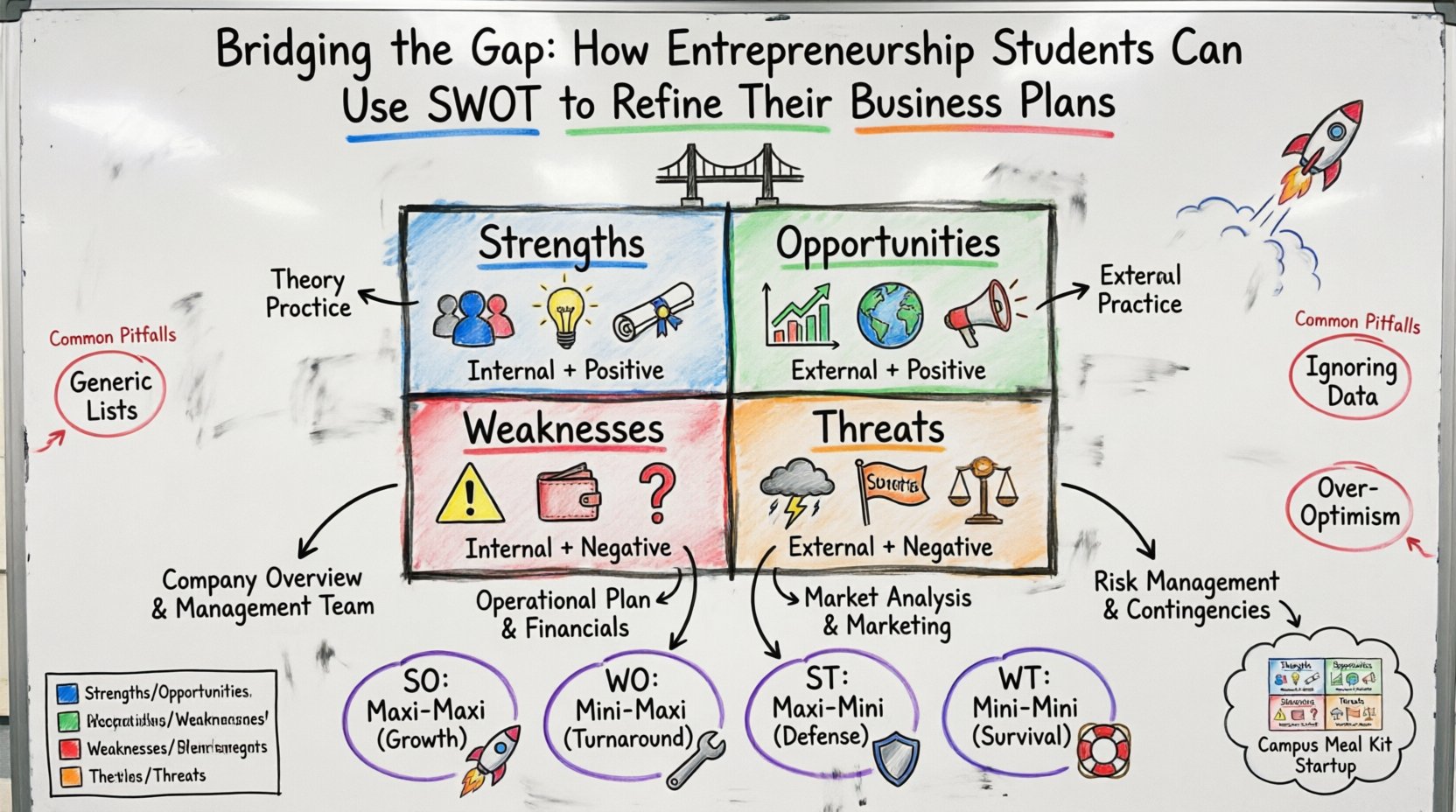
Before diving into the mechanics of refining a plan, one must grasp the core components of the SWOT model. It stands for Strengths, Weaknesses, Opportunities, and Threats. The framework divides factors into two dimensions: internal and external, and two dimensions of impact: positive and negative.
- Internal Factors: These are elements within the organization that you can control. This includes your team’s skills, capital reserves, intellectual property, and operational processes.
- External Factors: These are elements outside the organization that you cannot control but must adapt to. This includes market trends, competitor actions, regulatory changes, and economic shifts.
- Positive Factors: These are assets that help you achieve your goals. Strengths and Opportunities fall here.
- Negative Factors: These are liabilities that hinder progress. Weaknesses and Threats fall here.
For students, the value lies in the intersection of these quadrants. A business plan that ignores internal weaknesses is naive. A plan that ignores external threats is dangerous. A robust strategy requires acknowledging all four areas simultaneously.
Integrating SWOT into Your Business Plan 📝
Many students treat the SWOT analysis as a standalone assignment, placing it in an appendix or a single slide. To truly refine the business plan, the insights must permeate every section of the document. Here is how to map the analysis to specific plan components:
| SWOT Element | Business Plan Section | Application |
|---|---|---|
| Strengths | Company Overview & Management Team | Highlight unique capabilities that give you a competitive edge. |
| Weaknesses | Operational Plan & Financial Projections | Identify gaps and outline mitigation strategies or resource allocation. |
| Opportunities | Market Analysis & Marketing Strategy | Align product features with emerging market demands. |
| Threats | Risk Management & Contingency Plans | Prepare backup scenarios for economic downturns or competitor moves. |
By cross-referencing these sections, the narrative of the business plan becomes cohesive. Investors and professors look for consistency. If the SWOT analysis suggests a major threat but the Risk Management section is silent, the plan lacks credibility.
Deep Dive: Internal Factors (Strengths & Weaknesses) 💪
Internal analysis requires brutal honesty. Students often overestimate their capabilities due to the enthusiasm of a new idea. To avoid this, gather evidence rather than relying on intuition.
Identifying Strengths
Strengths are what you do better than anyone else. In the context of a student venture, these might not be massive resources. Instead, they often include agility and specialized knowledge.
- Human Capital: Does the founding team possess specific technical skills? Are there advisors with industry connections?
- Technology: Do you have a proprietary algorithm or a unique design process?
- Cost Structure: Can you operate with lower overhead than established competitors?
- Brand Potential: Is the concept aligned with current cultural values or sustainability trends?
When documenting these in the plan, avoid vague terms like “high quality.” Use metrics. If you claim speed, specify the turnaround time. If you claim expertise, list relevant certifications or prior projects.
Identifying Weaknesses
Weaknesses are areas where you lack resources or experience. Acknowledging these does not weaken the plan; it strengthens it by showing realism.
- Resource Constraints: Limited funding is a common student weakness. How does this affect hiring or marketing?
- Brand Awareness: New ventures have no reputation. How will you build trust without a track record?
- Operational Gaps: Do you lack a supply chain or a distribution network?
- Experience: Do you lack management experience in scaling a business?
The key to handling weaknesses in a business plan is mitigation. Do not hide them. State the weakness, then immediately follow with the strategy to address it. For example, if you lack a sales team, state that you will use a commission-based partnership model until revenue stabilizes.
Deep Dive: External Factors (Opportunities & Threats) 🌍
External factors are beyond your control, which is why they require continuous monitoring. A business plan is a snapshot in time; it must account for the volatility of the environment.
Identifying Opportunities
Opportunities exist where market needs are not being fully met. Students are often closer to consumer trends than legacy corporations.
- Technological Shifts: Are there new platforms or tools that lower the barrier to entry?
- Regulatory Changes: Are there new laws that favor your business model over competitors?
- Social Trends: Is there a growing demand for remote work solutions or eco-friendly products?
- Competitor Weaknesses: Is a major player ignoring a specific customer segment?
To validate opportunities, you must conduct market research. Surveys, interviews, and industry reports provide the data needed to justify your assumptions. When writing the plan, link every opportunity to a specific revenue stream.
Identifying Threats
Threats can kill a venture before it gains traction. They are the risks that keep founders awake at night.
- Economic Downturns: How will customers react if disposable income drops?
- Competitor Aggression: Will established players copy your idea and use their budget to crush you?
- Supply Chain Disruption: Are you reliant on a single vendor?
- Legal Risks: Are there intellectual property concerns or compliance issues?
In the business plan, these should be addressed in the risk analysis section. Show that you understand the landscape and have a contingency plan. For instance, if you rely on a single supplier, identify backup vendors.
Actionable Strategies for Each Quadrant 🛠️
Once the analysis is complete, the next step is synthesis. This involves combining the factors to create actionable strategies. This process is often called TOWS analysis, where you look at how to use Strengths to capture Opportunities, or how to use Strengths to avoid Threats.
SO Strategies (Maxi-Maxi)
Use your internal strengths to maximize external opportunities. This is the growth engine of your business.
- Example: If your strength is a highly skilled development team and the opportunity is a demand for AI tools, prioritize product development in that niche.
- Plan Integration: Set aggressive growth targets in the financial section that reflect this synergy.
WO Strategies (Mini-Maxi)
Overcome internal weaknesses by taking advantage of external opportunities. This is the turnaround strategy.
- Example: If you lack marketing budget (Weakness) but there is a viral trend on social media (Opportunity), focus on organic content creation rather than paid ads.
- Plan Integration: Outline a lean marketing budget that relies on community engagement.
ST Strategies (Maxi-Mini)
Use internal strengths to minimize or avoid external threats. This is the defense strategy.
- Example: If you have strong cash reserves (Strength) and a potential economic recession is looming (Threat), position your pricing model to be recession-resistant.
- Plan Integration: Include a cash flow buffer in the financial projections.
WT Strategies (Mini-Mini)
Minimize weaknesses and avoid threats. This is the survival strategy. It is often the most critical for early-stage ventures.
- Example: If you have limited technical skills (Weakness) and a competitor is launching a superior product (Threat), consider partnering with a technical firm or pivoting to a service-based model.
- Plan Integration: Clearly state the conditions under which you would pivot or shut down to protect investor capital.
Common Pitfalls Students Make 🚫
Even with a solid framework, errors can creep in. Recognizing these common mistakes will help you avoid them.
- Generic Lists: Writing “Good Service” as a strength is useless. Specificity is key.
- Confusing Internal and External: A competitor’s weakness is an external opportunity for you, not an internal strength.
- One-Time Exercise: Treating SWOT as a one-time task. The market changes, so the analysis must be revisited regularly.
- Ignoring Data: Relying on gut feelings rather than market research data.
- Over-optimism: Focusing only on Strengths and Opportunities while ignoring the reality of Weaknesses and Threats.
Case Study Example 📚
Consider a student startup planning to launch a subscription-based meal kit service on campus. Without SWOT, they might assume high demand is enough. With SWOT, the plan changes.
Strengths: Direct access to student housing, low marketing costs via student ambassadors.
Weaknesses: Limited storage space, reliance on a single kitchen vendor.
Opportunities: Growing interest in sustainable eating, dormitory contracts for dining halls.
Threats: Existing dining hall contracts, supply chain delays for fresh produce.
Refining the Plan:
- Based on Weaknesses: The plan includes a partnership with a local restaurant to outsource cooking if the kitchen vendor fails.
- Based on Opportunities: The marketing strategy focuses on sustainability certifications to appeal to eco-conscious students.
- Based on Threats: The financial model includes a 20% contingency fund for price fluctuations in produce.
This level of detail transforms a student project into a professional-grade business plan.
From Analysis to Execution 🚀
The final step is translating the insights into operational reality. The business plan is a living document. As you execute, you will gather new data. This data should feed back into the SWOT analysis.
- Regular Reviews: Schedule quarterly reviews of your SWOT matrix.
- KPI Tracking: Measure whether your strengths are actually delivering results.
- Pivot Readiness: If a Threat materializes, are you prepared to shift strategy?
Entrepreneurship is not a linear path. It is a series of adjustments based on feedback. The SWOT analysis provides the structure to make those adjustments intelligently. It ensures that you are not reacting blindly but responding strategically.
By treating the SWOT analysis as a core component of your business planning process, you bridge the gap between academic theory and market reality. You move from being a student with an idea to an entrepreneur with a plan. This distinction is what separates successful ventures from abandoned projects.
Start with the framework. Fill it with data. Test it against reality. Refine the plan. The path to a successful venture is paved with strategic clarity, not just enthusiasm. Use this tool to build a foundation that can withstand the pressures of the market. 🏗️📈