
Strategic planning is a critical function for any organization, yet it often stalls at the very first step. The SWOT analysis—identifying Strengths, Weaknesses, Opportunities, and Threats—is a staple of business strategy. However, the very act of analyzing can become a barrier to action. This phenomenon is known as analysis paralysis. When teams spend weeks debating the nuances of a single data point, momentum dies. The goal of this guide is to provide a framework for conducting SWOT sessions that are rigorous yet time-efficient, ensuring that insight leads directly to implementation.
Many organizations mistake depth for value. They believe that if they analyze for hours, the strategy will be better. In reality, diminishing returns set in quickly. The focus must shift from exhaustive data gathering to actionable synthesis. By establishing clear boundaries, utilizing structured facilitation, and enforcing time-boxing, you can transform a potentially endless debate into a decisive planning session.
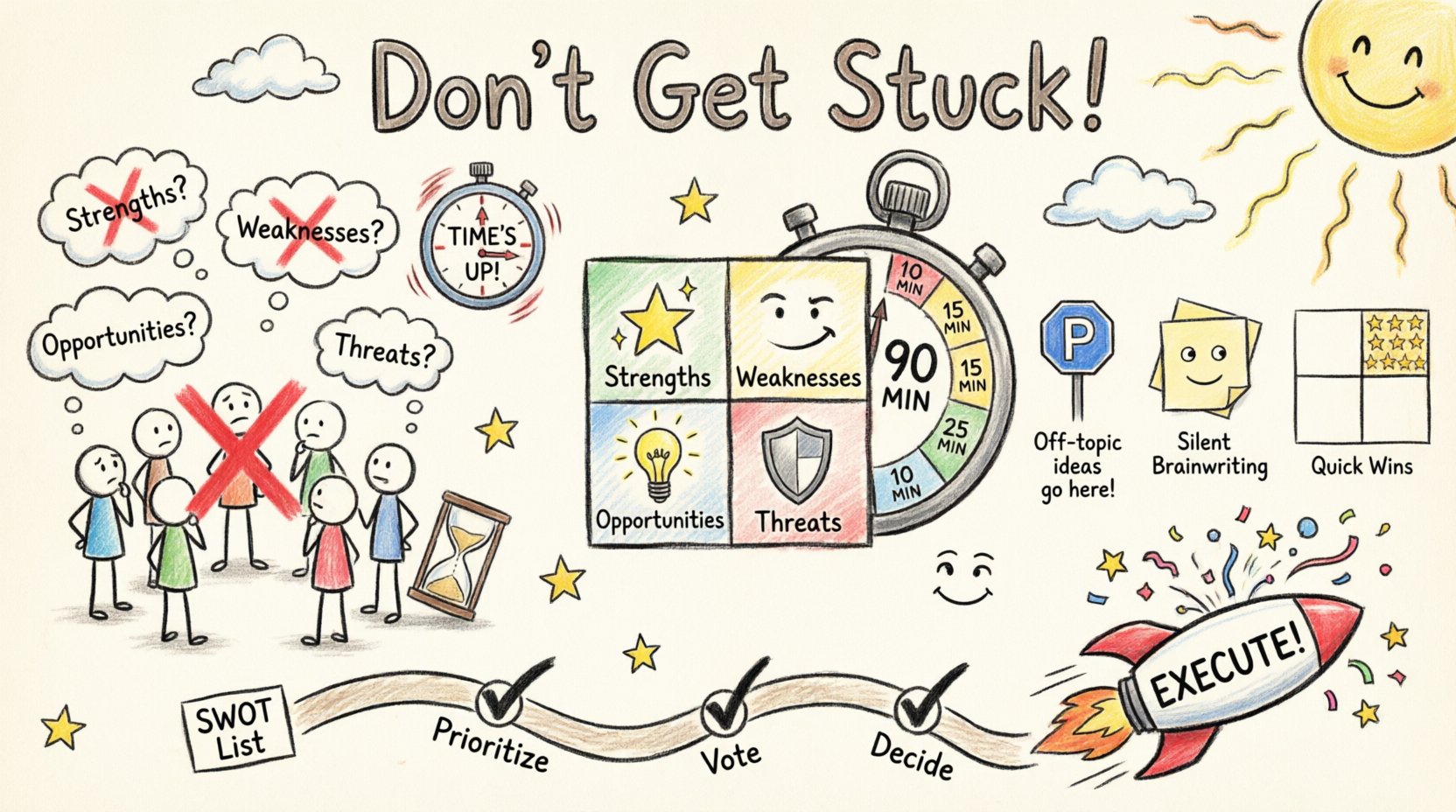
Understanding the Cost of Overthinking 💸
Analysis paralysis occurs when the fear of making the wrong decision prevents any decision from being made. In the context of a SWOT session, this manifests as teams getting stuck in the “Strengths” or “Threats” quadrant, endlessly refining definitions rather than moving toward “Opportunities” and “Action”.
The cost is not just time. It is opportunity cost. Every hour spent debating a classification is an hour not spent designing a solution. Consider the following impacts of an unfocused session:
- Resource Drain: Senior leadership time is diverted from execution to discussion.
- Morale Decline: Participants feel their input is not valued if decisions are never reached.
- Strategic Drift: The original objective of the session is lost amidst tangential discussions.
- Decision Fatigue: By the end of the session, stakeholders are too tired to commit to the resulting plan.
To avoid this, the session must be treated as a constraint-based exercise. Constraints drive creativity and focus. By limiting the time and scope, you force the team to prioritize what truly matters.
Pre-Work: Setting the Stage for Clarity 📝
A significant portion of the success of a SWOT session is determined before the meeting begins. Preparation reduces the cognitive load during the session, allowing participants to focus on synthesis rather than data collection.
Define the Scope
Never start a SWOT analysis without a specific question in mind. “What is our strategy?” is too broad. Instead, frame the session around a specific challenge or goal.
- Specific: “How do we enter the European market?”
- Time-Bound: “How do we improve retention over the next 12 months?”
- Contextual: “What capabilities do we need to launch Product X?”
Curate the Attendees
Inviting everyone to a SWOT session dilutes focus. You need diversity of thought, not a full department headcount. Select individuals who possess specific knowledge relevant to the scope.
- Facilitator: Someone neutral who manages time and keeps the group on track.
- Subject Matter Experts: People who know the data intimately.
- Decision Makers: Individuals with the authority to commit resources.
Distribute Pre-Reading
Do not use the session to read data. Send relevant market reports, financial summaries, and customer feedback before the meeting. Require attendees to review this material. This ensures the session is spent on interpretation, not information consumption.
The Time-Boxed SWOT Framework ⏳
The most effective way to prevent analysis paralysis is to impose strict time limits on each quadrant. This forces the team to accept “good enough” data rather than perfect data. The following schedule assumes a 90-minute session, which is often the maximum attention span for high-level strategy.
| Phase | Duration | Focus |
|---|---|---|
| Introduction & Scope | 10 Minutes | Align on the specific question and goals. |
| Strengths | 15 Minutes | Internal capabilities we control. |
| Weaknesses | 15 Minutes | Internal gaps we must address. |
| Opportunities | 25 Minutes | External trends we can leverage. |
| Threats | 15 Minutes | External risks to the plan. |
| Prioritization & Next Steps | 10 Minutes | Vote on top 3 actions. |
Notice the allocation. Opportunities and Threats often get less time than they deserve, but Strengths and Weaknesses can consume the entire meeting. The facilitator must ensure the team does not dwell too long on internal auditing at the expense of external scanning.
Facilitation Techniques to Maintain Momentum 🗣️
A facilitator is not just a note-taker. They are a guardian of the process. Their primary job is to interrupt digressions and enforce the time-box. Without active facilitation, the loudest voice in the room will dictate the outcome.
The Parking Lot Method
When a discussion veers off-topic, move it to a “Parking Lot” list. This acknowledges the point without derailing the current agenda. The facilitator notes it down and promises to address it later or after the session.
- Example: “That is a valid point about our HR policy, but it falls outside the scope of this market analysis. I will add it to the parking lot to review after we finish the Opportunities section.”
The 5-Minute Rule
If a specific point has been discussed for five minutes without a decision or conclusion, it must be escalated or set aside. This prevents the team from spinning wheels on minor details.
Silent Brainwriting
Group dynamics often lead to conformity. To get honest input, use silent brainstorming. Give everyone 3 minutes to write down their thoughts on a sticky note or digital board before sharing. This prevents early ideas from anchoring the group’s thinking and allows introverted voices to contribute equally.
Prioritizing Findings: From List to Action ✅
Completing the four quadrants is not the finish line. It is merely the data collection phase. The real value lies in prioritizing these findings into a strategic plan. A SWOT list with 50 items is useless. A list with 3 actionable priorities is powerful.
The Impact vs. Effort Matrix
Once the SWOT is complete, plot the top ideas on a 2×2 matrix. The X-axis represents Effort (Low to High). The Y-axis represents Impact (Low to High).
- Quick Wins (High Impact, Low Effort): Do these immediately.
- Major Projects (High Impact, High Effort): Plan these carefully.
- Fill-ins (Low Impact, Low Effort): Do these when resources allow.
- Thankless Tasks (Low Impact, High Effort): Avoid or outsource.
Linking SWOT to Strategy
Do not leave the quadrants isolated. Connect them to form strategic moves. This is often called TOWS analysis, though the principle applies to any strategic framework.
- SO Strategies: Use Strengths to maximize Opportunities.
- WO Strategies: Use Opportunities to overcome Weaknesses.
- ST Strategies: Use Strengths to minimize Threats.
- WT Strategies: Minimize Weaknesses to avoid Threats.
For example, if a Strength is “Proprietary Technology” and a Threat is “Competitor Price War,” the ST strategy is to emphasize value and differentiation rather than competing on price.
Common Pitfalls and How to Dodge Them ⚠️
Even with a framework, teams often fall into traps. Recognizing these patterns early saves time and reduces frustration.
| Pitfall | Behavior | Solution |
|---|---|---|
| Vague Definitions | Listing “Good Culture” as a Strength without evidence. | Require specific examples for every item listed. |
| Internal Bias | Only listing internal factors, ignoring market shifts. | Force the team to look outward for Opportunities and Threats first. |
| Blame Culture | Weaknesses become a session of finger-pointing. | Frame Weaknesses as “Areas for Development” to reduce defensiveness. |
| Analysis Creep | Adding new data points mid-session. | Enforce the pre-reading rule. No new data allowed during the session. |
Post-Analysis: Turning Insights into Strategy 🚀
The session ends, but the work continues. Without a clear handoff, the SWOT document becomes a shelf decoration. The output of the session must be a living document that drives daily work.
Create an Action Register
Every priority item identified must have an owner and a deadline. Do not leave items unassigned. An action register should include:
- Item: The specific action derived from the SWOT.
- Owner: The single person accountable for delivery.
- Deadline: A specific date for completion.
- Status: A mechanism to track progress (e.g., Not Started, In Progress, Done).
Schedule Follow-Ups
Review the progress of these actions in the next monthly or quarterly business review. This creates accountability. If the team knows the SWOT outcomes will be reviewed, they will take the prioritization seriously.
Iterate Regularly
SWOT is not a one-time event. Markets change. Competitors change. Internal capabilities change. Revisit the SWOT analysis quarterly or whenever a major shift occurs. This keeps the strategy relevant without requiring a full-scale re-planning exercise every time.
Conclusion: Discipline Over Complexity 🧠
The path to effective strategic planning is not through more data or longer meetings. It is through discipline. By limiting the scope, enforcing time-boxes, and demanding clear ownership of actions, you can avoid the trap of analysis paralysis. A SWOT session should feel like a sprint, not a marathon. The goal is clarity and direction, not perfection.
When you respect the time of your team and the complexity of the business environment, you create a culture where decisions are made with confidence. This approach ensures that your strategy remains agile, responsive, and focused on what actually moves the needle.
Remember, the best strategy is the one that gets executed. Keep your sessions focused, keep your time efficient, and keep your team moving forward.