
Every entrepreneur begins with a vision, a solution, and a belief in the market. However, the path from idea to viable enterprise is rarely linear. For early-stage ventures, the margin for error is slim, and the consequences of oversight can be fatal. Understanding and assessing risk factors is not about predicting the future with certainty; it is about preparing for uncertainty with clarity. This guide explores how to systematically evaluate risk within the context of the Business Model Canvas (BMC), ensuring your plan is robust, resilient, and ready for the realities of startup life.
Why Risk Assessment Matters in the Startup Phase ⚠️
Many founders view risk assessment as a bureaucratic exercise or a requirement solely for investors. This perspective overlooks the strategic value of identifying vulnerabilities early. When you map out risks, you are essentially stress-testing your business model before committing significant resources. This process reveals weak links in the chain, allowing you to reinforce them or pivot before they cause a collapse.
Risk in an early-stage business is not monolithic. It spans operational, financial, market, and strategic dimensions. Ignoring these factors often leads to the premature closure of promising ventures. A structured approach to risk management transforms uncertainty from a threat into a manageable variable.
- Resource Allocation: Identifying risks helps prioritize where to spend time and money.
- Investor Confidence: Demonstrating an understanding of risks signals maturity and foresight.
- Strategic Agility: Knowing potential pitfalls allows for faster pivots when conditions change.
- Founder Resilience: Mental preparation for challenges reduces panic during crises.
The Business Model Canvas as a Risk Map 🗺️
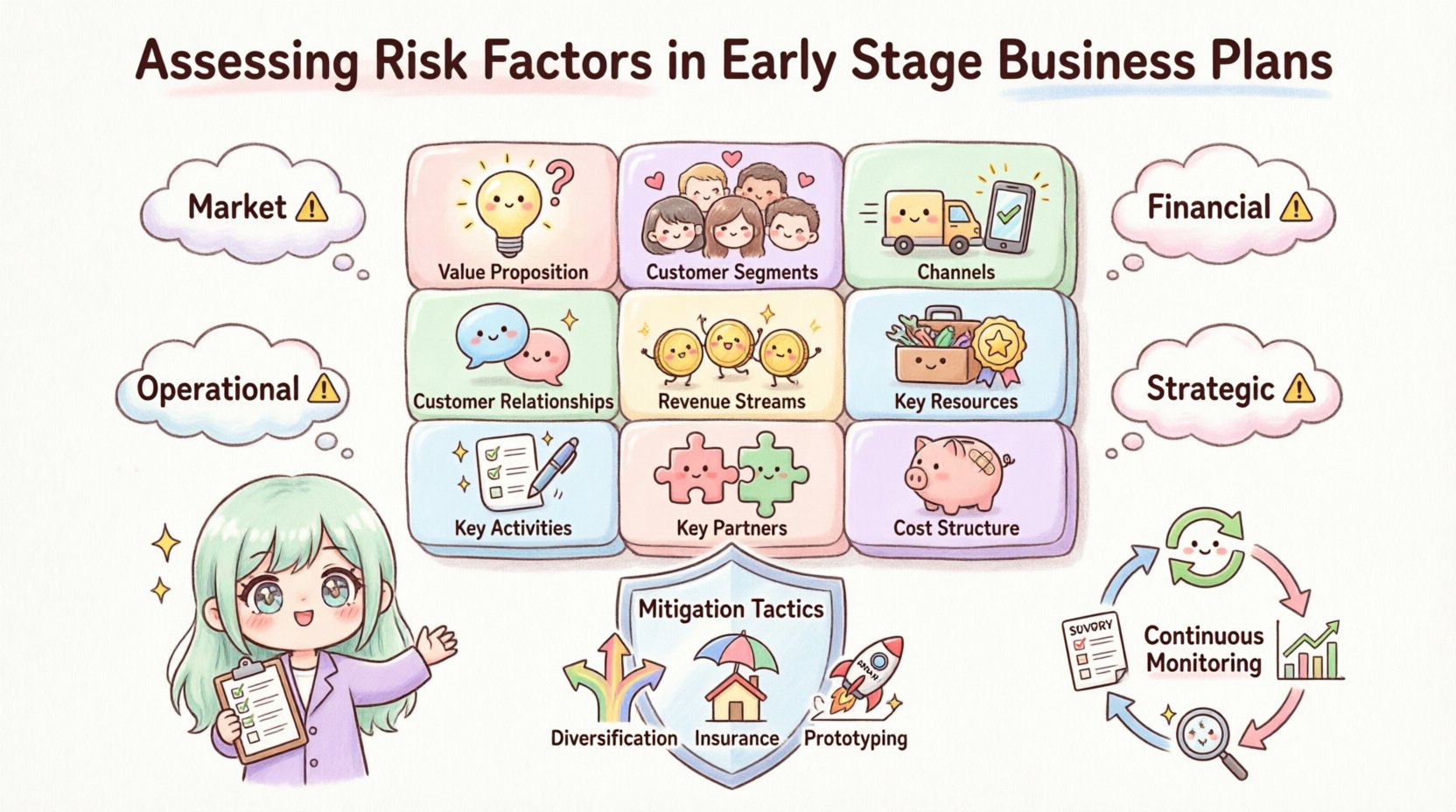
The Business Model Canvas provides a visual framework for describing how an organization creates, delivers, and captures value. While originally designed for clarity, it also serves as an excellent risk mapping tool. Each of the nine building blocks represents a potential area of failure or instability. By interrogating each block with a “What could go wrong?” mindset, you can uncover hidden vulnerabilities.
Traditional risk assessments often focus heavily on financial projections. However, in the early stages, operational and market risks often precede financial distress. The BMC allows you to drill down into the specific mechanics of your business to find these precursors.
Integrating Risk into the Nine Blocks
To effectively assess risk, we must look at each component of the canvas individually. The following table provides a high-level overview of where specific risks typically reside within the BMC structure.
| Building Block | Potential Risk Areas | Key Questions to Ask |
|---|---|---|
| Value Proposition | Market fit, differentiation, demand | Is this truly needed? Can competitors replicate it? |
| Customer Segments | Segmentation, accessibility, loyalty | Who exactly will buy? Is the market too small? |
| Channels | Reach, cost, control, efficiency | Can we reach them affordably? Are channels reliable? |
| Customer Relationships | Retention, acquisition cost, support | How do we sustain engagement? Is support scalable? |
| Revenue Streams | Pricing, sustainability, timing | Will customers pay? Is the model profitable? |
| Key Resources | Availability, IP, talent, technology | Do we have the assets? Are they protected? |
| Key Activities | Execution, quality, scalability | Can we do this repeatedly? What are the bottlenecks? |
| Key Partners | Dependency, reliability, alignment | Are partners stable? What if they leave? |
| Cost Structure | Burn rate, fixed vs. variable, cash flow | How long will cash last? Are costs controllable? |
Deep Dive: Analyzing Specific Risk Factors 🔍
1. Value Proposition Risks
The core of your business is what you offer. If this does not resonate, the rest of the model becomes irrelevant. Risk here centers on the assumption that the problem exists and your solution is the best one.
- False Demand: You may build something people say they want but will not use.
- Competitive Displacement: A larger player may enter the space with superior resources.
- Regulatory Hurdles: The solution may face legal barriers that were not anticipated.
To assess this, conduct rigorous customer discovery. Avoid relying solely on friends and family. Seek out strangers who fit your ideal profile. Ask for commitments, not just verbal affirmations.
2. Customer Segment & Channel Risks
Even with a great product, reaching the right audience is difficult. The cost of customer acquisition (CAC) can quickly outpace the lifetime value (LTV) of the customer.
- Fragmented Audiences: If your customer base is too broad, marketing messages become diluted.
- Channel Volatility: Relying on a single channel (e.g., one social media platform) creates a single point of failure.
- Trust Barriers: In new markets, establishing trust takes time and money.
Map your channels against your customer preferences. If your customers prefer in-person interactions but you plan a digital-only launch, you introduce friction. Diversify your channels to mitigate the risk of algorithm changes or platform policy shifts.
3. Revenue Stream Risks
Revenue is the oxygen of a startup. However, revenue models are often the most optimistic part of a business plan.
- Pricing Sensitivity: Customers may not value the offering at the price point you require for profitability.
- Payment Cycles: Long sales cycles can create cash flow gaps.
- Churn: High initial growth means nothing if customers leave immediately.
Test pricing early. Use beta offers to gauge willingness to pay. Structure contracts to ensure steady cash flow rather than relying on one-off transactions where possible.
4. Key Resources & Activities Risks
This block covers the assets and actions required to make the model work. The risk here is often operational capacity.
- Talent Gaps: Key roles may be unfilled or underqualified.
- Technology Failure: Software or hardware may not perform as expected.
- IP Vulnerability: Intellectual property may be easily copied or challenged.
Conduct a resource audit. Identify dependencies on specific individuals. If a single engineer or designer holds critical knowledge, document processes to reduce the risk of their departure.
5. Key Partners Risks
Startups rarely build everything from scratch. You rely on suppliers, distributors, and technology providers.
- Supplier Concentration: Relying on one vendor for a critical component creates leverage for them to raise prices.
- Partner Misalignment: Partners may have different incentives or exit strategies.
- Integration Complexity: Connecting systems or services can introduce delays.
Develop backup suppliers. Negotiate contracts with clear exit clauses. Maintain open communication to ensure strategic alignment.
6. Cost Structure Risks
Costs are often underestimated, especially in the early stages where overheads can creep up unexpectedly.
- Fixed Cost Rigidity: High fixed costs reduce flexibility during downturns.
- Hidden Costs: Legal fees, compliance costs, and taxes often appear later.
- Inflation: Rising costs of raw materials or labor can erode margins.
Adopt a variable cost model where possible. Build a financial buffer into your projections. Regularly review expenses against the budget to catch variances early.
Financial Risks and Capital Efficiency 💰
While the BMC covers the structural elements, financial risk requires specific attention. Early-stage businesses are most vulnerable to cash flow mismanagement.
Runway and Burn Rate
The runway is the time remaining until funds run out. The burn rate is the speed at which you spend money. Assessing these metrics requires realistic assumptions about sales velocity and expense timing.
- Conservative Projections: Underestimate revenue growth and overestimate costs.
- Contingency Fund: Maintain cash reserves for at least three months of unexpected expenses.
- Financing Risk: Be aware that raising capital is a full-time job that distracts from operations.
Liquidity Management
Profitability on paper does not equal cash in the bank. Accounts receivable delays can stall operations even if the business is “profitable”.
- Payment Terms: Align payment terms with customers and suppliers to improve cash flow.
- Inventory Management: Excess inventory ties up cash and risks obsolescence.
- Debt Obligations: Avoid high-interest debt unless the ROI is guaranteed.
External Threats and Market Dynamics 🌍
Not all risks come from within the organization. External factors can disrupt even the most well-laid plans.
Market Shifts
Technological advancements can render a business model obsolete overnight. Consumer preferences change, and trends fade. The risk lies in betting on a trend that is nearing its peak.
- Monitor Trends: Keep a pulse on industry news and competitor moves.
- Pivot Readiness: Build a product architecture that allows for adaptation.
Regulatory and Legal Changes
Compliance costs can rise unexpectedly. New laws regarding data privacy, employment, or industry-specific regulations can alter the cost structure.
- Compliance Audit: Review current regulations relevant to your sector.
- Legal Counsel: Maintain a relationship with a lawyer who understands your industry.
Mitigation Tactics and Contingency Planning 🛡️
Identifying risk is only the first step. The next step is mitigation. You cannot eliminate all risk, but you can reduce its impact or likelihood.
Strategies for Risk Reduction
- Diversification: Spread risk across multiple customers, suppliers, or revenue streams.
- Insurance: Transfer specific risks (liability, property) to an insurance provider.
- Prototyping: Validate assumptions with minimal viable products before full-scale investment.
Contingency Planning
Define “Plan B” scenarios for critical risks. What happens if the primary sales channel fails? What happens if a key partner leaves?
- Trigger Points: Establish metrics that signal when to activate a contingency plan.
- Decision Trees: Map out decision paths for different scenarios to reduce reaction time.
- Communication: Ensure the team knows the contingency plan and their roles in it.
Continuous Monitoring and Iteration 🔄
Risk assessment is not a one-time activity. The business landscape shifts, and new risks emerge as the company grows. A static document becomes obsolete quickly.
Establishing Feedback Loops
Create mechanisms to gather data on risk factors continuously.
- Customer Feedback: Use support tickets and surveys to identify service risks.
- Financial Reviews: Conduct monthly cash flow reviews to monitor financial risks.
- Competitor Analysis: Regularly review competitor moves to assess market risks.
Adapting the Canvas
As you learn, update your Business Model Canvas. If a risk materializes, adjust the canvas to reflect the new reality. This iterative process ensures the business model remains aligned with the market environment.
Building a Culture of Risk Awareness 👥
Finally, risk management must be embedded in the culture of the organization. It should not be the sole responsibility of the founder.
- Encourage Openness: Reward team members who flag potential issues early.
- Training: Ensure staff understand the risks relevant to their roles.
- Transparency: Share risk assessments with the team to foster collective responsibility.
When everyone understands the potential pitfalls, the organization becomes more agile. Problems are identified and solved before they escalate into crises.
Final Thoughts on Strategic Planning 📝
Assessing risk factors in early stage business plans is an exercise in humility and preparation. It acknowledges that the future is unknown and that resources are finite. By using the Business Model Canvas as a lens, founders can systematically examine every part of their venture for potential failure points.
This process does not guarantee success, but it significantly increases the odds of survival. It moves the business from a gamble to a calculated endeavor. Remember that risk management is dynamic. As the business evolves, so must the assessment. Regular reviews, honest data, and a willingness to adapt are the true foundations of a resilient startup.
Start by mapping your current model. Identify the top five risks. Assign an owner to each. Set a date for the next review. This simple routine can protect the vision and the venture from unnecessary threats.