

Mergers and acquisitions are among the most complex transformations an organization can undertake. Beyond financial and legal considerations, success often depends on how effectively business processes, applications, data, and technology are integrated after the deal is completed.
ArchiMate provides a powerful way to visualize and manage this complexity. By modeling the current and target architectures of both organizations, Enterprise Architects can identify overlaps, gaps, risks, and integration priorities. When combined with an AI Chatbot for ArchiMate modeling, this process becomes faster, clearer, and more collaborative.
Why M&A Integration Is an Architecture Challenge
During an acquisition, organizations must align multiple architectural dimensions at the same time. Business capabilities and operating models need to work together, core processes must continue without disruption, application landscapes often overlap, and technology platforms may follow very different standards. These elements are frequently documented inconsistently or not at all, which increases uncertainty during integration.
Without a clear architectural view, integration decisions are often driven by assumptions rather than evidence. This is where ArchiMate becomes especially valuable. It provides a shared language to represent how business, application, and technology layers fit together across both organizations, creating a common foundation for planning and communication.
Using ArchiMate to Model an M&A Scenario
An effective M&A ArchiMate model usually considers three complementary viewpoints. These include the pre-merger architecture of Organization A, the pre-merger architecture of Organization B, and a target integrated architecture that represents the future state. Each viewpoint serves a different purpose and supports different types of decisions.
Together, these views allow architects to compare structures, understand dependencies, and gradually move from analysis to integration planning.
Business Layer: Aligning Capabilities and Processes
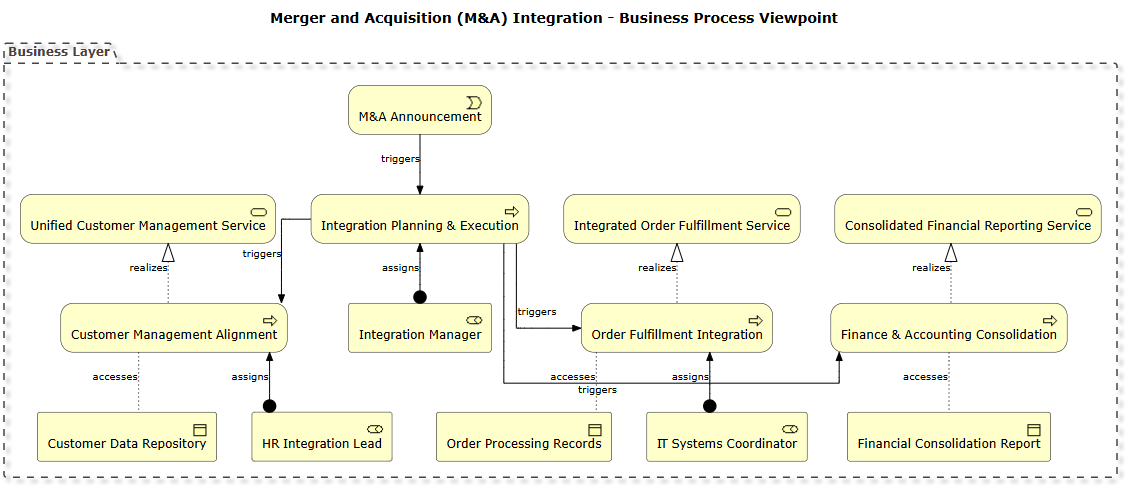
At the business layer, the focus is on understanding what each organization does and how their operations intersect. In an M&A scenario, this typically involves modeling business capabilities, core processes, and key roles across both companies.
An ArchiMate business view may include:
- Business capabilities such as Customer Management, Order Fulfillment, and Finance
- Business processes such as Sales Order Processing and Customer Support
- Business roles and actors from both organizations
By examining this model, architects can clearly see where capabilities overlap, which processes are critical to maintain during integration, and where operating models differ. With the support of an AI Chatbot, these insights can be surfaced quickly. Instead of manually adjusting diagrams, architects can describe the scenario in plain language and ask the AI to highlight overlapping processes or dependencies.
Application Layer: Identifying Redundancy and Integration Points
The application layer is often where M&A complexity becomes most visible. Many organizations discover they have multiple systems supporting the same business functions, each with its own data and integrations.
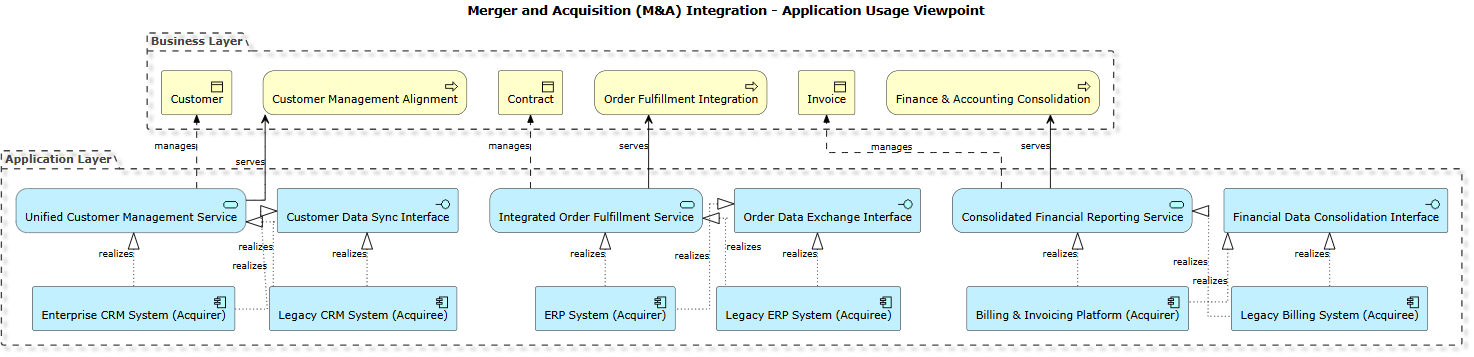
An ArchiMate application view may show:
- CRM, ERP, and billing systems from both organizations
- Application services that support shared business processes
- Key data objects such as Customer, Contract, and Invoice
This view helps teams identify redundant systems, assess business-critical applications, and understand where data synchronization or migration is required. With an AI Chatbot, architects can explore these questions conversationally. Asking which applications support a specific process or which systems depend on a legacy platform allows the AI to interpret the model and provide immediate, meaningful answers.
Technology Layer: Assessing Infrastructure Compatibility
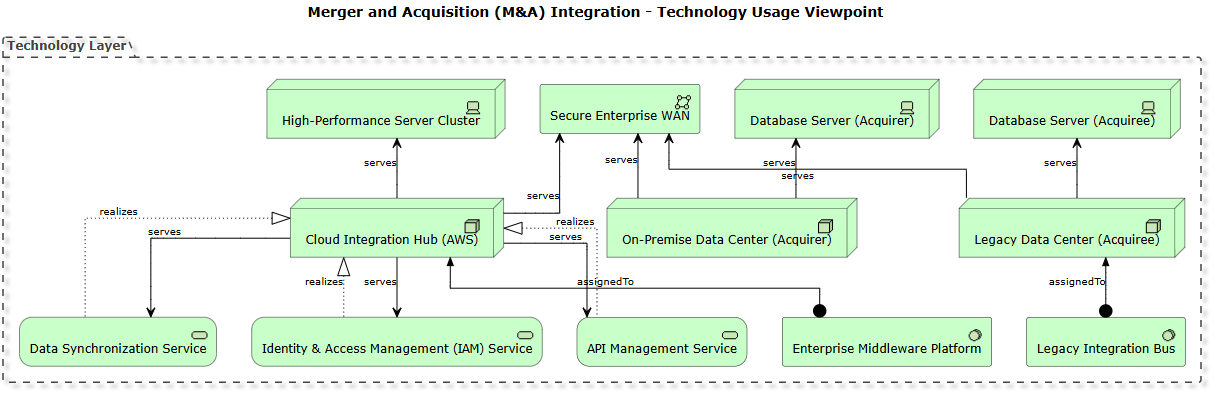
At the technology layer, integration risks are often related to infrastructure choices and platform compatibility. Differences in hosting models, middleware, or security standards can significantly affect integration timelines.
An ArchiMate technology view typically includes infrastructure services, databases, networks, and hosting environments. This layer allows teams to evaluate compatibility, identify standardization opportunities, and understand technical constraints that may limit certain integration options.
AI-assisted modeling is particularly valuable here. Architects can describe infrastructure changes, such as consolidating data centers or migrating systems to the cloud, and the AI updates the model accordingly without extensive manual rework.
Modeling the Target Architecture
The most important outcome of M&A architecture work is the target integrated architecture. This future-state view shows how the combined organization will operate, which applications will remain, and which technology platforms will be standardized.
Instead of treating this as a static diagram, AI Chatbots enable an iterative approach. Architects can refine the target architecture through conversation, experimenting with different integration options and immediately seeing the impact on the model. This encourages exploration while maintaining architectural consistency.
Explaining M&A Architecture to Stakeholders
M&A integration involves a wide range of stakeholders, many of whom are not familiar with ArchiMate notation. Dense diagrams alone are often insufficient for communicating architectural intent.
AI Chatbots help bridge this gap by turning models into clear, audience-friendly explanations. They can describe how the integration supports business goals, explain dependencies in plain language, and answer stakeholder questions directly from the architecture. This makes Enterprise Architecture more accessible and more influential during critical integration decisions.
Benefits of Using AI Chatbots for M&A ArchiMate Modeling
Combining ArchiMate with AI Chatbot capabilities delivers clear advantages:
- Faster creation and refinement of integration models
- Reduced manual drawing and layout effort
- Clearer communication with non-technical stakeholders
- Stronger alignment between strategy and execution
These benefits help architecture teams focus less on maintaining diagrams and more on guiding high-impact decisions.
Conclusion
Merger and acquisition integration is a complex, high-stakes process. ArchiMate provides the structure needed to model this complexity across business, application, and technology layers.
When enhanced with an AI Chatbot, ArchiMate modeling becomes more agile, accessible, and decision-oriented. Architects can visualize integration scenarios faster, explain them more clearly, and refine them collaboratively using simple text-based interaction.
In M&A initiatives where clarity and speed matter, AI-assisted ArchiMate modeling transforms architecture from a static deliverable into a strategic integration tool.