Strategic planning is often taught as a rigid framework in academic settings. The SWOT analysis stands as one of the most enduring models in business strategy. However, translating this four-quadrant model from a whiteboard exercise to a living, breathing component of organizational growth requires a nuanced approach. Many leaders find themselves stuck between theoretical knowledge and practical execution. The gap between classroom definitions and market realities can be wide. This guide explores how to bridge that divide using real-world scenarios and actionable methodologies. We will move past the basic definitions and focus on the application of Strengths, Weaknesses, Opportunities, and Threats in complex environments.
Modern business challenges are dynamic. They involve rapid technological shifts, evolving consumer behaviors, and global economic fluctuations. A static SWOT diagram often fails to capture this fluidity. To succeed, you must treat the analysis as a living document. It requires constant updates and deep engagement with data. This article provides a comprehensive look at how to leverage this tool effectively. We will examine specific industry examples, discuss data integration, and outline steps for turning insights into strategy.
The Foundation: Understanding the Real Meaning of SWOT 🧱
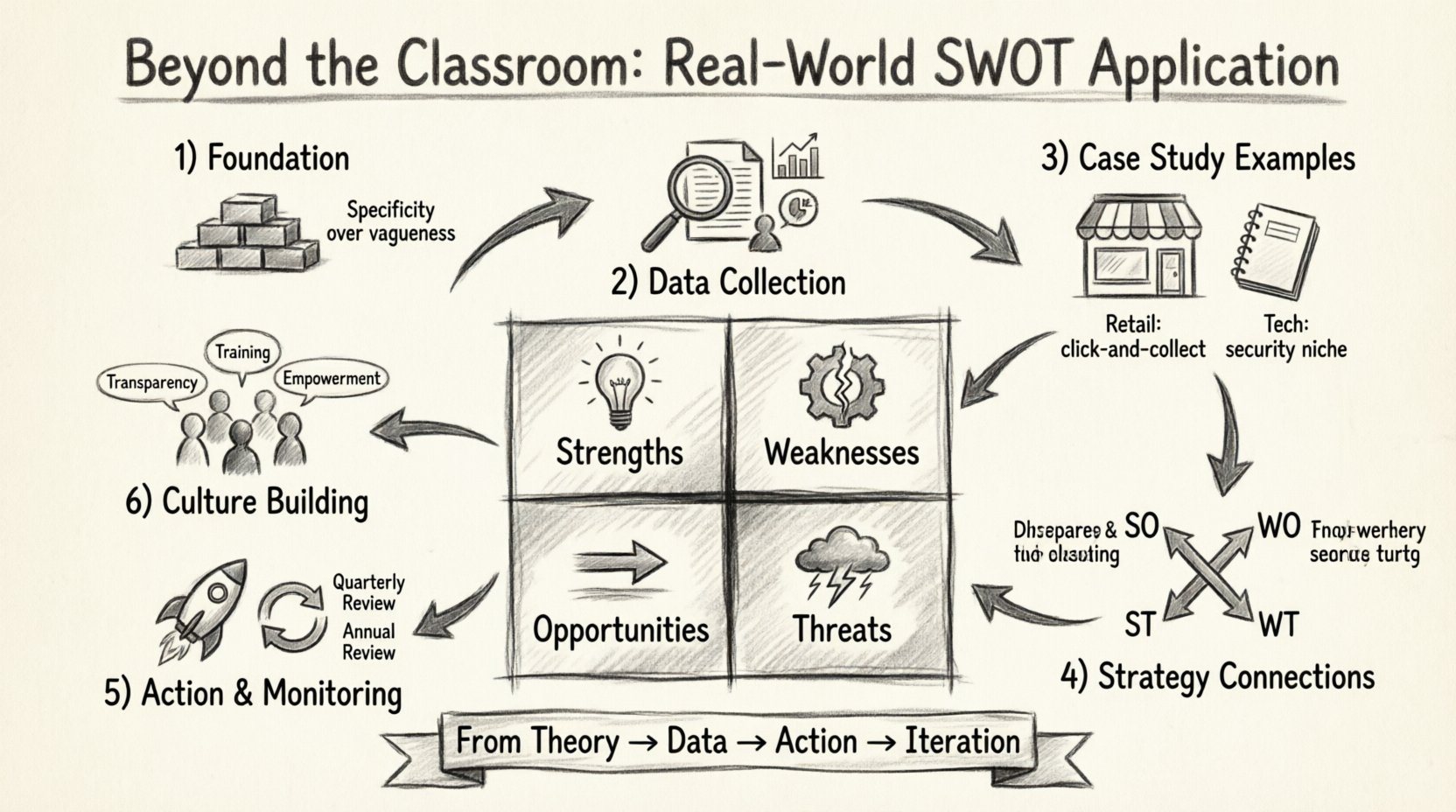
While most people know the acronym, the depth of each component is often overlooked. A superficial understanding leads to generic lists that offer no strategic value. To apply this correctly, you must look deeper into what each quadrant represents in a practical context.
- Strengths: These are internal capabilities that provide a competitive edge. They are not just “what we do well,” but what we do better than anyone else. This includes proprietary technology, brand loyalty, or unique supply chain relationships.
- Weaknesses: These are internal limitations that hinder performance. They are not merely errors to be fixed, but structural gaps. Examples might include outdated infrastructure, high employee turnover, or limited capital reserves.
- Opportunities: External factors that the organization can exploit. These arise from market gaps, regulatory changes, or shifts in consumer demand. Identifying them requires scanning the horizon, not just looking at current sales.
- Threats: External risks that could cause trouble. These include new competitors, changing laws, or economic downturns. They require proactive mitigation, not just reactive responses.
The key to a robust analysis is specificity. Vague statements like “strong marketing” do not help a strategist. Instead, specify “high conversion rates on social channels due to influencer partnerships.” Precision allows for better decision-making.
Why Academic Models Often Miss the Mark 📉
Classroom exercises often assume a static environment. You are given a scenario with fixed variables. In the real world, variables change by the minute. This disconnect creates a false sense of security. Leaders might feel prepared because they completed the exercise, only to find the market has shifted.
There are several reasons why traditional approaches fail in modern contexts:
- Lack of Data: Academic examples rely on provided data. Real-world analysis requires gathering data from multiple sources, including internal records and external market research.
- Groupthink: In workshops, dominant personalities can steer the conversation. This biases the results, causing genuine weaknesses to be ignored.
- Static Nature: A document created once a year is obsolete by month three. Strategy must be agile.
- Disconnect from Operations: Strategic teams often work in silos. If the analysis is not linked to operational teams, the insights remain theoretical.
To overcome these hurdles, you must prioritize engagement and data. The analysis should involve cross-functional teams. Marketing, finance, operations, and sales must all contribute. This ensures a holistic view of the organization.
Real-World Case Study: Retail Transformation 🏪
Consider a mid-sized retail chain facing the rise of e-commerce. A standard analysis might list “online competitors” as a threat. This is too broad. Let us look at a more detailed application.
The Scenario: A brick-and-mortar retailer with 50 stores in a specific region.
Strengths:
- Established local brand recognition.
- Physical inventory available for immediate pickup.
- Knowledgeable in-store staff.
Weaknesses:
- High overhead costs for maintaining physical locations.
- Inventory management systems are outdated.
- Limited digital presence.
Opportunities:
- Implementing a “click-and-collect” model.
- Partnering with local delivery services.
- Leveraging customer data for personalized promotions.
Threats:
- Large e-commerce giants expanding into the region.
- Changing consumer preference for online shopping.
- Rising commercial rent prices.
The Strategic Shift:
Instead of simply acknowledging the threat, the retailer used the analysis to pivot. They focused on the Strength of physical inventory to support the Opportunity of click-and-collect. They addressed the Weakness of outdated systems by investing in inventory management software. They mitigated the Threat of rent prices by negotiating shorter lease terms or expanding into lower-cost areas.
This example shows how SWOT drives specific actions. It moves from “we need to improve online” to “we will implement click-and-collect to leverage existing stock.”
Real-World Case Study: Tech Disruption 🖥️
Now consider a software development firm facing a market shift toward artificial intelligence. The challenges here are different from retail.
Strengths:
- Highly skilled engineering team.
- Strong reputation for security.
- Existing client base in finance.
Weaknesses:
- Lack of expertise in machine learning algorithms.
- Slow product development cycles.
- Dependence on legacy code.
Opportunities:
- Acquiring a small AI startup.
- Training current staff on new tools.
- Entering the healthcare sector where data security is paramount.
Threats:
- Open-source alternatives reducing pricing power.
- Regulatory changes regarding data privacy.
- Talent shortage in the AI sector.
The Strategic Shift:
This firm realized that competing on speed was impossible. They leveraged their Strength (security) to target a niche (healthcare). They addressed the Weakness (lack of ML skills) by acquiring a startup rather than hiring slowly. They mitigated the Threat of pricing power by emphasizing compliance and security over cost.
Integrating Data Without Tools 📊
You do not need expensive software to perform a high-quality analysis. The value lies in the thinking, not the platform. However, relying on gut feeling is insufficient. You need to integrate data to validate your assumptions.
Here is how to structure data collection without specific platforms:
- Internal Records: Review financial reports, customer feedback logs, and performance metrics. Look for trends over time.
- Market Research: Read industry reports, news articles, and competitor press releases. Identify where the market is moving.
- Customer Interviews: Talk to your clients. Ask what they value and what frustrates them. This reveals Strengths and Weaknesses you might not see internally.
- Competitor Analysis: Observe what competitors are doing. Are they raising prices? Launching new features? This highlights Threats and Opportunities.
Organizing this data is crucial. Use a central repository. Ensure everyone has access to the same version of the truth. This prevents the “he said, she said” dynamic that plagues meetings.
To help visualize how data informs the quadrants, refer to the table below:
| Quadrant | Data Source Example | Validation Method |
|---|---|---|
| Strength | Customer retention rates | Compare against industry benchmarks |
| Weakness | Project delay logs | Analyze frequency of delays by department |
| Opportunity | Industry growth reports | Check market size and growth rate |
| Threat | Regulatory updates | Review legal compliance requirements |
Identifying Genuine Threats vs. Noise 🚨
One of the most common errors in strategic planning is reacting to every headline. Not every market shift is a threat. Distinguishing between a genuine risk and background noise is a critical skill.
Ask these questions to filter threats:
- Relevance: Does this directly impact our core business model?
- Probability: How likely is it to happen in the next 12 to 24 months?
- Impact: If it happens, will it destroy the business or just cause minor inconvenience?
- Control: Can we influence the outcome, or must we adapt?
For example, a rumor about a competitor launching a product is noise until it is confirmed. A change in tax law is a threat that requires immediate attention. Focusing resources on noise drains energy from addressing real risks.
Similarly, distinguish between Opportunities and Distractions. Just because a new technology exists does not mean you should adopt it. If it does not align with your strengths, it is a distraction.
Turning Insights into Actionable Strategy 🚀
Once the analysis is complete, the work is just beginning. The goal is to create a strategy that addresses the findings. This involves connecting the quadrants. You do not analyze them in isolation.
SO Strategies (Maxi-Maxi): Use Strengths to seize Opportunities. For example, use your strong brand (Strength) to launch a new product line (Opportunity).
WO Strategies (Mini-Maxi): Overcome Weaknesses by taking Advantage of Opportunities. For example, use a new funding source (Opportunity) to upgrade your outdated technology (Weakness).
ST Strategies (Maxi-Mini): Use Strengths to minimize Threats. For example, use your cash reserves (Strength) to survive a price war (Threat).
WT Strategies (Mini-Mini): Minimize Weaknesses to avoid Threats. For example, streamline operations (reduce Weakness) to lower costs during a recession (Threat).
These connections form the core of your strategic plan. They tell you exactly what to do. They move beyond “what is” to “what must be done.”
Monitoring and Iteration 🔄
A strategic plan is not a one-time event. The business environment is constantly changing. What was a Strength yesterday might be a Weakness tomorrow. Therefore, the SWOT analysis must be reviewed regularly.
- Quarterly Reviews: Check the validity of your Opportunities and Threats. Have market conditions shifted?
- Annual Deep Dive: Re-evaluate the entire document. Are the internal Strengths and Weaknesses still accurate?
- Trigger Events: Update the analysis immediately if a major event occurs, such as a merger, acquisition, or regulatory change.
Tracking the effectiveness of your strategy is also vital. If a plan fails, revisit the analysis. Was the assumption wrong? Was the data incomplete? This feedback loop ensures continuous improvement.
Building a Culture of Strategic Thinking 🧠
Finally, the success of this tool depends on culture. If only the executives understand the SWOT analysis, the strategy will fail. Employees at all levels need to understand how their work contributes to the analysis.
Key Steps to Build Culture:
- Transparency: Share the findings with the team. Explain why certain decisions are made.
- Training: Teach employees how to identify Strengths and Weaknesses in their daily work.
- Empowerment: Allow teams to suggest improvements based on their observations.
- Consistency: Make strategic thinking a part of regular meetings, not just annual planning.
When everyone understands the context, execution improves. Employees make decisions that align with the broader goals. This creates a cohesive organization capable of adapting to change.
Final Thoughts on Modern Strategic Application 🌟
Applying SWOT analysis to modern business challenges requires more than just filling out a template. It demands deep engagement with data, cross-functional collaboration, and a willingness to confront uncomfortable truths. By moving beyond the classroom and into the real world, you can transform this classic tool into a powerful engine for growth.
The path forward is not about perfection. It is about clarity. It is about knowing where you stand, where you can go, and what stands in your way. With a rigorous approach, you can navigate complex markets with confidence. The insights gained from this process will guide your organization through uncertainty. Focus on the details, validate your assumptions, and act decisively. This is how strategy becomes reality.
Start by reviewing your current position. Gather your team. Look at the data. Then, build your plan. The market waits for no one, but preparation gives you the edge you need.