
Product Market Fit (PMF) is often misunderstood as a singular event rather than a continuous state of alignment. Achieving it requires a deep understanding of the relationship between what you offer and who you serve. Within the framework of the Business Model Canvas, the intersection of Value Propositions and Customer Segments forms the core engine of sustainable growth. Without this connection, resources dissipate into features that do not solve real problems. This guide explores the mechanics of aligning these critical components to build a foundation that withstands market shifts.
🔍 Understanding the Core Components
Before diving into alignment strategies, it is necessary to define the two pillars involved. Clarity here prevents ambiguity during the design phase.
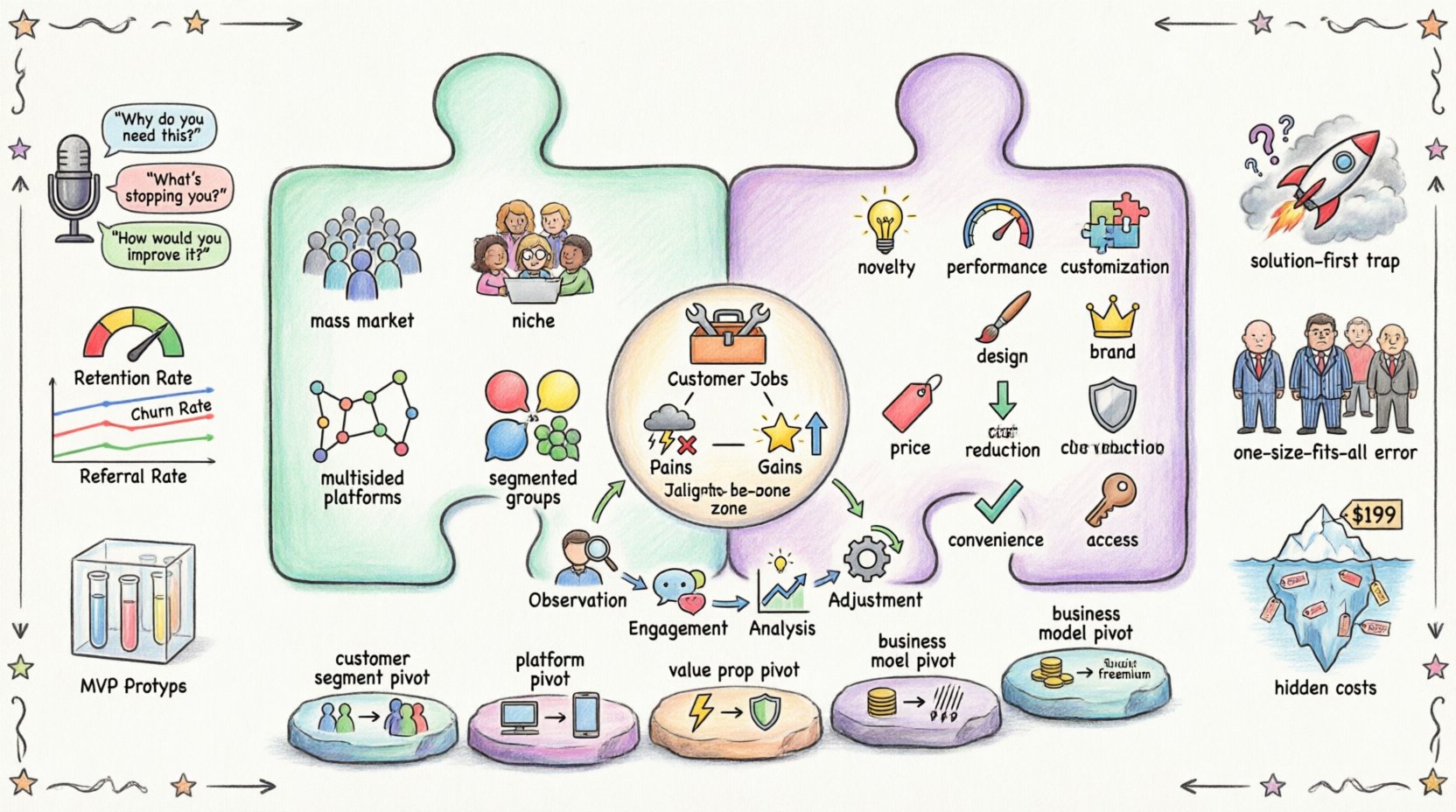
📦 Customer Segments Defined
Customer Segments represent the different groups of people or organizations a business aims to reach and serve. Not all segments are created equal. A company cannot effectively serve everyone with the same approach. Identifying the specific group allows for tailored messaging and resource allocation.
- Mass Market: Offering a product or service to a broad audience without segmentation.
- Niche Market: Focusing on a specific, specialized group with unique needs.
- Multisided Platforms: Serving two or more interdependent customer groups.
- Segmented: Distinguishing between different groups within a broader market based on specific needs.
When defining segments, look beyond demographics. Psychographics, behavioral patterns, and specific “Jobs to be Done” provide a richer picture. A customer segment is not just a list of ages or locations; it is a collection of shared needs and constraints.
💎 Value Propositions Defined
The Value Proposition describes the bundle of products and services that create value for a specific Customer Segment. It is the reason why a customer chooses one company over another. It answers the question: “Why should I care?”
A strong value proposition addresses specific customer issues through:
- Novelty: Offering something new that the market has not seen before.
- Performance: Improving the speed, efficiency, or quality of a task.
- Customization: Tailoring the offering to specific user preferences.
- Design: Enhancing the aesthetic or functional appeal of the product.
- Brand/Status: Providing a signal of prestige or identity.
- Price: Offering a cost advantage relative to competitors.
- Cost Reduction: Reducing the customer’s overall expenses.
- Risk Reduction: Lowering the perceived risk associated with a purchase.
- Convenience/Usability: Making the process easier or faster.
- Access: Providing availability where it was previously restricted.
🤝 The Mechanics of Alignment
Alignment is not about forcing a square peg into a round hole. It is about ensuring the shape of the peg matches the hole naturally. In the context of PMF, this means the Value Proposition must directly address the most critical pains or gains of the Customer Segment.
🛠 Identifying Customer Jobs, Pains, and Gains
To align effectively, you must map the Value Proposition to the Customer’s reality. This involves analyzing three specific areas:
- Customer Jobs: What is the customer trying to accomplish? This includes functional jobs (fixing a leak), social jobs (fitting in), and emotional jobs (feeling safe).
- Customer Pains: What obstacles prevent the customer from completing their job? This could be high costs, complexity, or fear of failure.
- Customer Gains: What outcomes does the customer expect or desire? This includes desired benefits, functional utility, and social acceptance.
When the Value Proposition removes a Pain or creates a Gain, alignment occurs. If it addresses neither, the fit is weak.
🔄 The Feedback Loop
Alignment is rarely static. Market conditions change, and customer needs evolve. The process requires a continuous feedback loop.
- Observation: Watch how customers interact with the offering.
- Engagement: Ask direct questions about their experience.
- Analysis: Look for patterns in behavior and feedback.
- Adjustment: Modify the Value Proposition or refine the Segment definition.
📊 Mapping Value to Segments
Visualizing the relationship helps identify gaps. The following table illustrates common Value Proposition types and the Customer Segments they typically serve.
| Value Proposition Type | Primary Focus | Typical Customer Segment | Key Metric for Fit |
|---|---|---|---|
| Economic Efficiency | Cost savings, ROI | Price-sensitive businesses or individuals | Cost per acquisition vs. Lifetime Value |
| Performance Optimization | Speed, reliability, quality | High-stakes industries (healthcare, logistics) | Uptime percentage or error rate reduction |
| Customization | Personalization, flexibility | Niche markets with unique workflows | Usage frequency of custom features |
| Risk Mitigation | Safety, compliance, security | Regulated sectors or security-conscious users | Adoption of security protocols |
| Convenience | Simplicity, ease of use | Mass market or non-technical users | Time to first value achieved |
Notice how the metrics change based on the type of value. A mass market user cares about ease of use, while a regulated sector cares about security. Trying to sell a “high-security” feature to a “mass market” user who just wants simplicity can lead to misalignment.
🔎 Validation Strategies
Hypothesis is necessary, but validation is the proof. You cannot assume alignment exists without evidence. There are several methods to verify the connection between your proposition and the segment.
🗣 Direct Customer Interviews
Conducting qualitative research allows you to hear the language customers use. This is distinct from asking “Would you buy this?” Instead, ask about past behaviors. “Tell me about the last time you faced this problem. How did you solve it? What did you hate about that solution?”
Listen for:
- Emotional language indicating frustration (Pain).
- Specific criteria used to evaluate solutions.
- Workarounds they have created to bypass existing solutions.
📉 Quantitative Metrics
Numbers tell a story that interviews cannot. Focus on retention and engagement rather than vanity metrics like total sign-ups.
- Retention Rate: Do customers come back? High retention suggests the value proposition solves a recurring problem.
- Churn Rate: Why are people leaving? High churn often indicates the product is not solving the core job.
- Referral Rate: Are customers telling others? This indicates high satisfaction and strong value.
- Conversion Rate: Does the messaging convert interest into action?
🧪 Minimum Viable Product (MVP) Testing
Build the smallest version of the solution that allows you to test the hypothesis. This reduces risk and investment before full-scale deployment. Use the MVP to observe real behavior. If users ignore a feature, do not assume they do not understand it. Assume the value is not perceived.
⚠️ Common Misalignments
Even experienced teams struggle with alignment. Understanding common pitfalls helps avoid them.
🚫 The Solution-First Trap
Many teams start with a technology or a feature and then search for a problem to solve. This reverses the alignment process. Instead, start with the problem and the segment, then design the solution. If you start with the solution, you risk building something nobody wants.
🚫 The “One Size Fits All” Error
Assuming a single value proposition works for all segments is a common mistake. A tool for a developer is different from a tool for a manager. One values customization and API access; the other values reporting and ease of use. Splitting the value proposition to match these distinct segments is often necessary.
🚫 Ignoring the Hidden Costs
Customers weigh not just the price of the product, but the cost of implementation, training, and maintenance. If the Value Proposition promises efficiency but the implementation requires weeks of training, the alignment fails. The “Cost” must be factored into the overall value equation.
📈 Iterating Toward Fit
Alignment is a journey, not a destination. As you gather data, you may need to pivot. A pivot is a structured course correction designed to test a new fundamental hypothesis about the product, strategy, or engine of growth.
🔄 Types of Pivots
- Customer Segment Pivot: The value proposition works, but the current segment is not responding. Try a different group with similar needs.
- Platform Pivot: Moving from a desktop experience to a mobile experience, or vice versa, changes how value is delivered.
- Value Proposition Pivot: The segment is correct, but the value they need has changed. Shift from “speed” to “security”.
- Business Model Pivot: Changing how you capture value, such as moving from a subscription to a freemium model.
🛡 Long-Term Sustainability
Once alignment is achieved, the goal shifts to sustaining it. Markets are dynamic. Competitors emerge. Customer expectations rise. To maintain Product Market Fit, the organization must remain agile.
- Continuous Discovery: Keep talking to customers even after launch. Do not go silent.
- Monitor Trends: Watch for external shifts that might render current value propositions obsolete.
- Scale Carefully: Expanding too quickly can dilute the focus that created the initial fit.
🏁 Final Considerations
Aligning Value Propositions with Customer Segments is the fundamental work of building a viable business. It requires discipline to resist the urge to add features that do not serve the core segment. It demands humility to accept feedback that contradicts initial assumptions. When done correctly, the result is not just a product that sells, but a solution that matters.
Focus on the human element. Behind every segment definition is a person with a problem. Behind every value proposition is a promise to help. When these two align, the business gains traction. This alignment is the quiet confidence that drives growth without the need for aggressive sales tactics or unsustainable hype.
Remember that the process is iterative. Start with a hypothesis. Test it rigorously. Measure the results. Adjust the offering. Repeat. This cycle ensures that the business remains relevant and responsive to the needs of the people it serves.