
Organizations frequently conduct SWOT analysis as a ritual. Teams gather, fill out a grid, and file the document away. The result is a static list of strengths, weaknesses, opportunities, and threats that gathers dust. For a strategic framework to be useful, it must move beyond description and enter the realm of action. This guide provides a rigorous methodology to transform a standard assessment into a dynamic engine for decision-making.
When a SWOT analysis fails, it is rarely because the data is wrong. It fails because the link between the data and the subsequent strategy is broken. To fix this, we need to apply specific filters to the information. The following five points serve as a checklist to validate the quality and utility of your strategic planning.
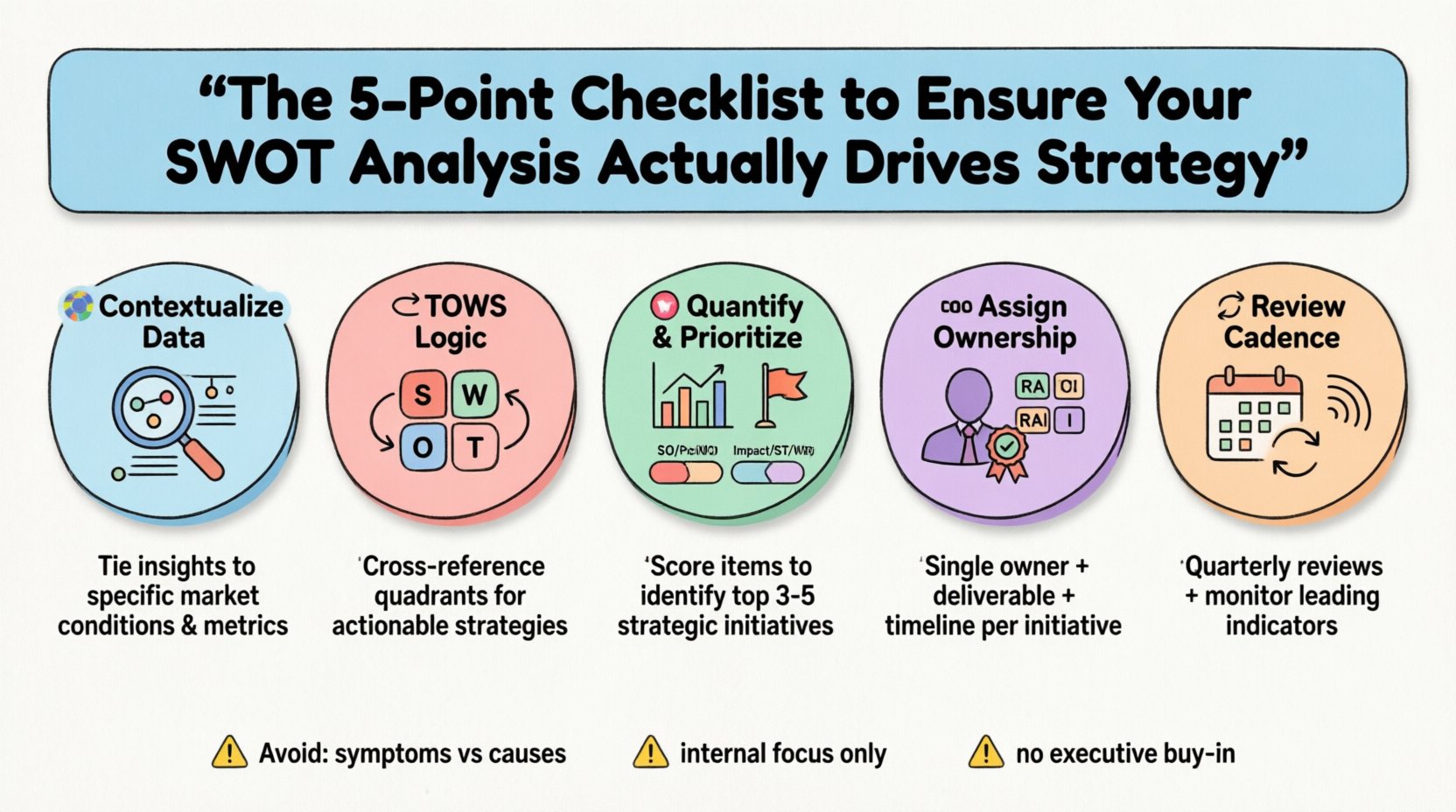
1. Contextualize the Data Beyond the General 🌍
One of the most common errors in strategic planning is creating generic statements. Phrases like “strong brand” or “weak marketing” lack the specificity required for execution. Without context, a team cannot determine the scale of a problem or the magnitude of a resource.
Every point within your analysis must be tied to a specific market condition, competitor action, or internal capability. Consider the difference between a vague observation and a contextualized fact.
- Vague: “Our customer service is good.”
- Contextualized: “Our customer service response time is 15 minutes faster than the industry average, leading to a 10% higher retention rate in the Q3 segment.”
Context forces the team to validate the statement with evidence. It prevents the group from relying on assumptions. When you define the boundaries of your analysis, you ensure that the resulting strategy applies to the current reality, not a hypothetical one.
Why Context Matters
Context acts as a boundary condition for strategy. If you do not define the market, you cannot define the competition. If you do not define the internal capacity, you cannot define the growth limits. This step requires deep research into:
- Market Trends: What are the regulatory changes affecting your sector?
- Competitor Moves: What specific product launches occurred last quarter?
- Internal Metrics: What are the actual numbers for employee turnover or production yield?
By grounding your points in data, you reduce the risk of bias. Subjective opinions often creep into brainstorming sessions. Data anchors the discussion in objective reality.
2. Interconnect the Quadrants Using TOWS Logic 🔄
A standard SWOT matrix treats the four quadrants as isolated islands. Strengths sit in the top left, and threats sit in the bottom right. They do not interact. This isolation is a critical flaw. Strategy is born from the interaction between internal capabilities and external conditions.
To drive strategy, you must cross-reference these quadrants. This approach is often referred to as a TOWS matrix. It asks specific questions that link the elements together.
| Interaction Type | Question to Ask | Strategic Outcome |
|---|---|---|
| SO Strategy | How can we use our Strengths to maximize Opportunities? | Growth and Expansion |
| WO Strategy | How can we use Opportunities to overcome Weaknesses? | Improvement and Correction |
| ST Strategy | How can we use our Strengths to minimize Threats? | Defense and Protection |
| WT Strategy | How can we minimize Weaknesses to avoid Threats? | Survival and Risk Mitigation |
For example, a strength in your internal research department (Strength) might allow you to capitalize on a new emerging technology market (Opportunity). This is not just a list item; it is a strategic vector. Without this connection, you have a list of attributes, not a plan of action.
The Cost of Isolation
When quadrants remain isolated, teams often focus too heavily on one area. They might obsess over fixing weaknesses while ignoring opportunities that could leverage their existing strengths. Conversely, they might chase opportunities without the capacity to execute. The TOWS approach ensures balance. It forces the leadership team to consider how every internal factor plays a role in every external factor.
3. Quantify the Impact and Prioritize 📊
A list of twenty items is as useful as a list of twenty items where all twenty are “high priority.” In reality, resources are finite. Time, capital, and human effort must be allocated. A SWOT analysis that does not prioritize is simply a wish list.
You need a method to score the impact of each point. This does not require complex software. It requires a structured conversation about impact and probability.
- Impact: How much will this affect the business if addressed? (Scale 1-10)
- Probability: How likely is this factor to materialize or change? (Scale 1-10)
- Urgency: Does this require immediate attention?
Use these scores to rank your items. The goal is to identify the top three to five strategic initiatives. Everything else becomes a monitoring item or is discarded.
Scoring Matrix Example
Consider the following approach to scoring threats and opportunities:
| Factor | Impact (1-5) | Probability (1-5) | Priority Score |
|---|---|---|---|
| New Competitor Entry | 4 | 3 | 12 |
| Regulatory Change | 5 | 2 | 10 |
| Supply Chain Disruption | 5 | 4 | 20 |
In this example, Supply Chain Disruption is the highest priority. It has the highest combined score. This allows leadership to direct resources specifically toward supply chain resilience rather than spreading effort thinly across all identified risks.
Quantification removes emotion from the decision-making process. It replaces “I feel like this is important” with “The data suggests this is important.” This objectivity is crucial for maintaining team alignment during execution.
4. Assign Ownership and Accountability 🤝
Strategies fail when no one is responsible for the outcome. A SWOT analysis often results in a departmental report where “Management” is responsible for everything. This is a recipe for inaction. Every strategic initiative derived from your analysis must have a single point of ownership.
This is not about blaming individuals. It is about clarity. When a task is assigned to a team, no one is responsible. When it is assigned to a specific leader, accountability is established.
- Identify the Owner: Who has the authority to make decisions regarding this initiative?
- Define the Deliverable: What is the tangible output required?
- Set the Timeline: When must the deliverable be completed?
Without ownership, strategic plans become suggestions. With ownership, they become commitments. This step bridges the gap between planning and doing. It transforms a passive review into an active management process.
The RACI Model Application
To further clarify roles, you can apply a simplified RACI framework to your strategic points:
- R (Responsible): The person doing the work.
- A (Accountable): The person who approves the work (only one).
- C (Consulted): Those who provide input.
- I (Informed): Those who need to know the outcome.
Ensuring that the “Accountable” role is distinct from the “Responsible” role prevents confusion. The Accountable person ensures the strategy aligns with the broader business goals, while the Responsible person executes the tactical steps.
5. Set Review Cadence and Iteration 🔄
A strategy is not a document written once a year. It is a living process. Markets change, competitors adapt, and internal capabilities evolve. A SWOT analysis conducted in January may be obsolete by June.
To ensure the analysis drives strategy, you must build a review cadence into the organizational rhythm. This prevents the document from becoming a historical artifact.
Recommended Review Cycles
- Quarterly Reviews: Assess the progress of strategic initiatives. Are the assumptions from the SWOT still valid?
- Annual Refresh: Conduct a full re-evaluation of the SWOT quadrants. Update the data points.
- Event-Triggered Reviews: If a major competitor launches a product or a regulation changes, pause and reassess immediately.
Regular reviews create a culture of adaptability. They signal to the organization that strategy is dynamic. This keeps the team agile and responsive to change rather than rigid and reactive.
Monitoring Leading Indicators
During reviews, do not just look at lagging indicators like revenue. Look for leading indicators that suggest the SWOT factors are shifting.
- If a “Threat” is a new technology, monitor adoption rates in the market.
- If a “Strength” is a talent pool, monitor hiring trends and retention rates.
By tracking these signals, you can update the strategy before a crisis occurs. This proactive stance is the hallmark of effective strategic management.
Common Pitfalls to Avoid ⚠️
Even with a checklist, teams can stumble. Here are common errors to watch for during the process.
Confusing Problems with Causes
Listing “low sales” as a weakness is a symptom, not a root cause. The weakness might be poor pricing strategy or a lack of distribution channels. Address the root cause to ensure the strategy is effective.
Ignoring the External Environment
Teams often focus inwardly on strengths and weaknesses. They neglect the external world. Opportunities and threats often come from outside the organization. A strong internal team cannot compensate for a shrinking market without an external pivot.
Lack of Executive Buy-In
If leadership does not engage with the analysis, the strategy will not be funded. Ensure that senior stakeholders are part of the workshop, not just the audience. Their involvement validates the priority of the work.
Integrating SWOT with Broader Goals 🎯
The final piece of the puzzle is alignment. The SWOT analysis must not exist in a vacuum. It must feed directly into the organization’s mission and vision.
When you review the strategic initiatives derived from the SWOT, ask: Does this move us toward our long-term vision? If the answer is no, discard it. Strategy is about choosing what not to do as much as what to do.
This alignment ensures that resources are not wasted on initiatives that do not contribute to the core objectives. It creates a cohesive narrative where every action supports the overarching direction of the company.
Final Thoughts on Strategic Execution 🚀
A SWOT analysis is a tool, not a destination. Its value lies entirely in how it is used. By applying these five points, you move from a passive assessment to an active management tool. You create a clear path from data to decision.
The market will not wait for your perfection. It requires agility, clarity, and focus. Use this checklist to sharpen your strategic edge. Ensure that every point on your grid has a purpose, a priority, and a plan. This is how organizations build sustainable growth and navigate complex environments with confidence.
Focus on the interplay between your internal reality and external possibilities. Assign clear responsibilities. Measure the impact. Review the progress. These steps turn a simple grid into a roadmap for success.